Uncensored — This model declares no content filter. SpicyAPI forwards the request without adding a platform content scan; legal and consent duties remain with the customer.

MiniMax H3 Singularity LoRA Review: Uncensored Fast Motion

Pick H3 Singularity LoRA for fast action and distant faces with your own H3 LoRAs; for calmer shots, base H3 LoRA renders faster and costs less.

Spicy Index

73.6/ 100

Preliminary

Freedom Score

100.0/ 100
  • Mild · The lightest prompts in the test

  • Moderate · Where filtered models start to refuse

  • Strong · Mid-scale; must be tested before a model is ranked

  • Very strong · Where most models start to hold back

  • Maximum · The top of the scale, scored in two halves: class A and class B

Price
$0.625 per 5-second clip
Median time
1.9 min
Success rate
Collecting data

MiniMax H3 Singularity LoRA runs Singularity, a community HDR fine-tune of the open-weights MiniMax H3, and loads up to three of your own H3 LoRAs on top of it. On 27 September 2026 we ran our full content ladder against both endpoints with no LoRA loaded at all: 36 runs across L1 Suggestive (lingerie, a slipping strap), L2 Mature themes, L3 Strong, L4 Intense (an intimate scene between two adults) and both L5 Extreme probe types, L5a (consensual restraint and impact play between adults) and L5b (cinematic gore), three per probe type on each endpoint, and every single one rendered. On 26 September, with an adult LoRA loaded, both image-to-video and reference-to-video rendered a request at the L4 Intense level as written.

The verdict

Pick it when the shot moves fast, or when a face has to hold up in a wide shot: sword work, dance, a whip pan, a crowd scene. Skip it when the shot is calm and you don't need a fine-tune, because the regular MiniMax H3 LoRA family renders in roughly half the time for about 25% less per second.

How it scores. See this page's score card for the current Spicy Index and Freedom Score; both are recalculated as we add runs, so we don't print a number that goes stale the next time we test.

Try MiniMax H3 Singularity LoRA →

Key facts

  • Freedom Score: on this page's score card, recalculated as runs are added; the 27 September round tested all 6 probe types, three runs each on both endpoints, with no LoRA loaded.
  • Pass rate: 36 of 36 runs on 27 September rendered across both endpoints with no LoRA loaded; both endpoints rendered an L4 Intense request on 26 September with an adult LoRA loaded.
  • Price: image-to-video is $0.0625 per second at 480p, $0.09375 at 540p, $0.125 at 768p and $0.25 at 1080p. Reference-to-video is $0.06, $0.09, $0.135 and $0.27, plus a small per-reference charge for extra images and audio clips.
  • Limits: image-to-video and reference-to-video only, no text-to-video in this family; 3 to 15 seconds per take; up to three LoRAs trained for MiniMax H3, strength 0 to 4 each.
  • Speed: slower than the regular MiniMax H3 LoRA family. A 5-second 480p clip took about 80 seconds in our testing against 25 to 50 seconds on base H3 LoRA; a 768p clip took 2 to 3.5 minutes.
  • Sources: the full parameter list is on the MiniMax H3 Singularity LoRA model page, and the scoring rules are on our review methodology page.

What we liked and what held it back

What we liked

  • Fast action stays sharp. The fine-tune's HDR training shows up exactly where a regular video model smears: a sword spin, a breakdance freeze, a whip-around camera. Both of our action examples kept the blade and the footwork readable mid-motion.
  • Your existing H3 LoRAs load unchanged. Singularity keeps MiniMax H3's architecture, and H3 LoRA files load with no conversion step: in a same-seed check on 27 September, the no-LoRA run repeated frame for frame and adding one LoRA changed the clip.
  • It held up at every content level we tried, with no LoRA loaded. L1 Suggestive through both L5 Extreme probe types, three runs each on both endpoints, 36 of 36 rendered on 27 September.
  • It rendered with an adult LoRA loaded, too. On 26 September, both image-to-video and reference-to-video rendered an L4 Intense request as written once an external adult LoRA was loaded.
  • Two starting points. Animate one opening frame, or combine up to nine images, three clips and three audio clips on reference-to-video and name each one in the prompt.
  • Sound in the same pass. Stereo audio is generated with the picture, not bolted on afterward.

What held it back

  • It's roughly twice as slow as the regular H3 LoRA family. A 5-second 480p clip took about 80 seconds against 25 to 50 seconds on base H3 LoRA in our testing; step up to 768p and budget 2 to 3.5 minutes.
  • It costs about 25% more per second than base H3 LoRA at the same resolution. $0.0625 against $0.05 at 480p on image-to-video, $0.125 against $0.10 at 768p.
  • No text-to-video. Both endpoints need a starting frame or reference material; for a written-scene-only request, use the regular MiniMax H3 LoRA family instead.
  • A strong concept LoRA can pull the clip away from your opening frame. When we loaded an adult LoRA at full strength with a prompt describing a different scene than the still, the first render ignored the frame and staged its own scene. Writing the prompt as a continuation of the frame, and starting concept LoRAs around 0.6 to 0.8, kept the frame held on a repeat run with the same LoRA.
  • Style LoRAs barely show from a photo. With a photographic opening frame or reference, the VHS-tape and 1939 cartoon LoRAs left the clip looking like the photo, even at strength 2.5. The regular H3 LoRA family does the same from a photo; only its text-to-video shows a style LoRA clearly.
  • It's a community fine-tune, not a MiniMax release. Treat it as a variant with its own quirks rather than an official upgrade path.
  • No aspect-ratio field on image-to-video. The clip takes the shape of your opening frame; crop before you send it if you need a specific ratio.

What the clips look like

The gallery holds published, safe-for-work examples from the H3 Singularity LoRA model page, shown as rendered. Our content-ladder test clips aren't shown; we report the results only.

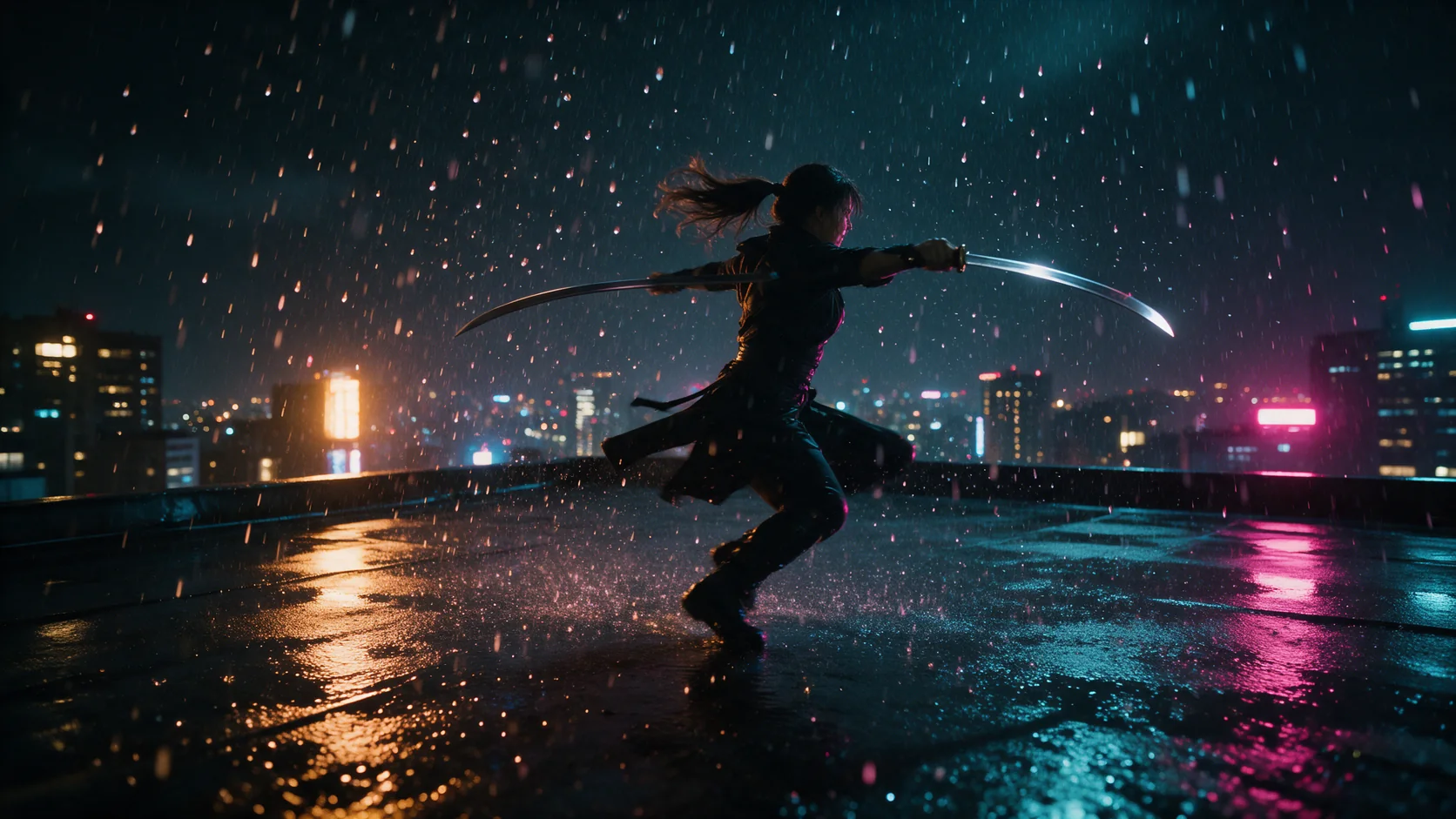
A spin and a cut, still sharp. From one still of a swordswoman on a wet rooftop, the fine-tune produced a full spin, a cut through the rain and a whip-around camera, with the blade and the water spray still readable mid-motion.

A style LoRA from a photo. The VHS-tape style LoRA we use on the regular MiniMax H3 LoRA family, at strength 0.8, on a fast breakdance spin in a neon underpass. The footwork stays sharp, but the photo sets the look, so the tape texture barely shows.

Two people from two stills, one fight. Reference-to-video took a swordswoman from one still and a young man from another, staged a fast exchange on the same rooftop, and both stayed recognisably themselves through the movement.

Prompts that worked

Write the action in two or three physical beats, name the camera move for each, and end with an Audio: line for impacts and breath. Continue the picture rather than describing a new scene, and on reference-to-video give each input a job (Picture 1 is the singer, Picture 2 is the stage) before you write the beats.

1. A spin and a cut (image-to-video, 768p, 5 s). The exact prompt behind the rooftop example.

text
From this exact frame: she spins, whips the sword up and cuts through the rain in one motion as the camera whips around her, water spraying off the blade. Crisp fast motion, no blur. Audio: rain, steel whistling through the air, a sharp exhale.

Run this prompt on MiniMax H3 Singularity LoRA →

2. A style LoRA on top (image-to-video, 768p, 5 s). The exact prompt behind the underpass example, with the vh5tape VHS-tape style LoRA loaded at strength 0.8. From a photographic frame the tape look stays faint; use it for the motion.

text
vh5tape, worn VHS tape. From this exact frame: he launches into a fast breakdance spin on one hand, legs sweeping in a circle, then freezes in a pose. Low camera circling him. Audio: a heavy hip-hop beat echoing in the tunnel, sneakers squeaking.

Run this prompt on MiniMax H3 Singularity LoRA →

3. Two references, one scene (reference-to-video, 540p, 6 s). The exact prompt behind the singer example: a portrait names the face, an empty stage names the location.

text
Picture 1 is the singer, Picture 2 is the stage. She walks out to the microphone under the three spotlights, spins once and sings the first line as the camera orbits her. Audio: a band kicking in, the crowd cheering, her voice.

Run this prompt on MiniMax H3 Singularity LoRA →

4. Two characters, one fight (reference-to-video, 540p, 6 s). One still per character, no LoRA.

text
Picture 1 is the swordswoman, Picture 2 is the young man in the hoodie. They spar on a rain-wet rooftop at night: she swings, he ducks and spins away, then they both stop and laugh. Fast tracking camera, crisp motion. Audio: rain, footsteps splashing, laughter.

Run this prompt on MiniMax H3 Singularity LoRA →

How far it goes

We test in two configurations, because they answer different questions. With no LoRA loaded, on 27 September 2026 we ran our full content ladder against both endpoints: L1 Suggestive, L2 Mature themes, L3 Strong, L4 Intense and both L5 Extreme probe types (restraint/impact and gore), three independent runs each per endpoint. All 36 runs rendered; none was softened or refused. With an external adult LoRA loaded, on 26 September we ran one request per endpoint at the L4 Intense level: image-to-video and reference-to-video both rendered as written, with the referenced people and setting carried through correctly on reference-to-video.

The one thing to watch is the opening-frame behaviour, not the content level. On our first image-to-video run with the adult LoRA at full strength, the prompt described a scene the opening frame didn't show, and the render replaced the frame with its own scene instead of continuing it. A repeat run with the prompt written as a continuation of the frame, and the LoRA at a lower strength, held the frame as expected. If you need the clip to stay on your picture, write the prompt as what happens next in that frame, and start concept LoRAs around 0.6 to 0.8 rather than at full strength.

The page label is Uncensored: we add no content filter on our side, and neither the weights nor the LoRA slots are reviewed. A refused request is not billed.

Not tested yet: a ladder run with a LoRA loaded at every rung (26 September covered only the L4 Intense level); anime or illustrated stills as the opening frame.

Adults only, in every still, reference, LoRA and output. Never depict a real, identifiable person without their consent.

LoRAs on this family

Singularity keeps MiniMax H3's architecture, so any LoRA trained for MiniMax H3 loads here unchanged, up to three per request with independent strengths from 0 to 4. To confirm the weights are really applied, we ran reference-to-video twice with the same seed and no LoRA, and got the same clip both times; adding one LoRA to the same request changed it. What a style LoRA doesn't do here is override a photo: the vh5tape VHS-tape LoRA at 0.8, and a 1939 cartoon LoRA at 1 and 2.5, left clips from a photographic frame or reference looking photographic. The regular MiniMax H3 LoRA family behaves the same way from a photo and shows those styles clearly only on text-to-video.

We also loaded an external adult LoRA trained for MiniMax H3 on both endpoints. At the L4 Intense level, image-to-video and reference-to-video both rendered as written. The one caveat: at full strength with a prompt describing a different scene than the opening frame, the concept LoRA pulled the render away from the frame on the first attempt, and holding the frame on a repeat run took a prompt written as a continuation plus a lower strength (0.6 to 0.8) rather than 1.0. That trade-off applies to any concept LoRA on this family, not only to adult ones.

There is no per-LoRA charge; you pay per second of output at the resolution you choose, whichever LoRAs you load.

What the community says

Singularity is a community fusion of several MiniMax H3 checkpoints, deep fine-tuned and pruned by the AIGC-Singularity team and published on Hugging Face. Early testers back up the fine-tune's stated goals: one wrote, "You guys weren't kidding when you say 'The result is a clean, sharp, and highly dynamic video generation model.'" and another reported that a result "totally followed the prompt, the image doesn't feel greasy at all", echoing the fine-tune's de-oiled-skin claim.

Not every report is clean: one user found that the fine-tune "will cause the original reference image or video to change color, with its saturation reduced, turning it overly grayish and white" in some runs. If a render comes back desaturated, a lower LoRA strength or a second take is worth trying before you assume the prompt is at fault.

Alternatives

  • Don't need a fine-tune or LoRAs? MiniMax H3 takes text, an opening frame or references, goes to 2k and costs about 70% less per second at 768p. Our H3 review.
  • Have H3 LoRAs but a calmer shot? MiniMax H3 LoRA loads the same LoRA files, renders in roughly half the time, and costs about 25% less per second at the same resolution. Our LoRA-versus-LoRA comparison.
  • No LoRA files of your own, just want uncensored loops fast? MiniMax H3 Spicy animates a still with no prompt required, from $0.038 per second at 480p. Our H3 Spicy review.
  • Want two-stage LoRAs on a different base model? Wan 2.2 LoRA separates high-noise and low-noise LoRA slots and starts at $0.024 per second, but tops out at 720p.

How far MiniMax H3 Singularity LoRA goes

Each level, on each task, based on confirmed results. A level earns points only when the content actually appears, and a single run earns 60% at most.

Freedom points by level and task
LevelImage to videoReference to video
MildThe lightest prompts in the test
3/3 delivered20.0 / 20 pts
ModerateWhere filtered models start to refuse
3/3 delivered20.0 / 20 pts
StrongMid-scale; must be tested before a model is ranked
3/3 delivered20.0 / 20 pts
Very strongWhere most models start to hold back
4/4 delivered20.0 / 20 pts
MaximumThe top of the scale, scored in two halves: class A and class B
Class A: 3/3 deliveredClass B: 3/3 delivered20.0 / 20 pts
Task score100.0 / 100.0Tested Sep 27, 2026100.0 / 100.0Tested Sep 27, 2026

Tested Sep 26, 2026 to Sep 27, 2026

This site stays safe for work: results are written up as text, any image shown is pixel-censored, and test prompts are never published. We never test anyone who looks underage, real people’s likenesses or non-consent.

See every test record →See the uncensored leaderboard →

Run your own prompt and see how far it goes
How MiniMax H3 Singularity LoRA earns its Spicy Index

Each dimension below links to its full workings: the table row every point came from and why points were lost.

Public leaderboards 45% of quality
Not yet tested

No exact match on a tracked public leaderboard yet. How it works

Blind output test 35% of quality
58.3
Arena quality 20% of quality
Not yet tested

Counts once the model has 100+ blind votes and a 95% interval under 200 Elo. How it works

Capability 10.5% weight
85.2
Freedom Score 30% weight
100.0

Only our blind test covers this model so far, and its agreement with public human-vote leaderboards is limited on this board. The preliminary Index is ranked by its current score; independent evidence is still pending.

Open the full test report →LoRA support75.0 / 100

Capability, item by item

Points from the public scoring table. Upscaled tiers and limits we set ourselves don’t count.

Native max resolution1080p
25.0 / 25
Longest single clip15 s
9.0 / 20
Native audioYes
15.0 / 15
Reference inputs9 reference images · 6 video or audio
15.0 / 15
Frame controlFirst and last frame
10.0 / 10
Task coverageImage to video, Reference to video, Video extension
7.5 / 10
Customization (LoRA)LoRA supported
3.8 / 5

What MiniMax H3 Singularity LoRA can do on SpicyAPI

Straight from the live model specification on SpicyAPI. Some creators offer more in their own apps; this is what you can call through our API today.

Capabilities by endpoint
FeatureImage to videoReference to videoVideo extension
Resolutions480p · 540p · 768p · 1080p480p · 540p · 768p · 1080p480p · 540p · 768p · 1080p
Clip length3–15 s3–15 s3–15 s
Aspect ratios—16:9 · 9:16 · 1:1 · 4:3 · 3:4 · 21:9 · 9:21—
Native audioYesYesYes
Reference inputs—15—
Seed controlYesYesYes
Negative promptNoNoNo
See every parameter and code sample →

How long it really takes

Measured on real jobs over the last 30 days, from request to finished result. Times include our own test runs.

Median time
1.9 min
90th percentile
8.3 min
Wait per second of video
12.8 s per output second
Success rate
Collecting data

A time appears once at least 10 completed jobs are in. Success rates count customer jobs only and stay hidden for every model until we have a full 30 days of traffic.

What people say about MiniMax H3 Singularity LoRA

2 positive · 0 mixed · 1 negative

  • You guys weren't kidding when you say "The result is a clean, sharp, and highly dynamic video generation model."

    hugging-face· Sep 10, 2026· PositiveSource

  • totally followed the prompt, the image doesn't feel greasy at all, thanks

    hugging-face· Sep 11, 2026· PositiveSource

  • This model will cause the original reference image or video to change color, with its saturation reduced, turning it overly grayish and white.

    hugging-face· Sep 15, 2026· NegativeSource

Quotes are verbatim from public posts, linked to the original. They are not ratings and don’t feed any score.

Models to consider instead of MiniMax H3 Singularity LoRA

What do you think?

Was this review useful?

Log in to vote.

Comments

Comments are checked automatically and by our team. We remove spam, offensive content, personal attacks and anything that names a real person without consent. Report a comment and we review it within one business day.

Tried this model? Share what worked. You need a free account to comment, so we can keep spam out.

MiniMax H3 Singularity LoRA FAQ

Try MiniMax H3 Singularity LoRA yourself

Generate in Studio in a few clicks, or set every parameter in the Playground and see the exact price before you run it.

$0.625 per 5-second clip

  • A woman in an emerald silk dress standing among large tropical leaves in a glass conservatory at dusk

    Wan 3.0

    Pick Wan 3.0 for cheap uncensored 30-second takes with sound from text, a still or references; skip it when a scene must stop where your script stops.

    Spicy Index
    87.7
    Freedom Score
    96.0

    Tested Sep 24, 2026

    Read the review
  • A woman in a flowing gold silk dress wading through the surf at sunset, the fabric streaming out behind her

    Seedance 2.5

    Pick Seedance 2.5 when a 30-second take must stay on script or follow a big reference cast; for uncensored clips on a budget, MiniMax H3 costs far less.

    Spicy Index
    81.4
    Freedom Score
    83.6

    Tested Sep 24, 2026

    Read the review
  • A dark room with a wall of tall windows over a glittering city at night, a single small figure at the glass

    Wan 3.0 Prime

    Pick Wan 3.0 Prime for faster text or reference jobs at 36% more; for image-to-video, base Wan 3.0 costs less and clears the same intimate-scene level.

    Spicy Index
    75.8
    Freedom Score
    80.7

    Tested Sep 24, 2026

    Read the review