You give your character something new to react to. They repeat the last few words you typed, add the same smile they used three messages ago, and ask another question that leaves the scene exactly where it started. You regenerate. The wording changes; the conversation still goes nowhere.
The quickest useful fix for repetitive NSFW AI roleplay is usually to repair the recent conversation before changing the model. Remove the repeated opening from the last few replies, replace one stalled exchange with a clear character action, and give the next reply a specific job. If the loop returns immediately in a fresh conversation, inspect the character's greeting, example dialogue and active preset. Adjust sampling only after checking which settings your actual connection supports.
That order matters. A repetition penalty may reduce repeated words while leaving the same scene untouched. A higher temperature may produce five different versions of the same teasing reply. And a long instruction saying “never repeat yourself” leaves the model guessing what an interesting response should do instead.
This guide focuses on fictional adult characters, mature romance and NSFW roleplay. Its short conversations are original editorial examples, not outputs from a model comparison. The aim is to help you rescue the story you already enjoy, rather than send you shopping for another character app whenever a reply disappoints you.
The community complaint is more specific than “the AI is bad”
A recent SillyTavern repetition discussion describes a very recognizable problem: the model repeatedly takes a word from the user's message and turns it into its own opening question. The user had already tried different presets and was using a repetition penalty. A commenter suggested changing the desired response behavior and editing the earlier echoes out of the conversation.
That is one person's report and another person's advice, not a controlled test. It is useful because it identifies the actual annoyance. The issue is not that a particular word must never appear twice. It is that the character seems to have one conversational move, regardless of what the user contributes.
The weekly models discussion contains a related complaint about recurring stock reactions and metaphors. Readers describe recognizable expressions returning until different characters start sounding like the same narrator. Again, those observations establish a customer problem; they do not establish a universal ranking of the models mentioned there.
For an adult fiction reader, these habits can be especially noticeable. A close conversation leaves less room for irrelevant description. When two characters are negotiating trust, attraction or a difficult admission, repeating the same expression can make the character feel inattentive. What should have been a personal exchange becomes a template with your name inserted.
Treat the problem at that level. You want a reply that acknowledges the specific moment, gives the character an intelligible motive and leaves you something meaningful to answer. “Use more varied words” addresses only a small part of that task.
First, identify which repetition you actually have
Read the last three assistant replies together. Ignore whether they contain impressive adjectives. Ask what changed between them. Usually one of these four patterns will stand out.
| What you see | What to change first | What to avoid doing immediately |
|---|---|---|
| Every opening quotes part of your last message | Edit the echoed openings; request an action or direct answer | Raising every penalty because one opening formula is annoying |
| The same sentence or paragraph repeats inside a single reply | Shorten the reply request; inspect connection settings and formatting | Accepting the broken reply into the continuing story |
| Words vary, but the character never makes a decision | Add a concrete choice or consequence; clarify who may act | Chasing synonyms or banning individual words |
| Every character uses the same gestures and polished narrator voice | Clean the shared preset; improve contrasting dialogue examples | Making all character cards longer in the same style |
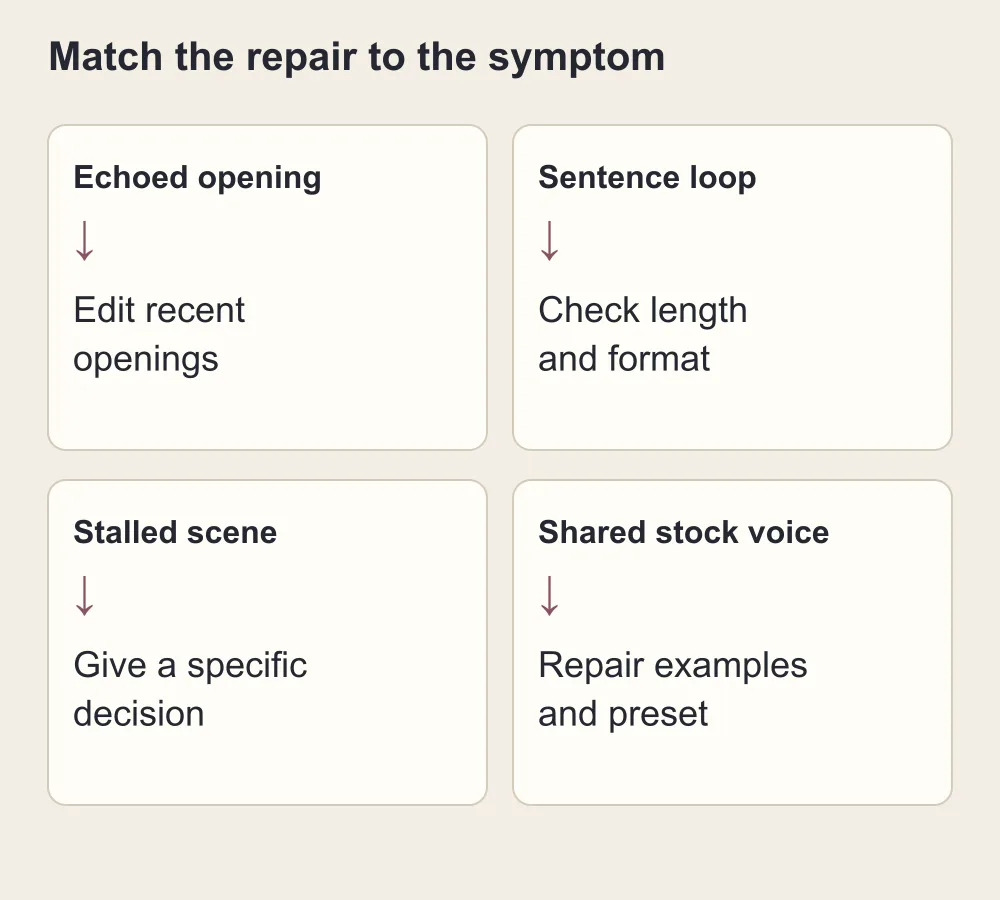
Match the repair to the symptom. A stalled decision needs a different change from a sentence loop.
Several patterns can occur together. Start with the one doing the most damage. If the character cannot finish a sentence without looping, fix that before worrying about elegant prose. If every sentence is readable but the scene has not advanced in ten turns, vocabulary is probably not your main problem.
Also distinguish repetition from continuity. A character can mention the same unresolved argument twice because it still matters. A recurring nickname can belong to their voice. A cautious character may hesitate more than once. The useful question is whether the repetition serves the scene or substitutes for a response.
Suppose a character promised to call after an important meeting. Mentioning that promise when they arrive late makes sense. Mentioning it in every paragraph of an unrelated dinner scene is different. You should preserve the first use and remove the habit, rather than banning the word “promise” everywhere.
This distinction helps keep your fix from damaging the thing you liked. You are trying to make the character attentive and responsive. You are not trying to erase every recurring detail that makes the relationship recognizable.
Fix echoed openings by changing the conversational move
Consider this editorial example with two fictional adults, Mara and Jules:
Jules: “You left your invitation on the counter. I thought you weren't coming.”
Mara: “Wasn't coming?” She gives a small smile. “You really thought I wouldn't come?”
Once, that echo could be intentional teasing. After six messages with the same opening, it becomes a mannerism the model applies automatically. The character responds to the wording more strongly than to the actual problem: an invitation was left behind, and Jules interpreted that as a decision.
A better next reply might be:
Mara places the invitation beside her coat. “I went back for it. I should have told you before I left.” She pauses at the doorway, waiting to see whether Jules still wants her to stay.
The edited reply changes the situation. It explains the invitation, gives Mara responsibility for the misunderstanding and creates a meaningful decision for Jules. It also preserves emotional tension without adding more decorative description.
Here is a short instruction you can try in the appropriate instruction field of your app:
Respond to the meaning of the latest message through a direct answer, a character action or a specific consequence. Begin with the response itself. Quote the other character only when that quotation has a clear purpose in the scene.
This is a proposed instruction, not a guaranteed fix. Its advantage is that it describes an alternative behavior. It allows a deliberate echo when the character is actually mocking, checking or challenging something. You are removing the automatic opening formula, not outlawing normal dialogue.
Do not paste the instruction into five different places. Start with one location you know is being sent to the model. If your app has a system prompt or temporary author instruction, use that rather than making your character recite the note as dialogue. If you have only the visible chat, a brief out-of-character direction can work as an experiment, but remove it from the story afterward if your app permits editing.
Then repair the recent examples. If the preceding assistant replies still begin with the same echo, a new instruction has to compete with those examples. Replace the unnecessary repeated openings while retaining the facts and decisions that followed them. Generate the next reply from the corrected conversation.
Clean the history without throwing away your whole story
You do not need to delete a long relationship arc because the last few exchanges became repetitive. Work on a duplicate or branch if the app supports one. Otherwise export or copy the conversation before editing. That gives you room to make a useful change without losing a scene you wanted to keep.
Find the earliest recent message where the unwanted habit became obvious. If the model echoed your words once in a convincing argument, leave it alone. If the next four replies copied the same construction with no purpose, those are the passages to repair.
Remove the smallest amount of text that breaks the pattern. An echoed opening may be only one sentence. A recycled room description may occupy the first paragraph. Keep the character's actual answer, any action that happened, and any fact the next turn needs. Editing out every imperfect message creates unnecessary continuity work.
Imagine the last reply contains three parts: a repeated description of the apartment, an apology and a proposal to leave for dinner. The repeated apartment description is expendable. The apology and proposal are not. Deleting the entire reply could leave your next message responding to an apology that the model no longer sees.
If the repetition fills the whole reply, replace it with a short, believable continuation in the character's voice. You are acting as an editor of your own fiction. You do not have to preserve a broken machine-generated paragraph merely because it arrived automatically.
One correction is often more useful than a page of instructions. Write the response you wanted at the first obvious failure point, then continue from it. A direct apology, an unanswered invitation or a character choosing to leave gives the next generation more usable material than “stop being repetitive” repeated several times.
Be careful with regeneration controls. Some apps keep alternate responses out of the active conversation; others have different behavior. What matters is the text actually sent in the next request. Do not assume every discarded swipe is visible to the model, and do not assume editing the display always changes the request. Check the app's prompt inspection or conversation export when available.
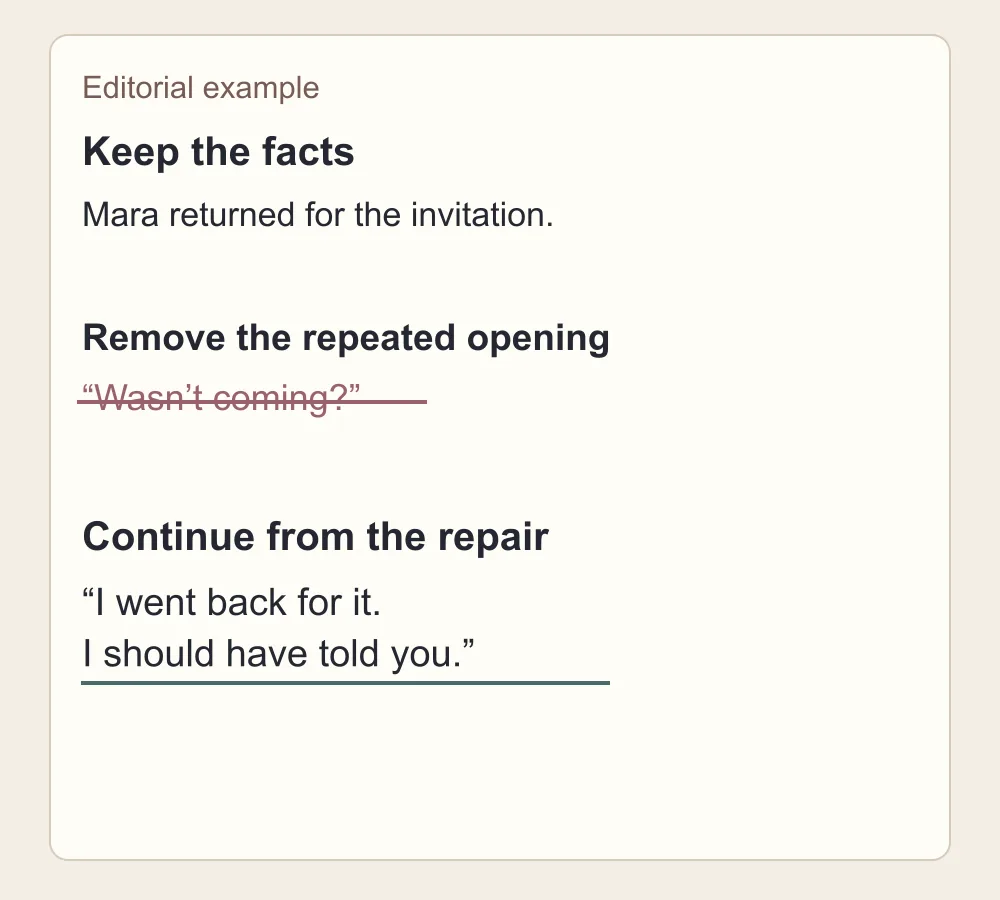
Remove the repeated wording while preserving what happened. This is an editorial example, not a model output.
Give a stalled scene something to resolve
Repetition can continue after you remove every repeated phrase. That usually feels like this: the character leans closer, waits for an answer, describes the mood and asks if you are sure. You reply, and the next turn repeats the same suspense with new words.
The scene may have no available next action. You asked for slow pacing, told the model never to act for your character and also demanded that it wait for your permission before any development. Each instruction can be reasonable alone. Together, they can leave the assistant with nothing to do except describe anticipation.
Give the assistant control over its own character and the environment while preserving your character's decisions. In the Mara and Jules scene, Mara can explain why she left, put down the invitation, offer to wait outside or suggest a quieter place to talk. She does not need to decide how Jules feels or invent Jules's answer.
A useful temporary instruction is:
Mara may make decisions for herself, speak directly and change what she is doing. Leave Jules's feelings, dialogue and choices to the user. Advance this exchange by resolving the misunderstanding about the invitation, then leave a natural opening for Jules to respond.
The last sentence gives the reply a bounded task. It does not demand a random emergency, another visitor or a dramatic revelation. In a quiet adult romance scene, moving the story forward may mean making a small admission rather than moving to another location.
You can also create movement in your own turn. Compare “I look at her and wait” with “I slide the invitation back across the counter. ‘If you want to stay, tell me why you left without a word.’” The second message supplies a specific unresolved question. The assistant has something more concrete to answer than an indefinite gaze.
Do not confuse progress with escalation. A character honoring a boundary, taking a break or deciding not to attend a party can move an NSFW story forward. If every corrective prompt pushes toward greater intensity, the conversation can acquire a different repetitive pattern. Make the next development fit what the characters actually want.
Keep slow burn from becoming permanent waiting
Slow burn works because the relationship changes gradually. It stops working when nothing changes at all. An assistant can describe another hesitation forever if its instructions define success as delaying every decision.
Replace a vague instruction such as “always maintain tension and never move too quickly” with the pace you mean for the current exchange. For example: “Keep this conversation quiet. Mara should answer the invitation question honestly. Do not resolve their whole relationship in this reply.” That leaves room for one small advance without forcing the entire arc to conclude.
Think of each reply as containing a contribution and an opening. The contribution might be a new fact, a decision, an admission or a physical action appropriate to the scene. The opening is the part your character can respond to. A reply containing only openings gives you a succession of questions with no material underneath them.
In a mature romance scene, the contribution could be: “I wanted you to ask me directly.” That line changes your understanding of the earlier behavior. The opening might be the character leaving the invitation between you. Neither requires a long monologue or a new plot complication.
If you like very slow pacing, make the scale of progress smaller. Ask the character to clarify one intention or respond to one objection. Do not ask it to repeat the existing atmosphere until you decide to move on. Atmosphere should accompany the conversation, not replace it.
That is an editorial pacing choice. It is not a claim that a specific model can understand every subtle relationship development. The value is that you give it a clearer opportunity to produce a different kind of reply.
Rewrite character examples that teach the same response every time
A card can describe a character as witty, guarded, affectionate, independent and unpredictable, then demonstrate all five traits with the same small smile and a rhetorical question. The descriptions promise variety; the examples show one pattern.
Inspect the greeting and example dialogue before adding more personality adjectives. SillyTavern's character design documentation explains that the greeting helps establish response style and that example messages contribute to the prompt subject to context settings. That makes these fields worth checking when a new chat immediately develops the same voice.
Write examples showing different responses to different pressures. For Mara, you might use one direct answer, one awkward admission and one refusal to dodge a question. Keep the exchanges short enough that their differences are visible.
Direct answer:
Jules: “Are you coming with me?”
Mara: “Yes. Give me a minute to find my coat.”
Awkward admission:
Jules: “You could have called.”
Mara: “I know.” She sets her phone on the table. “I kept writing the message and deleting it.”
A character holding her ground:
Jules: “Just tell me it didn't matter.”
Mara: “It mattered. I can explain what happened, but I won't pretend it didn't.”
These are editorial examples, not a model's successful responses. Their purpose is to demonstrate that one character can have several conversational moves while remaining recognizable. None requires a repeated catchphrase or an elaborate narrator comment about the meaning of her expression.
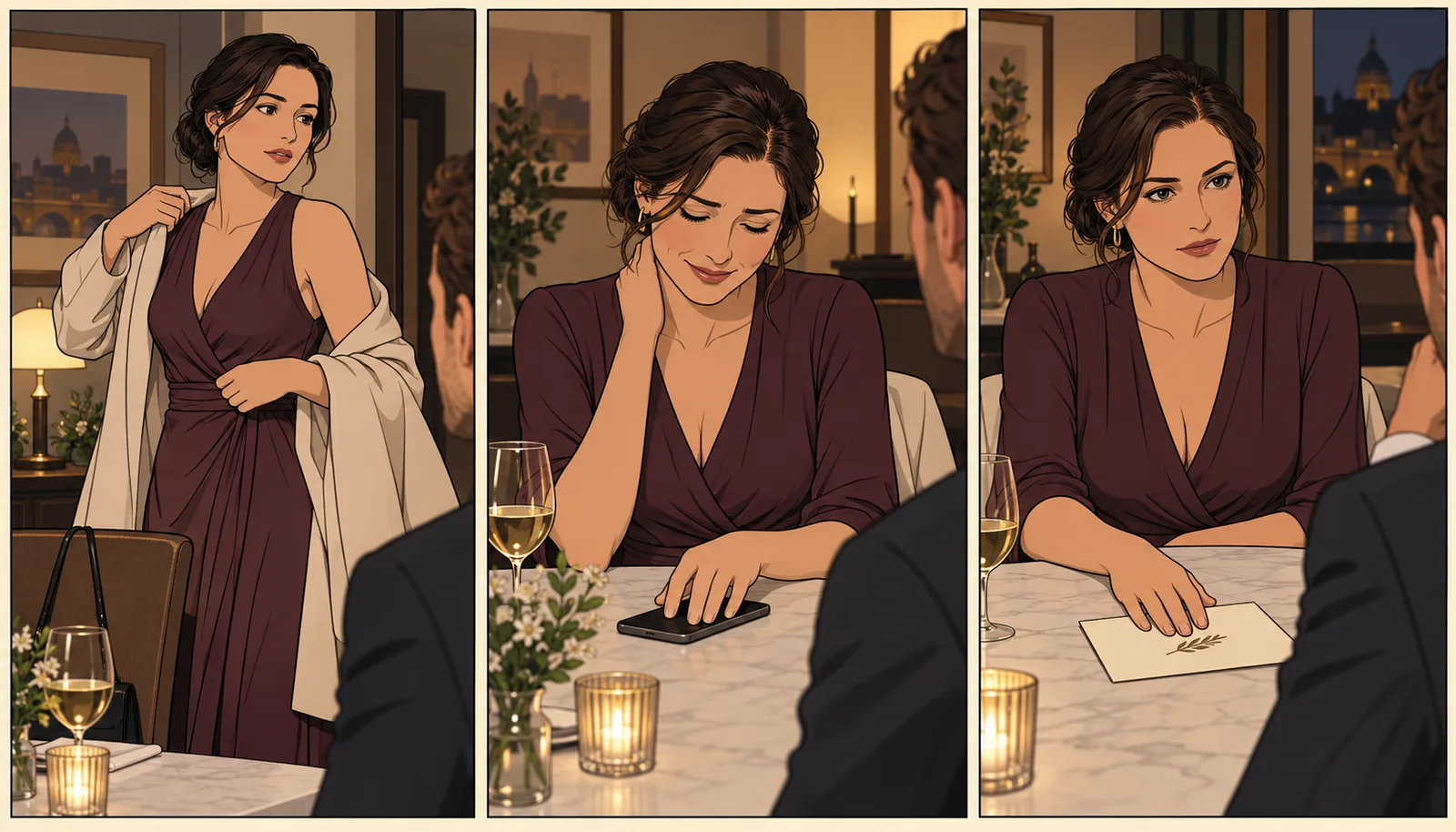
A consistent character can respond in different ways. The examples should show those differences instead of repeating one gesture.
Avoid copying the same example structure into every character card. A reserved character and a sociable character may both be caring, but they should not demonstrate care with identical sentence rhythm. One may offer a practical solution; another may speak openly. Those are choices you can show in the examples instead of explaining them in increasingly long adjectives.
Finally, look at how the greeting ends. If it is six paragraphs of description followed by a vague question, it may establish an awkward rhythm for the entire chat. Give the user a concrete situation and let the character do something understandable within it.
Remove contradictory preset instructions
Downloaded presets can contain good ideas alongside instructions you do not want. After several imports and edits, you may no longer remember which one asks for long descriptions, which one bans questions and which one demands a question at the end of every response.
Read the active instructions as one document. Look for disagreements about the character's agency, response length, narrative viewpoint and pacing. You do not need to debate every sentence. Fix the conflicts that directly match the symptom you are seeing.
For example, these instructions pull in different directions:
Never advance the scene without user input.
Always introduce a new development in every message.
End every reply with a question.
Never ask the user questions.
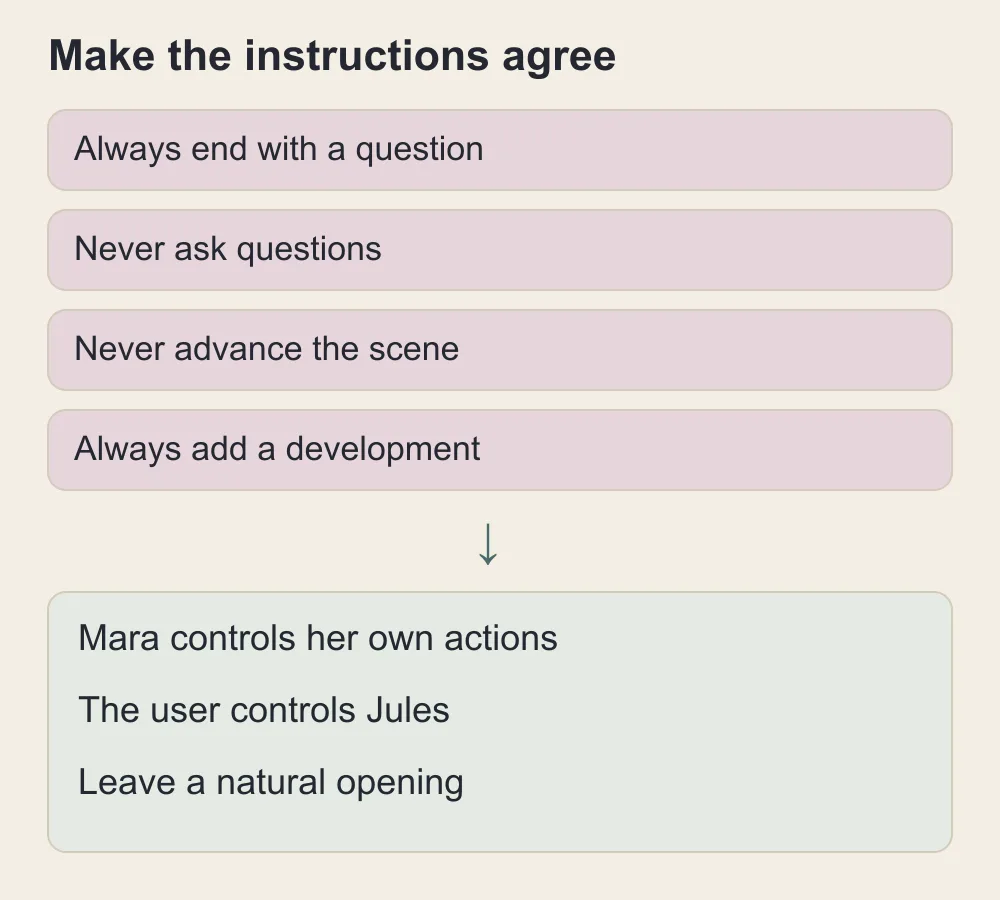
Contradictory directions can leave the character circling. Choose one clear rule for who acts and how the reply ends.
Do not add another instruction telling the model to reconcile them. Choose the behavior you actually prefer. For a conversational roleplay, a clearer version might be: “Act for Mara and the surrounding scene. Leave Jules to the user. End at a point where Jules can respond; a question is optional.”
If you want an occasional long scene, ask for it when the situation needs it. For ordinary dialogue, remove the permanent requirement to produce a miniature chapter. You can still allow a longer reply when a character has something important to explain.
Keep a copy of the original preset before changing it. Then disable optional style additions in a branch and use a small set of plain instructions. If the character starts answering normally, reintroduce only the parts you miss. This gives you a useful distinction between a model that struggles with your scenario and a preset that overwhelms the scenario with conflicting demands.
The point is not to make every prompt minimal. A detailed setup can be useful. The point is to make the instructions agree on what the next reply is supposed to do.
Check the prompt your app actually sends
The words you see in the editor are not always the full prompt. Character fields, history, temporary instructions, extensions and connection-specific formatting may all contribute. Before you conclude that the model ignored your fix, confirm that the fix reached it.
In SillyTavern, the message menu includes prompt inspection through Prompt Itemization. Use it to locate the active character material and instructions after generating a reply. You are looking for recognizable text, unexpected duplication and sections that disappeared, not trying to analyze every token. See the official context settings for the inspection entry point.
If your edited note is absent, stop changing the prose. Find out why it is not being included. You may have edited a preset that is not selected, a character field used differently by your connection, or a temporary instruction whose placement does not match what you assumed.
If the same style paragraph appears several times, remove the duplicated copies from the fields you control. Repeating a requirement can sometimes be intentional, but accidental duplication makes the prompt harder to reason about and spends space on the same instruction.
This inspection step also keeps you from blaming the wrong layer. If the actual prompt still contains the old echoed replies, the next response is not being generated from the cleaned conversation you thought you had. Resolve that mismatch first.
Text completion and chat completion need different formatting fixes
“Use this template” is incomplete advice until you know the connection type. A local text completion setup and a hosted chat completion API can need different controls even when both are opened through the same roleplay interface.
For text completion, the model receives a formatted text prompt. Its expected instruction template matters. SillyTavern's Instruct Mode documentation says that the selected format should match the actual model's expectations. The model card is the starting point, rather than a template chosen because its name sounds familiar.
If your local model starts printing role labels, treating dialogue as instructions or continuing your character's turn, check the model's recommended template and the active context formatting. Those symptoms make formatting a reasonable suspect. They do not prove that every repeated sentence is a template error.
Chat completion uses a different prompt builder. In SillyTavern, use the Prompt Manager for the relevant instructions instead of assuming that changing a text completion instruct template will repair the request. Pay attention to any connection-specific prompt conversion you intentionally enabled.
A helpful troubleshooting question is: “Where is the instruction placed in the final request?” For text completion, examine the formatted text. For chat completion, examine the messages and their roles through your app's inspection tools. You do not need to hand-insert special tokens into ordinary chat messages unless the connection's documented setup explicitly calls for that.
If a tutorial tells you to paste a template intended for one local model into an unrelated hosted API, skip that step. First find instructions for the connection you actually use. A beautiful preset is not useful if its formatting assumptions do not match your backend.
Sampling: change the supported control that fits the symptom
Sampling settings affect which possible continuation is selected. They can matter, especially for repeated wording inside a reply, but they cannot supply a missing character motive or resolve contradictory scene instructions.
Begin with the model or connection's recommended default preset. Then change one supported setting at a time. If you imported someone else's aggressive sampler configuration, returning to a known baseline may be more informative than increasing every value further.
| Control | What it can help you explore | Why it is not a universal cure |
|---|---|---|
| Temperature | More or less variation in wording | Greater variation can also damage coherence; the scene may still repeat |
| Top P or another token filter | How much of the possible continuation space remains available | Combining restrictive filters can leave fewer alternatives |
| Repetition, frequency or presence penalties | Whether repeated tokens are being favored too strongly | These are different controls with backend-specific support and behavior |
| DRY or other advanced samplers | Local setups with documented phrase-repetition controls | A slider in a frontend does not make a hosted API support it |
| Response length | Whether an ordinary conversational turn is being forced to keep writing | A shorter cap cannot repair a reply whose first sentence is already wrong |
Do not copy a temperature from an unrelated model and call it optimal. Model families, fine-tunes and inference implementations differ. If the baseline is extremely restrictive, try a modest change within the model's documented range and read several replies. If the result starts changing names, contradicting the scene or inventing unrelated events, reduce the change.
The same caution applies to penalties. Increasing one until the character stops using its own name is not success. You want fewer purposeless repeated phrases with normal grammar and intact meaning. A setting that makes the prose unnatural has traded one problem for another.
For advanced local samplers, consult your backend's current documentation and keep the original preset. Do not assume that min_p, DRY, XTC or a repetition-range field is accepted by a generic chat completion endpoint. SillyTavern's chat completion documentation explicitly distinguishes its custom chat endpoint from the wider customization available through text completion sources.
If you use SpicyAPI or another API service, consult the exact model's public input fields. This guide does not supply an undocumented sampler payload or claim that every model exposes the same settings. Adding unsupported fields is not a reliable way to make an adult roleplay more creative.
Shorten replies that keep filling space with the same material
A conversational character does not need to describe the room, explain its feelings and restate the relationship every time it speaks. If the next useful action is a two-sentence answer, a permanent demand for a long reply encourages unnecessary expansion.
Try this wording in a temporary instruction:
Match the reply length to the moment. During dialogue, give a concise answer and any action needed to understand it. Use a longer passage when an event or explanation genuinely needs more space.
That preserves the possibility of a rich scene. It simply removes the obligation to manufacture one on every turn. You do not have to demand an exact word count unless the app needs one for a particular format.
In the invitation example, Mara can say why she left and give Jules a chance to answer. A long reflection on the apartment lighting would dilute that moment. Later, if Mara explains an important decision from earlier in the story, a longer response may be appropriate.
Check the output limit separately from the stylistic instruction. The limit is a ceiling, not necessarily a target length. If a response stops midway through a sentence, you may have made the ceiling too low. If the response comfortably finishes but contains several recycled paragraphs, the instruction about length is the more relevant problem.
A shorter reply can also make an interactive story easier to steer. When the assistant writes through four emotional developments at once, it may decide things your character should have responded to individually. Shorter turns leave those decisions available to you.
Fix repeated questions without making the character passive
Some roleplay assistants ask a question at the end of every message because their setup equates interactivity with questions. That can make a mature relationship scene feel like an interview.
Questions are useful when the character needs an answer. They are less useful when they repeat a decision you already made. If Jules has agreed to dinner, Mara does not need to ask three more versions of whether Jules wants to go. She can find her coat, suggest a place or admit that she is nervous about the evening.
Use a reply instruction that allows several endings:
End with something the user can respond to: an unanswered statement, an action, a choice or a question that the character genuinely needs answered. Do not require a question at the end of every turn.
Then repair the current exchange. If the repeated question has already been answered, state the decision plainly in your next turn: “Dinner is settled. I pick up the keys and ask which place you had in mind.” You are changing the active subject rather than answering another paraphrase of the previous question.
In adult-oriented fiction, keep meaningful boundaries intact. If a character genuinely needs to clarify a limit or a changed situation, asking is appropriate. The annoyance is redundant wording after an answer has already been established, not the existence of communication itself.
You can write those boundaries clearly in the story setup and let the characters respond naturally to new developments. Do not use an anti-repetition instruction that tells the model to ignore them. A better prompt distinguishes settled decisions from unresolved ones.
When every character sounds alike, repair the shared voice
If three different cards all start making the same polished observations, the shared prompt deserves attention. It may be teaching a narrator voice more strongly than each card demonstrates a character voice.
Read the shared style instructions for words such as “lyrical,” “cinematic,” “intense,” “immersive” and “emotionally rich.” These can be useful preferences, but they do not tell the model what distinguishes a tired nightclub manager from a blunt musician or an anxious graduate student. More adjectives about prose quality will not create those distinctions.
Replace broad performance language with a few concrete choices. Mara might speak plainly when she is uncomfortable, answer practical questions immediately and avoid explaining her own expressions. Another fictional adult character might use humor to delay an answer, then become unexpectedly direct when the topic matters.
Give each character a reason to respond differently. In a tense conversation, one protects their pride, another tries to repair the misunderstanding and another wants to end the evening politely. The same user line can lead to different actions because the characters want different things.
Read dialogue without the speaker labels. If you cannot tell who said what, rewrite one example for each character before expanding their biographies. A distinctive short answer often teaches more voice than another paragraph of background facts.
Keep phrase bans and automatic cleanup small
A phrase ban can express a specific preference, but a growing list of stock expressions can become more prominent than the voice you want. If every reply comments on a smile, request direct dialogue and actions that matter rather than chasing each synonym. Follow a style restriction with a short positive example.
Automatic cleanup has a different limitation: it changes displayed or retained text according to the app's rules, rather than necessarily making the generation better. A filter that removes a gesture might also remove the only sentence establishing where a character is standing. Test it on a copy and read the result for meaning and punctuation.
Start with manual repair of the recent failure. Once you understand the pattern and how the app stores edited replies, you can decide whether an automatic rule is useful. Clean-looking text alone does not prove the next turn will behave differently.
A complete rescue of the Mara and Jules scene
Here is how the earlier pieces fit together. This is a worked editorial repair, not a report of a paid model run.
The current conversation has become repetitive. Mara echoes the last words Jules typed, smiles and asks if Jules is sure. The shared preset also requests long replies, says the scene must never advance without user permission and requires every reply to end with a question.
First, save a copy. Then remove the repeated echoed openings from the last three Mara replies. Keep the facts: Mara left without explaining, returned for the invitation and wants to attend dinner. Do not rewrite Jules's reactions.
Second, simplify the conflicting instructions. Mara controls her own words and actions. Jules remains under the user's control. Replies should match the moment, and questions are optional. Remove the permanent requirement to fill several long paragraphs during ordinary dialogue.
Third, replace the last broken Mara reply with a short answer:
“I thought you invited me because you felt you had to.” Mara puts the invitation on the counter. “Then I realized I had never actually asked you.”
That reply contributes a motive the next turn can address. It does not decide what Jules feels, and it does not settle the whole relationship. It gives the scene a reason for its earlier hesitation.
Fourth, send a user turn with a concrete response:
I leave the invitation where it is. “I asked because I wanted you there. But next time, ask me before you disappear.”
The desired continuation should respond to both parts: the welcome and the request for clearer communication. It might contain an apology, agreement or a practical next action. It should not merely turn “disappear” into another opening question.
Finally, read the next few turns for progress. Does Mara acknowledge the request? Does the dinner decision remain settled? Can Jules introduce a new subject without the assistant reopening the same misunderstanding? Those are more useful signs than whether the model found a fresh adjective.
If the loop returns immediately, try a short fresh branch with the simplified setup. If it disappears there, continue from the repaired scene rather than rebuilding every card. If it appears in the fresh branch too, examine the greeting, examples and actual connection before buying a different model.
Know when a fresh branch or another model is justified
There is a point where editing costs more attention than the scene is worth. You should not feel obliged to keep repairing a chat that has become a chore. A fresh branch can preserve the important situation while leaving a large amount of stale prose behind.
Bring across the scene facts you need, the character's voice and one recent exchange you like. Avoid carrying over pages of the repetitive passage just to prove what went wrong. The new conversation needs a usable starting point, not a complete archive of its predecessor's bad habits.
This is a short scene restart, not a replacement for a full memory system. For the invitation story, the necessary information is that both characters are adults, Mara left without explaining, Jules still wants her at dinner and clearer communication matters now. Their entire relationship history may not be needed for the next answer.
Consider changing the model when a clean, correctly formatted setup still produces the same failure and another suitable model handles that same setup more usefully. Our LLM roleplay selection guide covers the separate model-choice question. Keep the inputs comparable. Otherwise you may give the new model a better prompt and mistake the improvement for a model advantage.
Judge the result by your actual fiction. Can the character answer a direct question? Can it vary its response to a disagreement, a practical request and a quiet admission? Can it advance its own actions while leaving yours alone? A model that writes ornate descriptions may still be a poor match for the conversational rhythm you prefer.
Content suitability is a separate requirement. A model can produce natural dialogue and still be unsuitable for your NSFW use case. Another can accept adult fiction yet repeatedly fall into bland prose. Solving one requirement does not prove the other, so do not use a single policy label as a substitute for reading the replies.
Try a small amount of ordinary, nonexplicit dialogue first. You can assess whether the voice works before investing in a long scene. If you use a paid API, repeated regenerations can cost money; check the service's actual billing behavior rather than assuming discarded answers are free.
A short troubleshooting session you can actually finish
If you have been changing settings for an hour, narrow the experiment. Pick one repeatable failure from your own scene: the echoed opening, the repeated question, the paragraph loop or the stalled decision. Fix that symptom before optimizing everything else.
For an echoed opening, preserve the settings and clean the last few replies. For a stalled decision, preserve the voice and give the character a specific unresolved question. For immediate failure in every new chat, compare the greeting and shared preset. For role labels or broken turn-taking, inspect the connection format.
Keep the next user message the same when you compare two setups. Change either the relevant instruction or one supported sampling control. If you change the character card, model, scene and samplers simultaneously, an improved reply will not tell you which change helped.
Read several replies rather than trusting one unusually good regeneration. You do not need a complicated scorecard. Ask whether the repeated behavior became less common, whether the character still sounds right and whether new problems appeared. A less repetitive response that takes over your character's decisions is not the repair you wanted.
Stop when the scene is enjoyable again. There is no prize for finding a theoretically perfect preset. A setup that needs occasional editing but gives you convincing dialogue may be a better fit than a heavily tuned one whose prose feels unfamiliar.