You want to create images for a fictional adult character, perhaps inside a companion app or a private creative project. BasedLabs appears in the search results with an uncensored image generator. Before buying credits, you need two answers: can it handle your intended NSFW work, and can you call it from your application?
BasedLabs is worth considering for browser-based exploration, but its public information does not establish a dependable NSFW API contract. It advertises creative freedom while also publishing restrictions on higher-intensity adult content. It does have accessible SDK documentation, and its pricing page advertises API access through sales. Calling it a platform with “no API” is inaccurate. Calling it unrestricted is also more than its published policies support.
This review examines those public materials. We did not create an account, buy credits or run a paid generation comparison, so this is not an image-quality test or a measured refusal-rate ranking. What it can answer is unusually practical: where the policy conflict lies, what the developer documentation actually contains, and why the advertised approximate image allowance is a poor basis for budgeting your chosen model.
| Your immediate need | What the available information supports |
|---|---|
| Explore several image families in a browser | A reasonable reason to consider BasedLabs |
| Depend on unrestricted NSFW generation | Not established by the public policy and marketing pages |
| Find evidence that an API exists | Public SDK documentation exists; API access is also advertised through sales |
| Start a production integration today | Current credentials, model IDs and contract details still need confirmation |
| Upload a confidential character library | Resolve the data and submission terms first |
The NSFW promise and the written policy do not line up neatly
The important conflict is on BasedLabs' own site. Its uncensored image generator page promotes creative freedom and private generation, while a notice near the top says certain adult image categories are prohibited and moderated. Its Blocked Content Policy covers generated content and describes a moderation filter with possible manual review of flagged material.
Those statements matter more than the keyword in the page title. A mature fantasy portrait and a higher-intensity NSFW scene are different requests. A service might accept the first while restricting the second; neither outcome proves that every adult-oriented image is supported or rejected.
There is also evidence that the story has changed over time. In a user's custom-training support post, the author describes an announcement allowing NSFW FLUX generation while reporting rejected training uploads. This is a user's account of a past issue, not an official current permission or proof that the issue remains unresolved.
For someone producing a recurring adult character, the distinction is consequential. Generating a new scene, uploading a reference and training a custom character are separate operations. Permission or success in one does not establish permission or success in the others. You could discover that the initial portrait works but that the next stage of your planned series is unavailable.
Our conclusion is therefore narrower than “BasedLabs does not support NSFW.” The public pages do not give a consistent, sufficiently specific promise for a developer to build an NSFW feature around. We have not measured what each model currently accepts. If adult imagery is essential to your product, obtain an answer covering the exact model, content category and input operation before committing to that dependency.
That question can be concrete without reproducing an explicit prompt: “Our application makes clearly adult, fictional character imagery. Does the agreement allow this category on the named text-to-image task, reference editing and custom training? Which of these operations is subject to rejection?” A reply about artistic freedom alone does not answer it.
Do not try to solve a contractual refusal by hiding the intended request. If the service is unsuitable for your lawful use, choose a service and model that openly support the work.
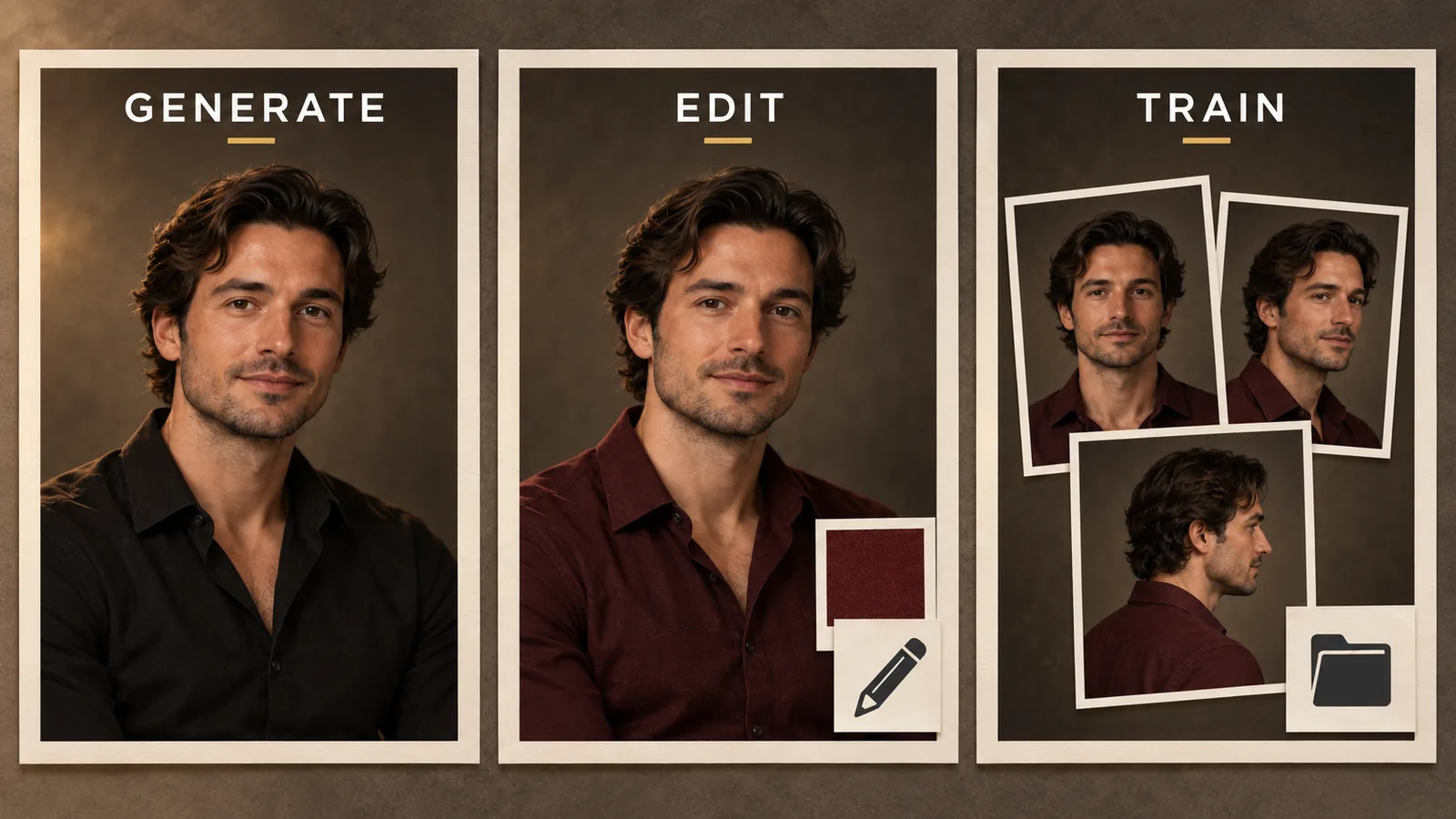
Illustration: these are separate creative operations. Support for one does not establish the availability or policy of the others.
BasedLabs has API documentation: here is what it actually tells you
A surprisingly common description of BasedLabs is that it has no public API documentation. There is a publicly accessible SDK documentation site. Its quick start describes installing the basedlabs package and initializing a client with an API key. The createImage reference documents a method with prompt, modelId and negativePrompt.
The problem is not the complete absence of developer material. The problem is that this material alone does not establish a working, current integration. The method example uses model-123 rather than a usable model identifier. The quick start imports basedlabs, while the method example imports @basedlabs. We did not execute either example, so there is no basis for claiming which import works with a currently issued key.
This gap has a concrete history. A developer asked about the missing model identifiers in a support discussion on the BasedLabs site. That post shows a real integration question; it does not prove today's API still lacks a model list.
If you are an indie developer, the correct takeaway is encouraging but qualified: there is something to ask BasedLabs to enable and document. You do not have to assume programmatic generation is impossible. You do need the current installation instructions and a real model ID before turning an example into production code.
The minimum useful handoff is one working call for your account, its actual response and the operation you intend to sell. A text-to-image example will not demonstrate reference editing. An image URL will not tell you how long the file remains available. An API key will not tell you whether your subscription credits and API usage share the same balance.
For a companion application, insist on the details that change the user experience: how a rejected request appears, whether it consumes credits, how a slow job is retrieved, and what happens if your server loses the connection after submission. These questions protect you from showing a user “try again” when the first request is still running or already billable.
There is no reason to invent a fresh code sample with a guessed endpoint or model ID here. The public reference does not supply enough verified detail to offer a current, runnable NSFW integration. A code block that looks plausible would make this review less useful.
API access through sales is a real option, with a different buying process
The pricing page explicitly advertises enterprise pricing, API access and custom solutions through sales. BasedLabs' enterprise page also promotes team workspaces, custom workflows and an uptime SLA. These are advertised enterprise features, not benefits we confirmed on a regular creator account.
Sales-led access can make sense for an agency with several creators and an engineer maintaining shared workflows. A negotiated arrangement might be more useful than a small self-service account, especially when someone must answer questions about permitted content, data handling and support. It is not inherently worse than a self-service API.
It is a different fit for a solo builder who wants to launch a small image feature this afternoon. Until access and pricing are agreed, the cost and start date are unknown. An enterprise page cannot supply those missing figures. Treat the advertised SLA in the same way: a headline percentage is not your application's contractual remedy, support response time or maintenance exclusion.
The sensible decision is based on your team. If you already like the creative interface and can wait for a negotiated integration, contact sales with a specific workload. If immediate self-service access is a hard requirement, choose an API whose current documentation, model task and price you can inspect before purchasing. Do not replace that requirement with browser automation; a consumer session is not a substitute for authorized API access.
Credit prices: calculate the selected task, not the approximate image allowance
BasedLabs' pricing page describes monthly subscription credits and additional top-ups for subscribers. It lists $10 for 300 credits and $99 for 3,300 credits among its packs. Its image examples include 5 credits for Imagen 4, 8 for FLUX Pro Ultra and 16 for Nano Banana Pro. It labels model costs approximate and dependent on settings.
Here is the arithmetic using the stated pack quantities, excluding any separately applied bonus:
| Example listed task | Credits | At $10 / 300 credits | At $99 / 3,300 credits |
|---|---|---|---|
| Imagen 4 | 5 | $0.167 | $0.150 |
| FLUX Pro Ultra | 8 | $0.267 | $0.240 |
| Nano Banana Pro | 16 | $0.533 | $0.480 |
These are allocated credit costs, rounded to three decimals. They exclude the subscription and are not checkout totals or NSFW permissions. A headline approximate image count cannot represent all three tasks.
The useful formula is simple: divide the dollars you pay for a credit allowance by the credits you actually receive, then multiply by the selected task's charge. If a bonus changes your credited balance, use that actual balance. If an output setting changes the generation charge, use the charge displayed for that setting.
This also explains why a flat statement such as “BasedLabs costs seven cents per image” is unreliable. It ignores which model makes the image. Comparing that estimate with a cheap task on another service would mix different jobs and potentially different output settings.
Pack allocation and cash spending are different too. You may only use part of a prepaid balance on today's project. That does not make the rest of the purchase disappear from your bank statement. If you will use the remaining credits later, the allocated task cost is useful; if this is a one-off project, the amount you must purchase is often the more relevant figure.
A character-gallery budget should include editing and discarded results
Consider a hypothetical project: choose a fictional adult character, then produce a gallery with an evening outfit, a different room and several expressions. The public-facing images remain fully clothed. The private creative requirements still make NSFW compatibility relevant.
Your work has at least two distinct stages. First, you search for an appealing identity and composition. Second, you try to preserve that selected identity while making revisions. Buying more fresh generations is not necessarily a substitute for the second stage: they may give you attractive images of different people.
Start the budget with the actual creative mix. A useful short note is “initial portraits, source-based revisions, final enlargement,” followed by the chosen task for each. If the editor charges differently from generation, give it its own line. If a task bills by image area, calculate using the intended output size. Do not apply a text-to-image rate to every operation simply because all the deliverables are pictures.
Now include selection. Suppose, purely as an example, you spend $12 on completed attempts and accept six final images. Your effective production cost is $2 per accepted image. If you accept only three, it is $4. Neither number is a measured BasedLabs success rate; the example shows why the total bill and the keeper count belong together.
For a recurring character, a discarded edit can be more frustrating than a discarded first portrait. You already had a face you liked, and the revision may lose it. Judge the face, outfit and display crop together before approving the image. A result that is technically valid but changes the character is not useful for that series.
This is also where a cheap trial can provide meaningful information without becoming a sprawling model tournament. Use a clearly adult fictional character brief, select one source, and ask for one narrow authorized change. It reveals whether the task you need is available and whether its output is useful enough to justify a larger batch. It does not establish the service's full NSFW boundary.
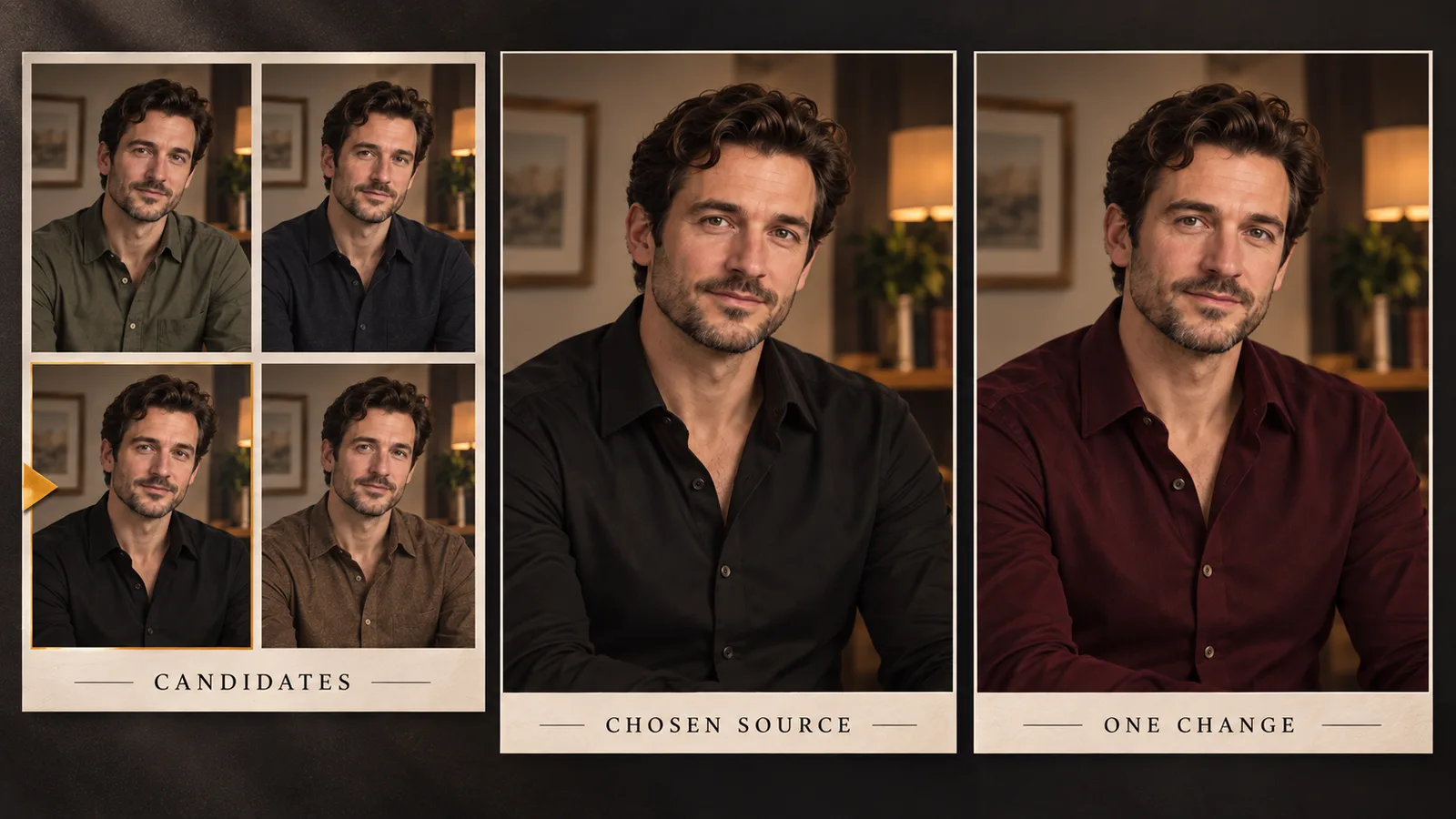
Illustration: the gallery budget includes selection and revision. These pictures explain a workflow and are not BasedLabs test outputs.
Several model families are useful; their names are not a quality verdict
BasedLabs' model directory presents image families including FLUX, Nano Banana, Seedream, Z-Image, Recraft and GPT Image. That variety is a genuine reason to investigate the platform: one creative interface can be convenient when you are exploring several visual directions.
But a family label does not tell you which version and task your account can use. “FLUX” could leave unresolved whether you are buying a new generation or an edit, what resolution it delivers and which controls are exposed. The same caution applies to a family name in an article or a model selector.
For an adult-character series, your most useful comparison is usually task-specific. Can you start from the approved portrait? Can you supply a second reference for a garment or room? Can you isolate a local change? Can you obtain the desired delivery shape without cropping away the face? Those capabilities matter more than how many logos appear on the homepage.
An exposed seed is not an identity guarantee. Nor should you assume that every hosted family lets you set sampling steps or guidance. Use the fields available on the task you actually choose. If a creator tutorial mentions controls that your selected editor does not expose, adding them to a prompt is not equivalent to setting them.
We have not run a same-input image comparison on BasedLabs, so we cannot rank its face preservation, hands, prompt adherence or adult-content delivery against another platform. The supported attraction is choice within a browser. Whether that choice produces your preferred character still needs a task-level result.
“Private” generation does not automatically mean confidential uploads
For a private adult-character project, there are three different concerns: whether other users can see the pictures, whether the service can access them, and how long related data is retained. A private gallery setting answers only the first.
BasedLabs' privacy notice describes collection of account content and sharing with service providers and employees. It says personal information is retained while the account exists and typically for six years after closure. That statement concerns personal information; it does not establish a six-year storage period for every generated image. Nor does it support a blanket promise of zero retention or no human access.
The Terms of Service also contain broad submission-license language, a non-confidentiality provision and separate wording about modified content. Those clauses deserve attention before uploading a proprietary character library. A private-generation marketing statement is not enough to resolve their application to your files.
For a small creator using entirely fictional material, a practical first choice is to explore with a character designed for the trial rather than a confidential client asset. For an application handling authorized user photos, obtain specific terms for uploads, processing, deletion and permitted access. Never assume that a user agreeing to have a picture generated also agreed to publish it in a community gallery.
This is not a claim that BasedLabs publishes private uploads or uses them for training. We did not establish either behavior. It is a distinction between the promises a creator sees and the commitments a developer needs when handling someone else's material.
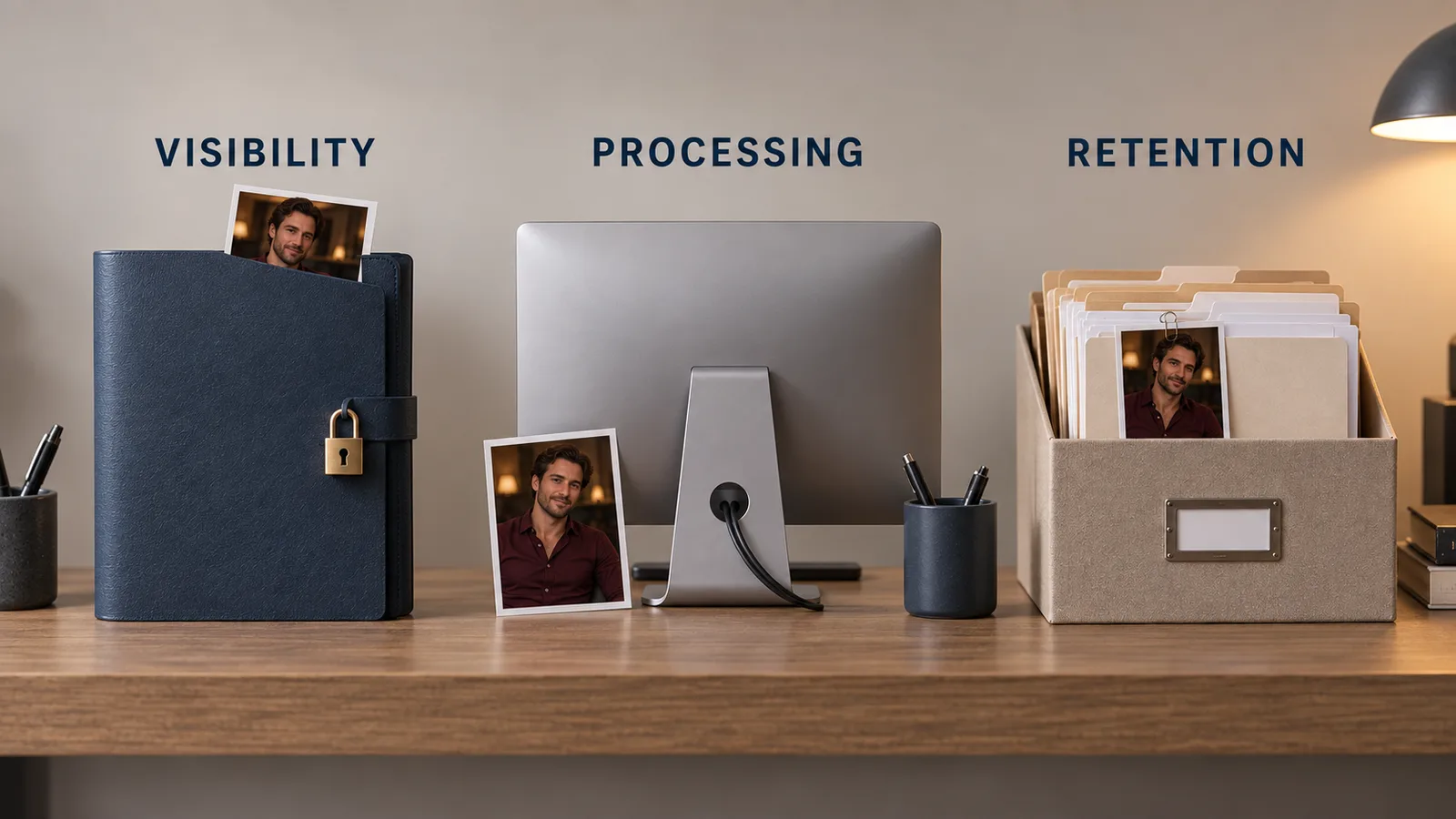
Illustration: gallery visibility, service processing and data retention are different questions.
Free access and refunds: do not assume a trial can absorb every experiment
BasedLabs' homepage advertises free signup. That is not a specified allowance of free image generations. We did not create a new account to verify its starting balance, so we cannot promise a no-payment image trial, a daily credit allowance or a free NSFW generation.
This matters most when you are comparing an editor. Being able to open a page or type a prompt is not the same as being able to submit the exact reference-based job and download its result. Look at the selected task's charge and your available balance before counting it as a free test.
BasedLabs' separate refund policy allows requests within 30 days under stated conditions, including certain service errors and unresolved technical problems. It excludes a change of mind and non-use. It does not promise that every unwanted completed image will be refunded.
A creative mismatch and a technical failure are different problems. If an image arrives but does not resemble your approved character, save the source and result and ask what remedy applies. If no deliverable arrives, keep the task and payment information needed to investigate. In either case, avoid assuming that buying a pack turns every experiment into a refundable trial.
Who should consider BasedLabs, and who should choose another route?
Consider BasedLabs if you want a browser-based place to explore image families and you can work within its confirmed content rules. Its broad model presentation is relevant for a creator still choosing a visual style. An agency already interested in the interface may also find a sales conversation worthwhile for shared workflows and API access.
Choose a different starting point if your immediate requirement is a documented, self-service NSFW image API with clear task pricing. That is a buying requirement, not proof that another service makes better pictures. Our HotAPI and SpicyAPI comparison examines specific generation and editing tasks, prices and published policy differences without claiming an unrun visual winner.
If you are choosing primarily for source-based character revisions, start with the uncensored image editor comparison. A generic generator recommendation can miss the editing controls you actually need.
The decision we would make as an adult-product developer is specific: do not commit a customer-facing NSFW feature to BasedLabs on the landing-page label alone. There is real developer material and an advertised API offering, so the next step is not to dismiss the platform. It is to obtain a current, working task and a clear agreement for the intended adult workflow. If those answers fit your needs, a small paid evaluation is reasonable. If they remain vague, keep the platform for optional exploration and build the core feature around a more clearly documented arrangement.