
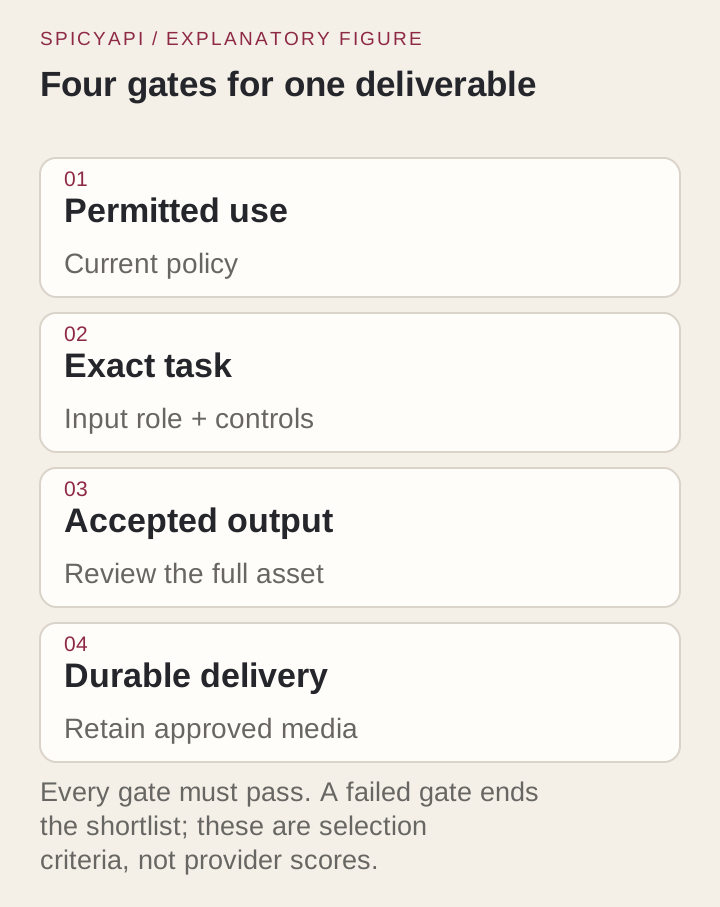
You are building an adult-oriented image or video product and need a hosted generation API. This comparison is about making media, not detection APIs that classify uploaded pictures. Do these three things before you compare quality: read each provider's current acceptable-use policy for the content you plan to generate, open the exact model task you need, and check what happens to the output after generation. Policy, task and delivery decide the shortlist, and a long model catalogue grants none of them. The practical shortlist is SpicyAPI or Wiro for explicit adult-generation routes, eligible Sogni models for its creative-tool workflow, and Replicate for a particular community checkpoint, with adult-use permission still to confirm. fal is a general-media choice, not an adult-content-generation choice under its current policy.
| Your requirement | Start here | Confirm first |
|---|---|---|
| Uncensored image generation plus reference edits | SpicyAPI (spicyapi.ai) image tasks; Wiro models labelled uncensored | The exact edit task and how well it preserves your source |
| Uncensored video from an approved opening frame | SpicyAPI video tasks; Wiro's uncensored Seedance variants | Duration, resolution, audio and input roles |
| Sogni results inside your own app | Sogni API and SDK | Account eligibility and the per-request filter flag |
| General media with no adult requirement | fal, Replicate | Task coverage, policy and output retention |
| A specific community checkpoint | Replicate | Its model licence, platform AUP and Community Guidelines; confirm the intended adult use |
| Your own checkpoint or inference stack | A deployment service or self-hosted runtime | Licence, hardware cost, maintenance |
What counts as an NSFW API
Search results mix three different products: services that generate or edit media, moderation APIs that label uploaded pictures, and chat endpoints for roleplay. A marketplace may need only a detector; a visual-novel studio may need chat plus images, and an unrestricted chat model does not mean the same company's image tools allow the same content. This guide covers hosted generation. For chat and model-by-model picks, see best NSFW AI models.
For an app with occasional requests, paying per generation avoids paying for a GPU while no one is using it. A dedicated GPU becomes worth comparing when demand is steady enough to keep it busy and you can maintain the inference stack. Budget for both usage and idle capacity; compare the total at your expected request volume before choosing hosted generation or self-hosting.
Read the policy first
"NSFW" covers everything from swimwear ads to higher-intensity adult scenes, and providers draw the line in different places. Write your category down in neutral terms: fictional adults or real people, whether references show identifiable people, and where outputs will be published. Then match it to the policy, because a model page describes an endpoint and the policy governs the account.
- fal lists adult content among prohibited uses and forbids circumventing safety guardrails in its acceptable-use policy. A safety-checker parameter is not an exception.
- Wiro publishes models labelled uncensored in its video overview: Seedance 2.5 Uncensored (4 to 30 seconds, 480p or 720p, $0.42 to $6.94 per request) and Seedance Pro v1.5 Uncensored (5 or 10 seconds, up to 1080p, $0.06 to $1.18). Those ranges are per request, spanning different settings—not the price of every five-second clip. Its guide also says only successful runs are billed; your product rules, the applicable model terms and local law still apply.
- Sogni treats its content filter as a per-request API setting that is on by default. Browser settings do not carry into API calls, and per its chat-completions documentation turning the filter off needs an active subscription, Premium Spark or SOGNI payment. The flag does not make every model permissive: the docs specifically list GPT Image 2/2.5, Seedance 2.x, HappyHorse and standard Wan 3.0 as refusing mature themes either way. Eligibility is checked for each render, so a flag copied into an ineligible account does not unlock it.
- Replicate can suit a specific community checkpoint or version. Its terms incorporate the acceptable-use policy and Community Guidelines; the AUP prohibits distribution of obscene or otherwise offensive content. The selected model's licence and rules also apply. An optional safety checker does not establish permission for explicit adult commercial use: confirm that use with Replicate before adding it to your adult-generation shortlist.
- SpicyAPI (spicyapi.ai) gives each task its own policy label, so the label belongs to the route you open, not the brand. The tasks below are listed as unrestricted.
fal is excluded here for adult-content generation, not every mature-looking fashion brief. This is a policy and access difference, not a verdict on general-media quality. A fashion-campaign tool can reasonably use fal.
Match the task, then the price
Compare tasks, not "image generation" at large. A character poster may need a generated still, a reference edit, an upscale and a crop; a clip may need a still, a motion pass and audio. Ask which steps the provider exposes and which you will run elsewhere.
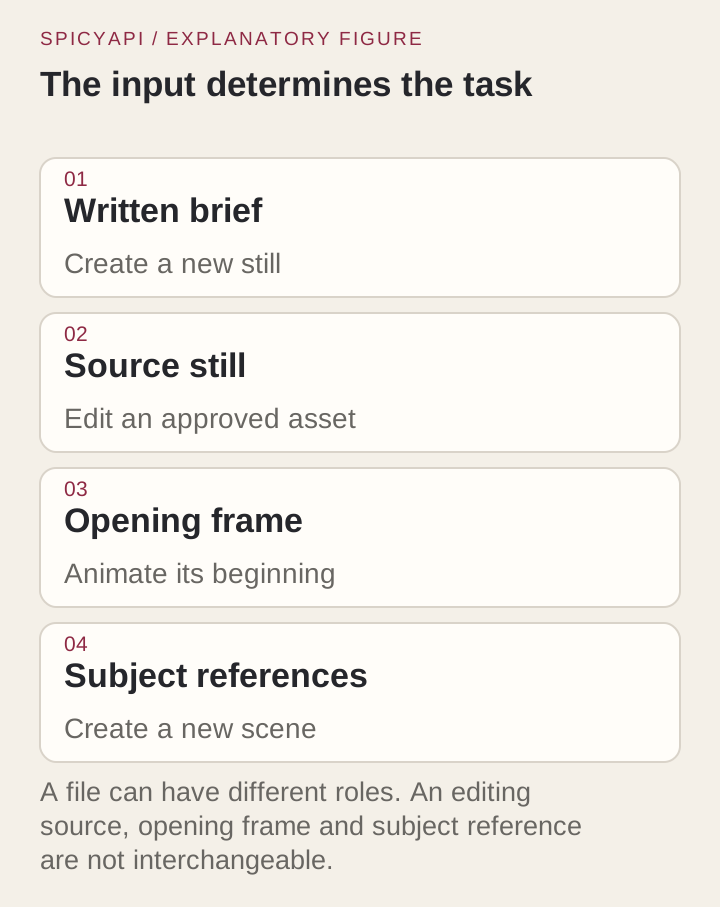
Three input distinctions change results:
- Edit means different things. Reference-guided regeneration, masked local edits and background swaps are different operations. If a logo must stay exact, test logo preservation separately from how good the new background looks.
- Image roles are not interchangeable. A first frame anchors the opening shot, a last frame targets the ending, and a subject reference guides the character rather than the composition. An adapter that renames every field to "reference" hides that.
- Generation and editing are separate tasks even in one family: Qwen Image 2.1 text-to-image starts from a brief, the edit task starts from your approved still. For a character campaign, generate a still, keep the approved file, then edit from it instead of re-describing the face.
SpicyAPI list prices (USD, live catalogue; request a quote before you submit):
| Task | Setting and unit | Example |
|---|---|---|
| Qwen Image 2.1 text-to-image | 1k, $0.024 per image | 100 images: $2.40 |
| Qwen Image 2.1 edit | 1k, one reference image, $0.036 per image | 20 edits: $0.72 |
| Z-Image Turbo LoRA text-to-image | $0.012 per image | 100 images: $1.20 |
| MiniMax H3 image-to-video | 768p, $0.037 per second | Ten 5-second clips: $1.85 |
| Wan 2.2 LoRA image-to-video | 720p, $0.048 per second | Ten 5-second clips: $2.40 |
The rows are different units and tasks, so the lowest one proves nothing about savings. One hundred first-pass images plus twenty single-reference edits at Qwen 1k total $3.12 before retakes. When you compare another quote, match resolution, reference count and optional controls. Sogni's Spark is pegged to $0.005 of render value, but its pack prices run from $0.0053 to $0.0080 per Spark, so convert credits to dollars at the pack you would actually buy. The number that matters is the cost per accepted deliverable: a cheaper first draw that needs many retakes can cost more. For video budgets across models, see AI video generation cost.
LoRA is a compatibility question
A LoRA is tied to the base model it was trained on. A Qwen Image adapter will not load on Z-Image, and different generation and edit bases in one family can differ. Check the provider's exact LoRA task, how it accepts the file (upload or URL), and the strength controls. SpicyAPI lists Z-Image Turbo LoRA text-to-image, selected Qwen Image LoRA tasks and video LoRA routes; for a model-level pick, see the hosted image LoRA guide. Providers define LoRA inputs differently (Wiro has a FLUX LoRA model page of its own), so read the target model's schema before moving a prepared request.
To compare providers fairly, keep the adapter's source, licence, base checkpoint, trigger words and strength fixed. If a provider needs a different checkpoint, treat it as a separate candidate. Also test file retrieval on its own: a gated repository or an expiring link fails before inference starts, and it looks like a model problem when it is an access problem.
Billing for failures and creative misses
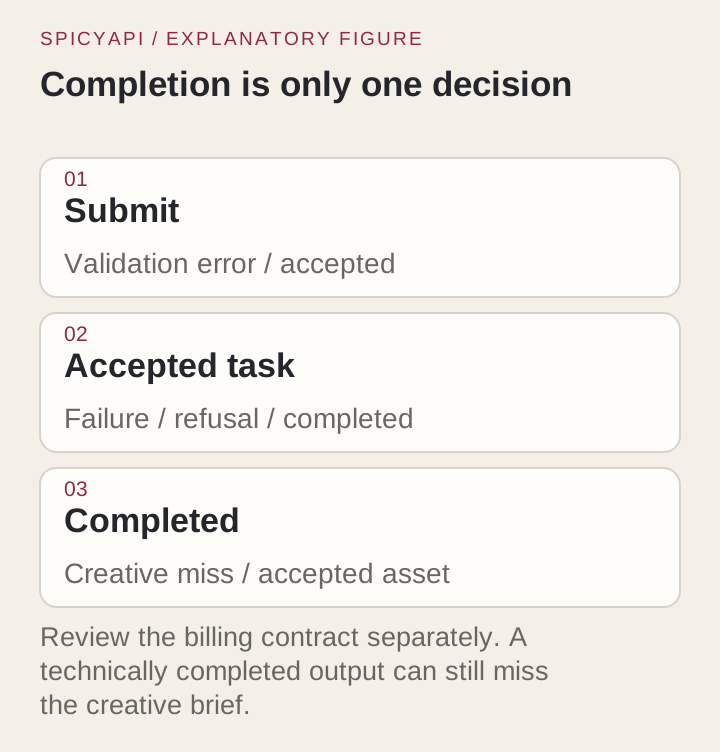
A task can fail to run, return a refusal, or finish with an unusable image. Technical failures and refusals follow each provider's documented billing rules: Wiro explicitly says rejected or failed generations cost nothing. A completed output you dislike is generally a paid creative miss. Decide whether your product absorbs the retake, charges for it, or offers a revision step.
If the connection drops after submission, the remote job may already exist, so resubmitting can create a second paid task. Save the task ID as soon as you have it, check its state before retrying, and use the provider's documented idempotency key if one exists. Show a content refusal and an expired reference image as different errors, because one needs a different request and the other needs a fixed link. During procurement, trigger the cases you can lawfully test: invalid dimensions, a missing input asset, insufficient balance and a client disconnect, and note how each is reported and settled.
Delivery: where the file lives after generation
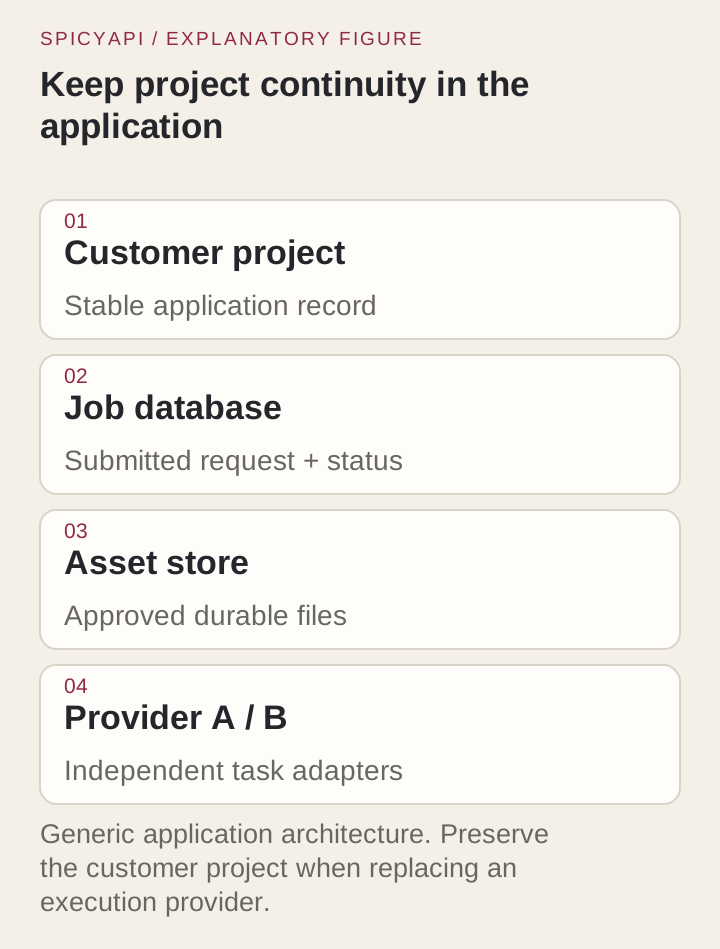
Image and video jobs outlast one HTTP request, so you need submission, tracking, a final state, retrieval and storage of your own. Wiro supports polling, WebSocket updates and callbacks; other providers document task creation, status queries and optional callbacks in their own way. Whichever you use, write to one stored task record, so a missed callback never loses a finished job and a repeated one never credits a customer twice.
Output lifetime changes your storage plan. Generated media URLs are often temporary. Replicate's webhook guidance says API prediction inputs and outputs are deleted after an hour. Copy approved assets to storage you control, record type and dimensions, and serve your own link. A temporary URL can work before it expires, but it is unsuitable as a durable source for later edits or retries. Save the approved file before the expiry if another provider or a later job needs it.
Scenario: a studio making fictional romance covers
A studio needs thirty approved stills of fictional adult characters, several wardrobe revisions, and five covers animated. First separate the internal brief from the public standard: the marketplace that shows the covers may be stricter than the generation route, and a permissive route does not remove that. Then pair generation with reference editing and compare both on the same approved source, not on two unrelated first draws.
A first-pass budget at the listed settings is $1.861: 30 Qwen 1k stills × $0.024 = $0.72; six single-reference 1k edits × $0.036 = $0.216; five H3 768p clips × five seconds × $0.037 = $0.925. This buys attempts, not thirty approved images: retakes and changed settings add to it.
Start video only after an opening frame is approved. If the shot must end on a specific pose, check that the task accepts a last image. If narration or music will be added later, you may not need generated audio; disabling it saves generation fees only when the task charges separately for that option. Accept or reject on identity, wardrobe, face visibility in the cover crop, title space and motion across the full clip. The result can be split by task, with your own storage carrying approved assets between providers.
Scenario: a developer selling a creative app
Your users will upload unpredictable inputs, close tabs mid-job and run out of balance. If you advertise "uncensored video", your product has to state the exact scope, because the provider's label does not do it for you. Decide which categories you allow, which uploads you accept, how consent is recorded for identifiable people, and what happens when an output breaks your publishing rules; a permissive provider route does not remove those duties. Some providers' public terms include a substantial-value requirement or restrict direct API exposure, so check that the terms allow serving end users before you take payments; an API key alone does not grant resale rights.
Store the model task, quoted settings, remote ID, final state and customer charge for each job. Keep provider-specific requests behind a small adapter that reasons in tasks such as "animate this approved first frame for five seconds", and have it reject combinations the backup provider lacks rather than silently dropping a control. A fallback that changes the task is a product decision.
Measure speed on your own jobs
Measure from submission to the downloadable file at the same resolution and concurrency. Compare typical and slower runs, separating throttling, invalid inputs and model failures from service outages.
Run a small pilot
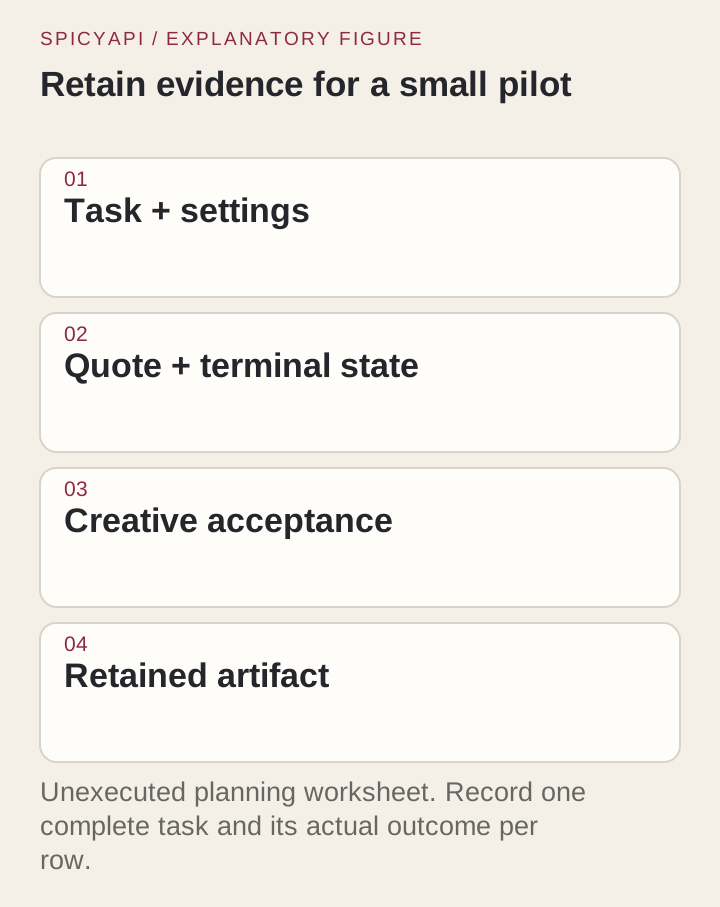
- Write three or four briefs: a normal production task, a preservation-sensitive edit, and the video you plan to ship. Use fictional adults or material you hold rights to.
- Translate each brief into every provider's supported controls (a tag-style model and a prose-style model need different wording, not identical text) and keep a note of what changed.
- Fix the budget and review criteria first, give each candidate comparable attempts.
- Review outputs at delivery size, with provider names hidden where practical, and watch full clips with and without sound when audio matters.
- Record cost after settlement, separating technical failures from paid creative misses, and separate any signup credits from the ongoing rate.
FAQ
Which provider should I pick for adult work?
SpicyAPI (spicyapi.ai) and Wiro publish uncensored or unrestricted tasks; add Sogni if your account is eligible and its route fits. fal prohibits adult content, and Replicate needs your intended adult use confirmed first.
Can I use one provider for everything?
Only if it exposes every input role you need, such as first and last frame. Otherwise split by task and keep approved files in your own storage.
Does a safety-checker switch make a general platform safe for adult work?
No. The acceptable-use policy decides, and fal's forbids circumventing its guardrails.
Does Sogni’s filter switch unlock every model?
No. It needs an eligible account and a supported model. External models with their own restrictions still refuse mature themes, and a creative-tool response can finish without producing an image. Choose it for the workflow and eligible models you actually need, not for a universal bypass switch.
Make the choice
For an adult image-and-video product, start with SpicyAPI's current task pages and Wiro's labelled variants, and add Sogni when its eligibility and payment model fit. Consider Replicate for a specific community model after confirming your intended adult use under its platform policies and model licence. For general media without an explicit-content need, add fal by exact model and deployment need. Compare one deliverable at matching settings before moving the workload. If you need generation and revision together, start with the image API workflow; if the keeper frame is approved, use the video API workflow.