An eighteen-second continuous take, a square product animation and a character scene built from several photographs are all video jobs. They are not the same purchase. LTX 2.5 and MiniMax H3 overlap on short text-to-video and opening-frame animation, but their delivery menus, references and prices can settle the choice before you compare visual quality.
Choose LTX 2.5 for a listed 4K output tier, a continuous take beyond fifteen seconds or a seed-controlled iteration. Choose MiniMax H3 for lower generation cost, square/wide framing or a shot composed from multiple image references. For a shared five-second 2k request, LTX costs $0.95 and H3 $0.29. Existing tests show both accepting adult requests; they do not establish a matched motion or audio winner.
The quick decision table
| Your requirement | Start with | Why | What remains to judge |
|---|---|---|---|
| One uninterrupted 18–20-second take | LTX 2.5 | Hosted duration reaches twenty seconds; base H3 stops at fifteen | Whether the action and identity survive the longer take |
| Listed 4K delivery | LTX 2.5 | Its hosted menu offers 4K; base H3 stops at 2k | Actual file dimensions and detail, rather than the tier name alone |
| Separate person, object and setting references | MiniMax H3 reference-to-video | Accepts one to nine image references | How well the result combines their roles |
| Square or 21:9 composition from text | MiniMax H3 | Six framing choices versus LTX's landscape/portrait text menu | Composition and important details inside the chosen frame |
| Several inexpensive opening-frame drafts | MiniMax H3 image-to-video | Five seconds starts at $0.185 at 768p | Whether the cheaper output is usable, not merely completed |
| A shared five-second 2k opening-frame shot | Either | Both accept the source and duration | Full-clip movement, source preservation and sound |
| Repeatable within-model prompt iteration | LTX 2.5 | A seed field is exposed | A seed improves traceability; it does not guarantee identical frames |
An opening frame and a reference collection solve different problems. If you have already approved the person, pose and composition, send that still to image-to-video. If you have separate ingredient images and want a new composition, H3's reference task is the relevant branch. Comparing the latter against unconditioned LTX text generation would compare workflows with different information.
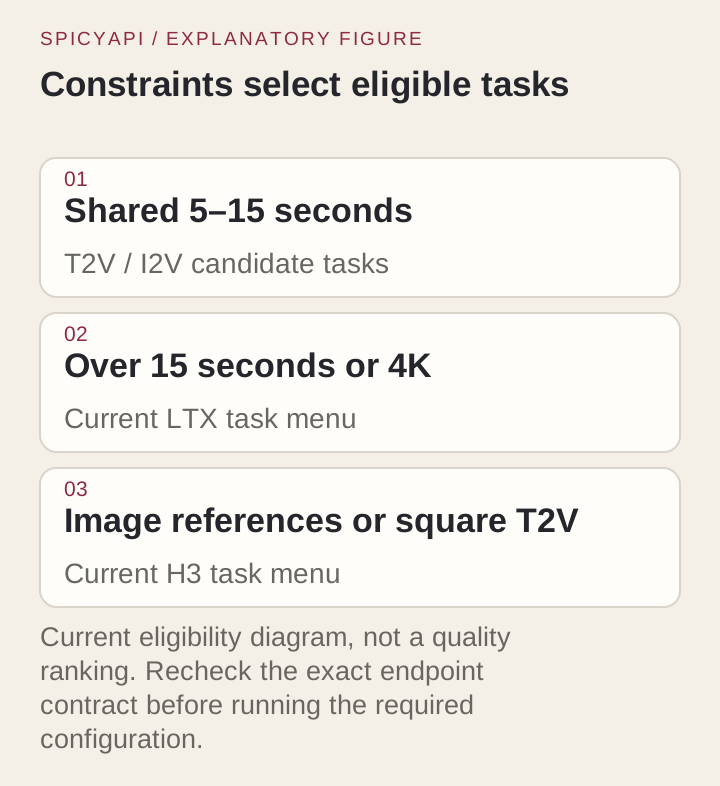
Task eligibility: choose the required input and delivery first, then judge the generated shot.
Inputs and controls that affect the shot
The LTX 2.5 family has hosted text and image tasks. The MiniMax H3 family adds image-reference generation. These are base H3 and LTX 2.5, not H3 Max, a Spicy sibling or LTX 2.3.
| Control | LTX 2.5 | MiniMax H3 base |
|---|---|---|
| Text-to-video duration | 5–20 whole seconds | 5–15 whole seconds |
| Image-to-video duration | 5–20 whole seconds | 4–15 whole seconds |
| Optional ending frame | Yes on image-to-video | Yes on image-to-video |
| Image-reference task | Not exposed in this hosted family | 1–9 images, 4–15 seconds |
| Resolution tiers | 720p, 1080p, 2k, 4k | 768p, 2k |
| Text framing | 16:9 or 9:16 | 16:9, 9:16, 1:1, 4:3, 3:4 or 21:9 |
| Seed | Optional | Not exposed on these base tasks |
| Prompt expansion | No switch | No switch (removed on 9 October 2026) |
| Sound | Generated audio-video output | Generated audio-video output |
For image-to-video, the source frame determines the starting composition rather than an independent aspect-ratio selector. An ending image should represent a physically plausible continuation: the same character, camera direction and setting, with one meaningful state changed. It is an intended destination, not proof that every intermediate frame will preserve the source.
In a hands-and-object shot, source preparation is more valuable than extra adjectives. Keep the full object, the intended contact surface and enough space for the action visible. A tightly cropped hand beside an unseen cup asks the video model to invent the missing relationship. A wider approved frame defines that relationship before movement starts.
The native LTX model card and MiniMax H3 repository describe broader tooling and reference workflows. This hosted H3 reference task accepts images, not native video/audio-reference arrays. Local LoRA and runtime capabilities should likewise not be sent as invented API fields.
Price: the difference is large enough to affect iteration
These are SpicyAPI output rates for text and opening-frame generation.
| Five-second output | LTX 2.5 | MiniMax H3 |
|---|---|---|
| Lowest listed tier | 720p: $0.45 | 768p: $0.185 |
| Intermediate tier | 1080p: $0.65 | Not offered |
| Shared 2k label | $0.95 | $0.29 |
| Listed 4K tier | $1.50 | Not exposed |
The shared 2k prices were confirmed with free exact-request quotes. H3's $0.29 is about 69% below LTX's $0.95 for the same requested duration and tier label. That is a purchase difference, not a measured 69% improvement in production efficiency. Four H3 candidates cost $1.16; two LTX candidates cost $1.90. If the less expensive candidates repeatedly miss the required movement, the price advantage may not produce a finished shot.
A useful cost calculation is all generation charges used to obtain the accepted shot, plus material finishing work. For example, two successful but unusable H3 2k drafts and a third keeper total $0.87. One LTX keeper would be $0.95. A failed task and a completed creative miss are different billing outcomes; use the settled task records when calculating a real total.
H3 references introduce another charge. A free quote for five seconds at 768p with one reference returned $0.1918, rather than the $0.185 no-reference output subtotal. Quote the actual reference count instead of treating it as a free input. Base H3 also no longer offers prompt expansion (removed on 9 October 2026), so there is no expansion switch and no expansion fee to budget for. Do not budget for an option merely because its field appears in the schema.
The lowest-tier comparison asks a different question. LTX 720p and H3 768p have different delivery sizes. For a small draft that can be a sensible economy; for an equal-resolution evaluation it is not a substitute for the shared tier.
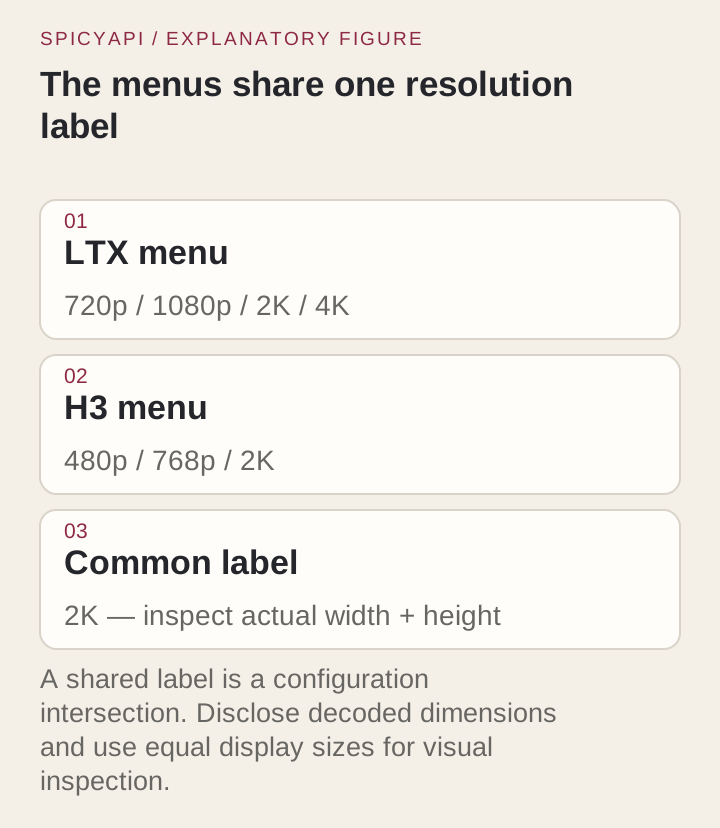
The shared 2k label identifies a configuration intersection. Compare decoded dimensions and view the full files at a consistent display size.
What the existing tests say about NSFW and output quality
Based on our September 2026 tests, both families can generate uncensored adult video:
- LTX 2.5: twenty-four adult-content requests across text and image tasks produced twenty-three content matches and one softened text result. The categories and counts differ; this is not twenty-four tests of the same scene.
- Base MiniMax H3: twelve adult-content requests matched in the archived text, image and reference-task sample. Two additional violence probes are separate from that adult sample.
- Neither sample is a paired contest. Different prompts, dates and repetitions mean their totals cannot establish that H3 is generally more reliable or that LTX is less capable.
The LTX 2.5 review describes mixed visual outcomes, including a good club scene and severe artefacts in some complicated movement. The H3 review documents its own historical content and task findings. Content acceptance matters for an adult workflow, but it does not grade hand geometry, camera control or identity through a scene.
One concrete delivery check is already available: the September capability archive records an LTX 2.5 2k, eleven-second request delivering 2560×1408 pixels, 11.04 seconds and a meaningful audio track. That establishes an actual long, high-resolution audio-video output in that configuration. It does not establish lip-sync accuracy, a fixed render time or a comparison with an H3 clip.
For an adult editorial shot, prepare the character and wardrobe in the opening image, then direct one visible movement. Evaluate both the intended content and the cinematic result. A clip that returns the right content with drifting hands is still unsuitable when hand contact is central to the brief.
A practical shared shot: one cup, one movement, one sound
To compare the two routes on something observable, use a five-second pottery scene: an adult potter turns a blue cup a quarter-turn, taps its rim once and rests both hands beside it. The camera stays still. The visible contact and sound make failures easy to describe.
The storyboard and illustrations show the intended action, rather than results from either model.
Static medium-wide shot in a quiet ceramics studio. An adult potter in an indigo apron stands behind a wooden workbench. One small blue glazed cup with a single handle rests on the bench. The potter brings both hands to the cup, gently turns the cup a quarter-turn with both hands, taps its rim once with one finger, then rests both hands beside it. Keep the cup intact and continuously visible. No cuts or camera movement. Quiet room tone and one light ceramic tap, no dialogue or music.
This prompt gives each instruction a job:
- Subject and setting: define who acts and where, rather than a long style inventory.
- Object: one blue cup with one handle makes duplication or redesign visible.
- Action order: approach, turn, tap, rest gives the scene an ending instead of open-ended motion.
- Camera: a static composition keeps movement easier to judge.
- Sound: one short contact event lets you check timing; it does not test dialogue or singing.
For an opening-frame run, use the same approved file on both routes. Replace the descriptive first sentences with: “Use the supplied image as the character, cup and studio design. Preserve their appearance and composition.” Keep the action, camera and sound instructions. Two separately generated source pictures would introduce an extra difference before either video task begins.
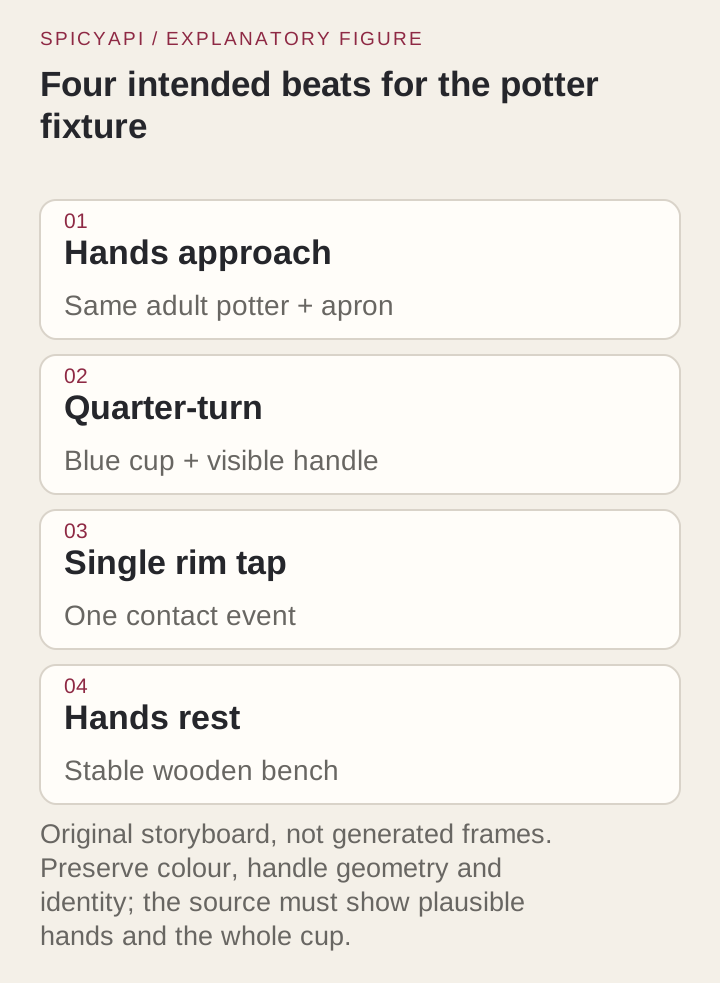
Four beats: hands approach, cup turns, finger taps the rim, then hands rest.
Text-to-video API inputs
Save one of these requests as request.json and submit it with the SDK workflow in the video API guide. The runner reads the chosen model ID and input, quotes without creating by default, and uses a saved task ID for recovery.
{
  "model": "lightricks/ltx-2.5/text-to-video",
  "input": {
    "prompt": "Static medium-wide shot in a quiet ceramics studio. An adult potter in an indigo apron brings both hands to the cup, gently turns one blue handled cup a quarter-turn on a wooden workbench, taps its rim once, then rests both hands beside it. Keep the cup intact and visible. No cuts or camera movement. Quiet room tone and one light ceramic tap, no dialogue or music.",
    "duration_seconds": 5,
    "resolution": "2k",
    "aspect_ratio": "16:9",
    "seed": 42017
  }
}
For the corresponding H3 request, keep the prompt, duration, tier and framing. Remove seed, because the base H3 task does not expose it:
{
  "model": "minimax/h3/text-to-video",
  "input": {
    "prompt": "Static medium-wide shot in a quiet ceramics studio. An adult potter in an indigo apron brings both hands to the cup, gently turns one blue handled cup a quarter-turn on a wooden workbench, taps its rim once, then rests both hands beside it. Keep the cup intact and visible. No cuts or camera movement. Quiet room tone and one light ceramic tap, no dialogue or music.",
    "duration_seconds": 5,
    "resolution": "2k",
    "aspect_ratio": "16:9"
  }
}
For image-to-video, select each family's image task, supply your source as image_url, omit aspect_ratio and retain the movement prompt. Leave the ending image out of the first attempt unless reaching that specific frame is the question. Add the same compatible ending image to both in a separate trial if ending control matters.
When H3 references are the better workflow
Suppose the potter, cup and studio exist as three separate approved images. H3's reference task can combine them into a new shot. Explain their roles explicitly: “Image 1 defines the potter and indigo apron; Image 2 defines the blue cup and handle; Image 3 defines the studio. Compose a medium-wide view of the potter at the workbench, then perform the turn, tap and rest sequence.”
That is useful even without a comparison winner. It avoids asking the model to invent the object from text, and avoids forcing all ingredients into an already-approved first frame. Review whether it actually preserves each role. If a precise starting composition is essential, compose that still first and use opening-frame generation instead.
Judge the result without turning every trial into a laboratory project
Watch the complete clip at its intended speed before inspecting individual frames. A good first frame does not show whether the handle disappears halfway through or whether the action cuts away before the tap.
| What to check | A useful result | A miss worth recording |
|---|---|---|
| Cup and handle | One continuous object with consistent geometry | Extra cup, changing handle, melting rim |
| Hand contact | Hands visibly rotate the cup; finger reaches the rim | Floating fingers, duplicated hand, movement without contact |
| Sequence | Hands approach, turn, one tap, then rest | Actions reversed, repeated taps or no ending |
| Character | Same appearance within the clip; source retained on image input | Face or wardrobe redesign through motion |
| Camera | One fixed view | Unrequested push, cut or angle change |
| Sound | One tap near visible contact, quiet ambience | Extra music, missing tap or obvious timing mismatch |
For text generation, the two models may invent different faces. That alone is not a miss. Judge each invented character's continuity. For image input, compare the returned character with the source as well.
Inspect the actual dimensions, duration and audio stream. The requested five seconds may not equal the encoded duration exactly. Preserve the original before trimming, resizing or replacing sound. If a visual keeper only needs a sound edit, record that as a visual success with an audio repair; do not present the replacement sound as native output.

A potter, blue handleless cup and board with turn-and-tap sketches. The handled cup required by the prompt is shown in the final illustration.
Fix the failure that matters to the brief
Change the instruction linked to the visible problem rather than rewriting the whole prompt after every attempt.
| Problem | Next change | Why |
|---|---|---|
| Cup shape or handle drifts | Improve the source view and simplify the rotation | Defines the object before demanding complex motion |
| Hands pass through the cup | Begin with hands already near the intended contact; reduce the movement | Removes a difficult approach-and-grasp transition |
| Tap comes before the turn | Keep the action order in one short sentence | Makes the intended sequence clearer |
| Several actions crowd five seconds | Test only turn-and-rest, then add the tap | Separates insufficient time from object-control failure |
| Camera changes despite the brief | Use a composed opening image and one continuous-shot instruction | Gives the view a visual anchor |
| Correct visual take, distracting sound | Keep the take and edit its soundtrack if the project permits | Avoids buying a different performance merely to repair audio |
| Wrong identity in reference composition | Clarify the image roles or prepare a combined opening frame | Distinguishes reference selection from first-frame animation |
For adult creative work, include wardrobe and the intended final state in the approved source/brief. If the scene changes intensity beyond what you requested, count that as a fidelity problem rather than an automatic improvement. Acceptance of the content is only one condition for a usable shot.
A small comparison budget you can actually use
Choose the trial around the decision. If an eighteen-second continuous take already selects LTX, do not fund unrelated H3 requests to re-prove the duration limit. If you need H3's reference collection, compare reference arrangements within H3. If the question is shared opening-frame motion, start there rather than paying for both text and image branches.
At five seconds and 2k:
- One opening-frame pair: $0.95 + $0.29 = $1.24.
- One pair for text and one for image: four clips, $2.48.
- Two attempts for each model in each mode: eight clips, $4.96.
These subtotals exclude source-image creation, references, additional revisions and finishing. One pair shows what happened on one shot; it does not measure a stable keeper rate. Repeat only when the first result leaves an important decision unresolved.
For a strict baseline, preserve the same source and prompt and give each model the same number of attempts. If you adapt the wording for a model, keep that branch separate and allow the other the same opportunity. A same-number seed across different models would not align their randomness even if both exposed one; here only LTX does.
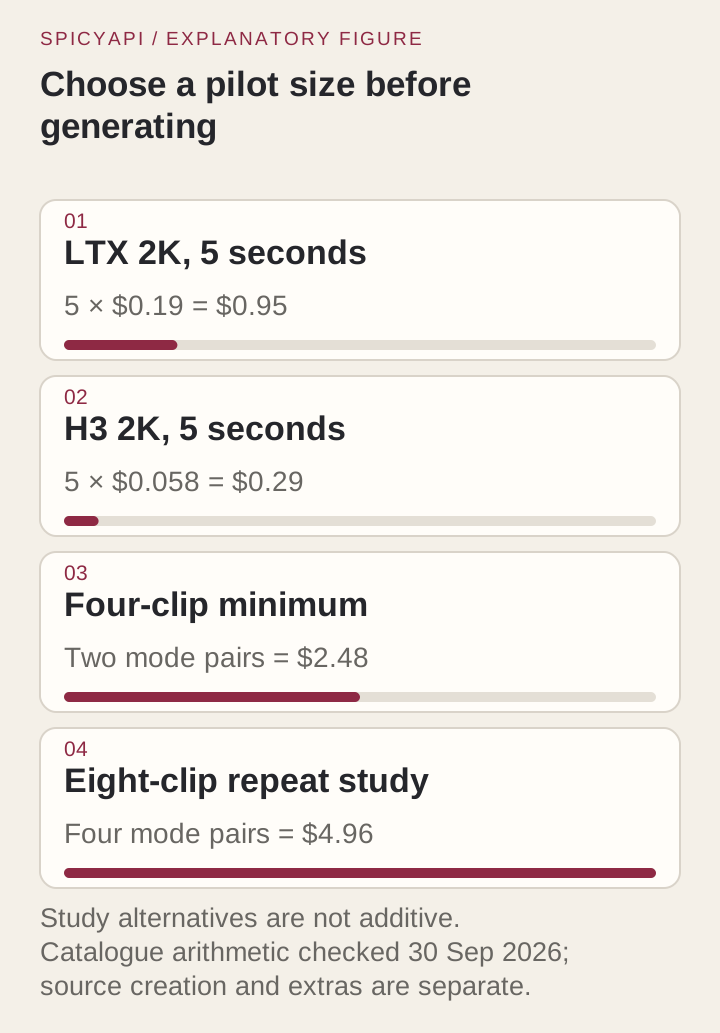
The diagram’s four-clip minimum covers both text and image modes. For one opening-frame comparison, two clips cost $1.24; source preparation is extra, and the alternatives are not additive.
Local deployment, speed claims and use terms
Lightricks' competitive comparison page mixes native capabilities and differently described deployments. A local generation time and a hosted API completion time are not directly comparable. The community discussion of that chart raises precisely that scope problem; its opinions are not a matched SpicyAPI benchmark.
For hosted work, the current 30-day completion snapshot favors H3 for faster iteration:
| Completion metric | LTX 2.5 | MiniMax H3 |
|---|---|---|
| Median | 85 seconds | 34 seconds |
| 90th percentile | 3.7 minutes | 1.7 minutes |
| Wait per output second | 10.5 seconds | 3.8 seconds |
These rolling figures include mixed durations, resolutions and internal test jobs; they are not matched five-second trials. H3 is the more promising starting point when turnaround matters, while the actual request can finish outside these typical times.
Native weights and their licensed use carry separate terms. The H3 community license excludes the US, EU, UK and South Korea from its default territory and expressly addresses hosted services and outputs. The LTX-2.x license has different commercial conditions. Catalog availability does not by itself establish the permissions for a particular deployment or use; consult the applicable service agreement as well as the model terms.
Frequently asked questions
Which is better for NSFW video, LTX 2.5 or MiniMax H3?
Both accepted adult requests in the archived base-task samples. LTX had one softened text result; H3's smaller adult sample matched. Those different samples do not prove a general winner. Use H3 for inexpensive short drafts or multiple image references, and LTX for the longer take or 4K tier; assess the actual content and motion together.
Is MiniMax H3 cheaper at the same output tier?
At the shared 2k label, five seconds quotes $0.29 on H3 versus $0.95 on LTX. Reference inputs add fees, and decoded dimensions should be checked before calling it an identical-pixel comparison. The completed attempts needed for the final shot determine real production cost.
Can H3 make a twenty-second or 4K clip on these tasks?
No. These base hosted H3 tasks stop at fifteen seconds and 2k. LTX 2.5 lists up to twenty seconds and a 4K tier. Combining several H3 clips in an editor is possible, but it produces a sequence rather than a guaranteed uninterrupted twenty-second generation.
Can I use the same starting and ending images on both?
Yes on the two image-to-video tasks. Use the identical files and compatible compositions. Inspect the middle of the returned clips as well as the endpoints: reaching a similar last frame does not prove that hands and objects remained coherent during the transition.
Do both generate sound, and which is faster?
Both generate audio-video. H3 has the shorter hosted median in the comparison above: about half a minute versus nearly a minute and a half for LTX. That favors H3 for quick drafts, but mixed-workload timing does not rank dialogue quality or synchronization.
The decision
For a short scene without a special delivery constraint, H3 is the lower-cost starting candidate. For a long continuous take, listed 4K output or seed-controlled iteration, LTX has the relevant controls. Choose H3 references when separate ingredient images should define a new composition. Choose opening-frame generation on either when the composition is already approved.
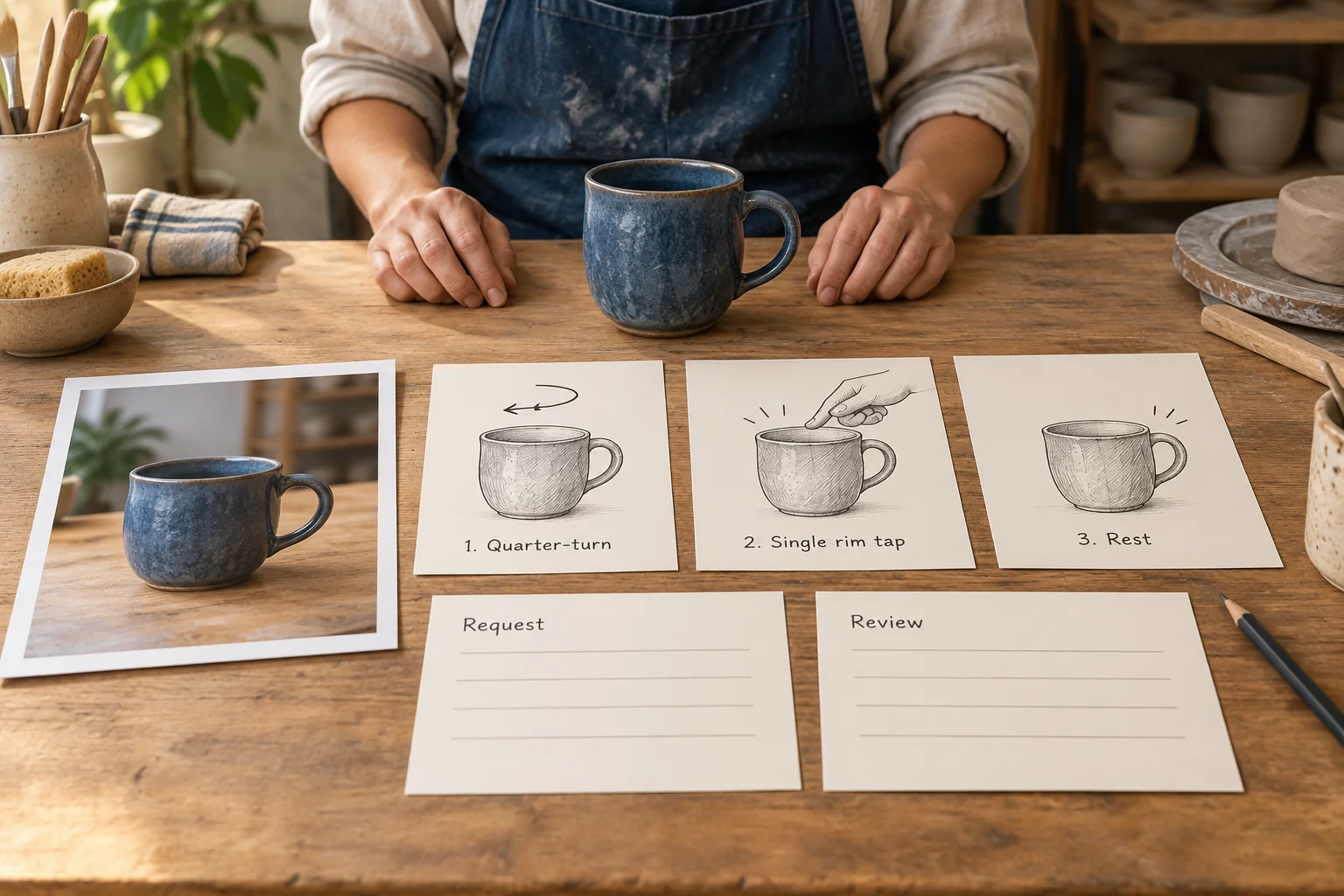
The handled cup and the three actions after the hands approach: quarter-turn, single rim tap and rest.
When both tasks fit, use the $1.24 five-second 2k pair to resolve the actual motion question instead of purchasing a broad benchmark by default. Judge the action, source preservation, sound and charge together, then keep the model that delivers the shot your project needs.