
You may have started with Replicate because a working model was one API call away. Now the product needs an image editor, a reliable asset handoff, a different price unit, or your own checkpoint. Those are different reasons to move, and they lead to different alternatives.
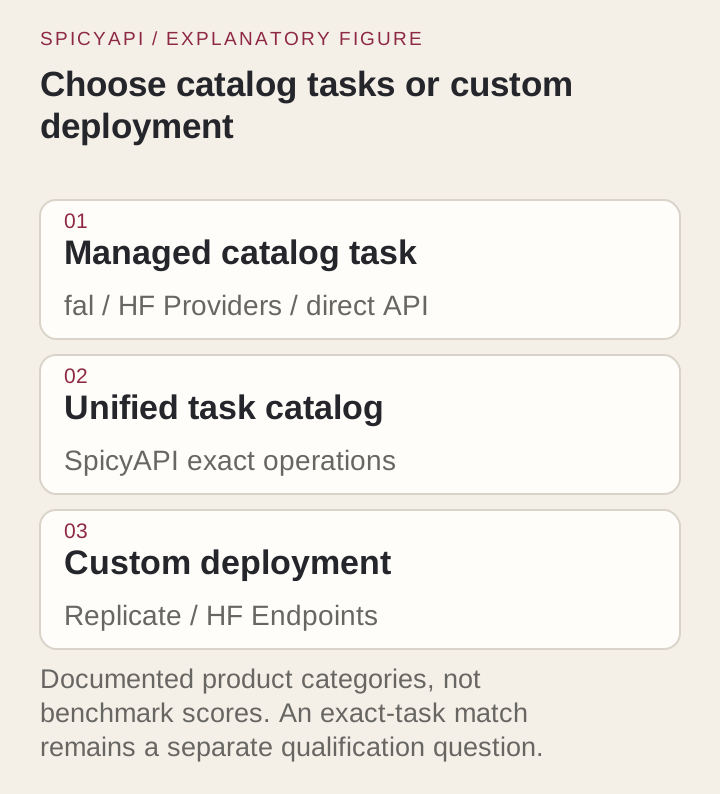
For ready-to-use media models, shortlist fal, Hugging Face Inference Providers, publisher-direct APIs and SpicyAPI. For your own weights or inference pipeline, compare managed deployments or self-hosted workers. Replicate already offers both hosted predictions and custom deployments, so first identify which part you want to replace.
The shortlist: which alternative fits your job?
| What you need | Start with | Why it fits | Main tradeoff |
|---|---|---|---|
| A hosted image, video or audio model | fal | Managed model endpoints with model-specific inputs and pricing | You still need an endpoint that supports your exact operation |
| Open models and a choice of hosted providers | Hugging Face Inference Providers | Access through the Hub and a common client surface | A routed request can use Replicate or fal itself; the interface and the backend are separate choices |
| Native features from one model family | Publisher-direct API | A direct relationship with the model publisher | Separate clients, billing and delivery rules for each publisher |
| Supported uncensored image and video tasks | SpicyAPI | Model pages expose the operation, creative controls and customer price | A catalog API does not deploy an arbitrary private checkpoint |
| Your own checkpoint, runtime or private service | Replicate deployments or Hugging Face Inference Endpoints | Deployment and capacity controls | Packaging, scaling choices and idle capacity affect the bill |
| Your own serving stack | Runpod custom workers or a self-hosted GPU | Control over weights and inference implementation | You own the worker, queue, updates and recovery |
Runpod workers are one option for running your own handler: active workers stay ready, while flex workers can scale to zero and start again when a job arrives. They supply the execution infrastructure; you supply the model handler and its supported operations.
A product-photo application may need three operations: edit an uploaded bottle, remove its background, and animate the approved result. A broad model catalog is useful only if it supplies those operations. Conversely, a research team needing a private checkpoint gains little from a cheaper image endpoint that cannot load its weights.
Replicate pricing is not always GPU-time pricing
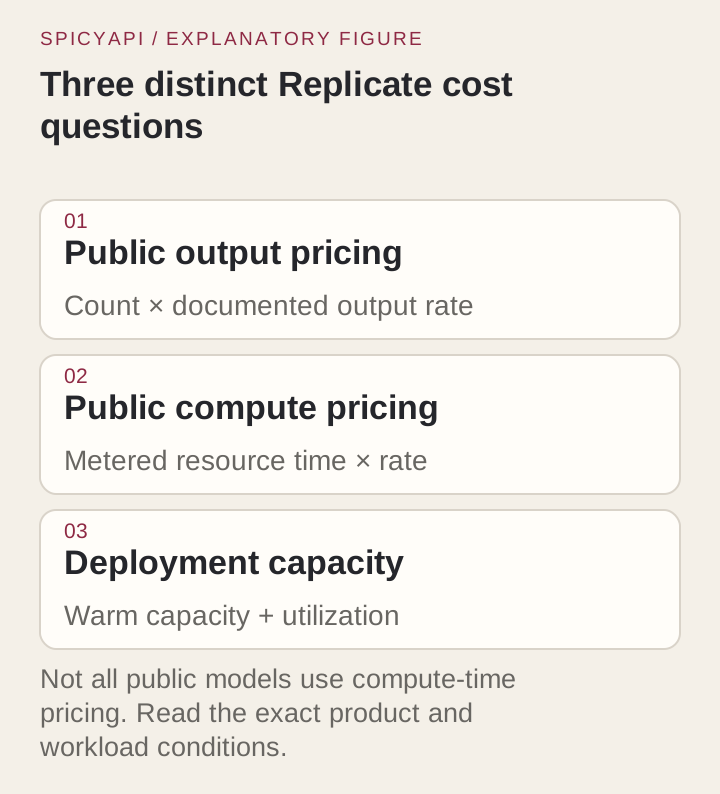
Replicate supports two billing families. Some models charge for compute time; others charge by inputs or outputs. The billing documentation also distinguishes public models from private models and deployments:
- Output-priced models: budget from the image, video or other published unit and its conditions.
- Public compute-priced models: active processing time determines the charge; setup and idle time are not billed.
- Private models and deployments: setup, active time and idle time can all be charged. Keeping a worker warm buys capacity even when it is waiting.
This matters if the reason for leaving is unpredictable cost. Moving from a compute-priced community model to an output-priced official model on Replicate may solve that problem without changing platforms. If the reason is a missing edit control, changing the billing mode will not solve it.
fal: a strong candidate for managed media endpoints
fal belongs on the shortlist when you want a ready-to-call media model rather than to operate its GPU. Compare the chosen endpoint's input surface with your application: a text-to-image model, an image editor and an image-to-video model are separate operations, even when they share a family name.
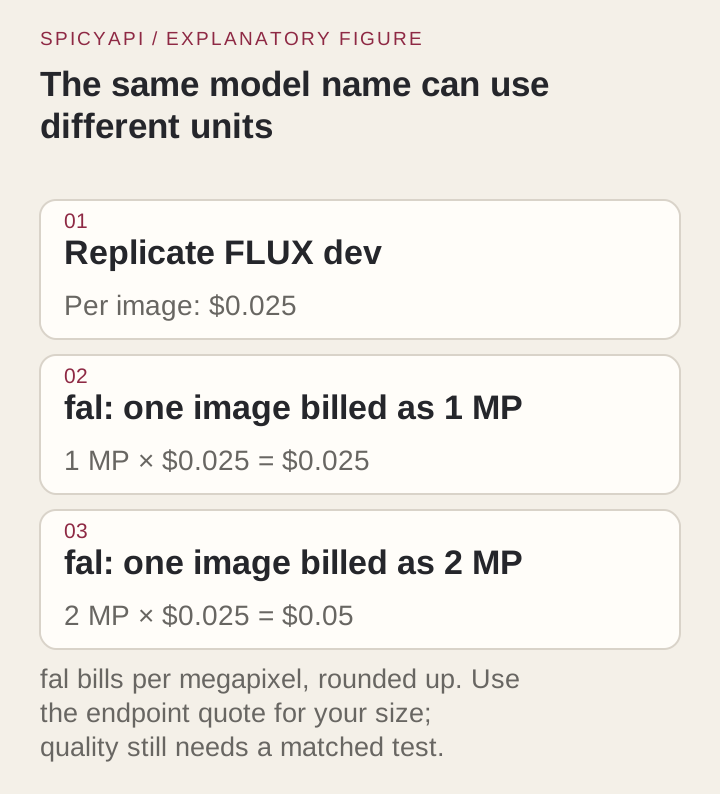
Its FLUX.1 dev endpoint illustrates why the billing unit deserves attention. fal's FLUX.1 dev page lists $0.025 per megapixel, rounded up to the next whole megapixel. That is different from a flat per-image price.
- Choose it when: the managed endpoint has the model and controls you need, and its published unit fits the way you generate.
- Look elsewhere when: your required workflow depends on a private checkpoint or custom inference graph that the chosen endpoint cannot run.
For an existing application, the migration is more than a renamed request field. Preserve the distinction between a generated asset and a downloadable, retained file. Your backend should finish the asset-ingestion step before telling the customer their image or video is safely stored.
Hugging Face: choose between provider routing and a deployment
Hugging Face has two relevant products. Inference Providers routes supported model calls to participating providers. Inference Endpoints provides a dedicated deployment. Choose between them according to whether you need a hosted model or your own running service.
Provider routing can make an open-model workflow easier to explore. However, Replicate is itself a Hugging Face provider, and fal is another. Calling through a Hugging Face client does not necessarily move execution away from Replicate. Choose the backend as well as the model if the migration is meant to change the serving provider.
For routed calls, Hugging Face's pricing guidance distinguishes billing through Hugging Face from using your own provider key. The latter keeps billing with that provider. A small free credit can help you explore; it is not a production budget.
For a custom checkpoint, dedicated endpoint economics include hardware and billed running time. Inference Endpoints pricing uses hourly rates billed by the minute while endpoints initialize or run.
- Choose Providers when: you want supported open models through a shared client and can select an appropriate backend.
- Choose Endpoints when: you need a deployment of a particular model rather than a fixed catalog task.
Publisher-direct APIs: useful when one family drives the product
A publisher-direct API is worth considering when a native feature matters more than catalog breadth. Examples include reference-image handling, model-specific editing or a release available only through the publisher's own service.
A product built around one family can justify that separate integration. A product combining stills, video, cutouts and speech may accumulate several clients, accounts and billing paths. The practical cost is then maintaining those integrations alongside the model calls.
Choose direct access for a concrete native capability. Choose a catalog provider when the supplied task coverage and one application integration are more useful.
SpicyAPI: supported media tasks, including uncensored workflows
SpicyAPI suits applications that need supported image and video operations with a published task price. Begin with the image API catalog or video API catalog, then select the mode that matches your starting material.
For example, an uploaded product image needs an editor, while an approved still needs an image-to-video task. Background Remover supplies a one-image cutout operation. Wan 2.2 Spicy image-to-video supplies five- or eight-second clips with an optional ending image. Five seconds costs $0.095 at 480p or $0.19 at 720p. Background removal costs $0.0048 per image. Those are concrete catalog operations; they are not arbitrary private-model hosting. To try one, open its model page and use the Playground tab, then press Run model.
SpicyAPI’s FLUX.1 dev LoRA task costs $0.018 per image. A FLUX.1 dev LoRA task is not automatically an identical replacement for a plain FLUX.1 dev request. An adapter-enabled task may be the right choice for a style, but compatibility and its input fields come with that specific route.
- Choose SpicyAPI when: its supported tasks cover the product's image, edit or video workflow, including the uncensored models you need.
- Keep a deployment provider when: your application needs its own weights, custom code or hardware configuration.
Worked example: FLUX.1 dev, image pricing and megapixel pricing
The Replicate pricing page lists FLUX dev at $0.025 per image. fal lists FLUX.1 dev at $0.025 per megapixel, rounding up. Under those published units:
| Requested output | Replicate per-image arithmetic | fal megapixel arithmetic | What changes the bill |
|---|---|---|---|
| One image billed as 1 MP | $0.025 | 1 MP × $0.025 = $0.025 | The units happen to align |
| One image billed as 2 MP | $0.025 | 2 MP × $0.025 = $0.050 | A larger billed size |
Use the endpoint’s billed megapixel quantity rather than assuming that a 1024-square image rounds to two units. A smaller frame is not necessarily a saving if your delivery needs the larger one, and a larger frame is not necessarily useful if you will crop most of it away.
For a video workload, replace pixels with the relevant purchased unit. Finished-video seconds and GPU processing seconds are different quantities. A five-second delivered clip may require substantially longer compute time, so comparing two dollar-per-second labels can be misleading.
When keeping Replicate is the better decision
Keeping Replicate is sensible when its deployment controls solve a requirement the alternative would remove. A private checkpoint, a pinned model implementation or a warm service may be more important than a lower advertised image price.
Before migrating, separate three cases:
- The model misses the brief. Consider a different model or version; changing only the host may preserve the same weakness.
- The service contract is awkward. A different task API, billing unit or retention rule can solve the application problem.
- The application loses successful outputs. Fix asset ingestion; switching providers does not repair an unsaved file.
Migrate the asset contract, not just the request URL
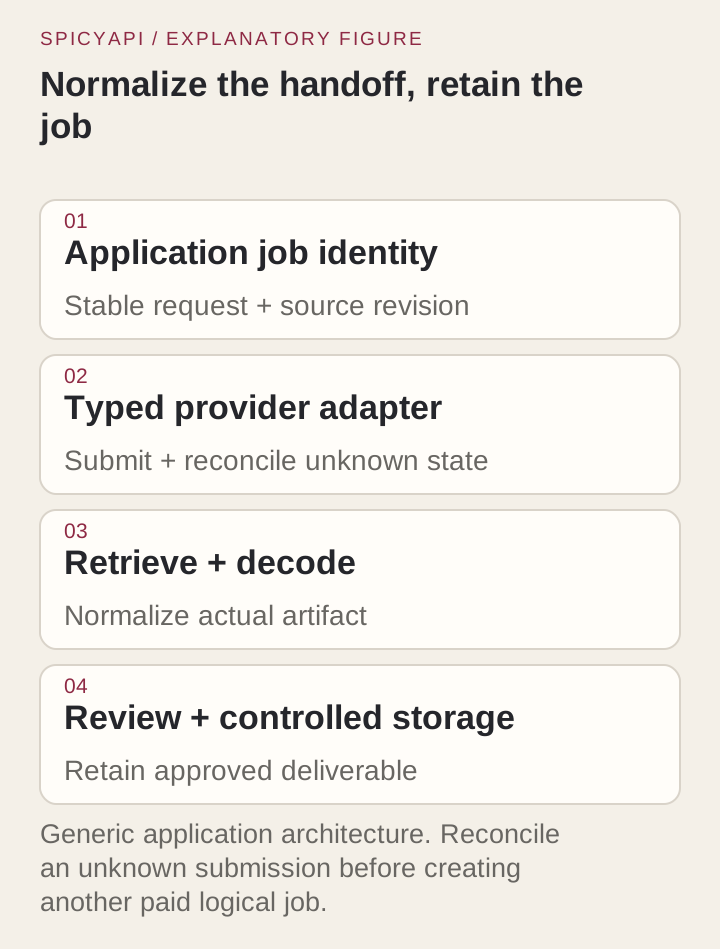
Replicate's data-retention documentation makes the distinction concrete: predictions created through its API lose their inputs, outputs, files and logs after one hour by default, while web-created predictions are retained indefinitely. A customer-facing library should therefore download API results promptly into storage the application controls.
A useful migration record contains:
- Creative input: prompt, reference files and their roles, requested dimensions and model version.
- Task identity: your application's job ID and the provider's task ID.
- Delivered asset: image or video file, dimensions or duration, format and storage location.
- Recovery state: whether submission, generation and download completed.
Retain accepted files in permanent storage independently of the provider client. If the new route fails, the customer should still have yesterday's assets and the application should still know which jobs are complete.
A small migration trial with a clear decision
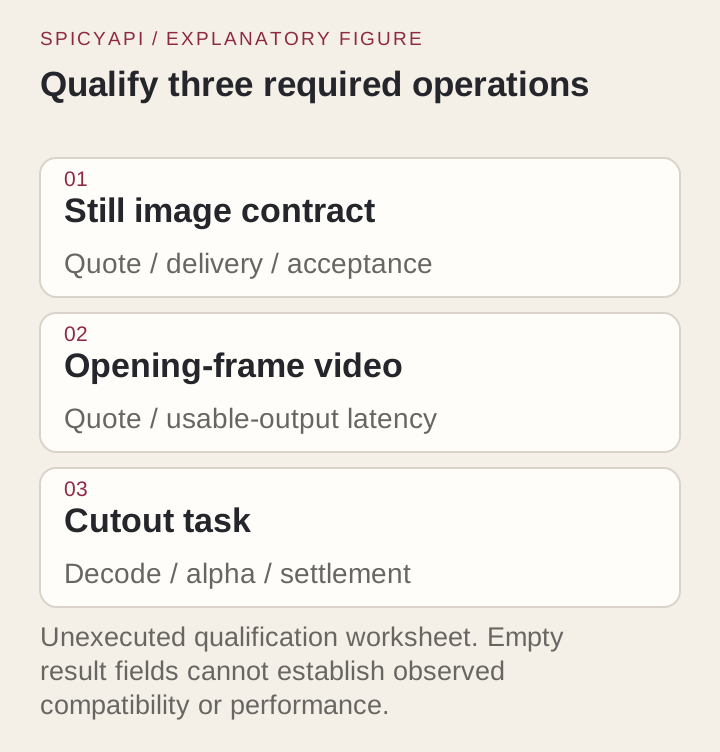
For a product-photo app, compare three operations: an edit that preserves the bottle label, a video that animates the approved opening frame, and a cutout with clean transparent edges. Count the attempts and finishing work needed for each accepted file; a lower quote can lose its advantage after reruns.
Roll out one operation at a time. Keep the existing provider available until the new path can submit, retrieve and store an asset. If a response is lost after submission, reconcile the existing task before creating another paid job.
Frequently asked questions
Is Replicate free?
Replicate offers limited trial access to selected models before billing is required. For ongoing production use, budget from the exact model's published unit. Free credits from an alternative can cover exploration, but they should not drive a long-term provider choice.
What is a good alternative to Replicate for images and video?
fal is a candidate for managed media endpoints; Hugging Face Inference Providers offers supported models with provider routing; SpicyAPI offers supported image and video tasks, including uncensored workflows. Choose the route that has the input operation and delivery controls you need. Use a deployment service for custom weights.
Is Hugging Face an independent alternative to Replicate?
It can be, depending on the backend. Hugging Face also routes to Replicate, so changing the client alone may leave the serving provider unchanged. A dedicated Hugging Face Inference Endpoint is a different deployment product.
Is a per-image price easier to budget than GPU time?
Usually, for a stable output configuration. But dimensions, quality settings or multiple passes can change the quantity you buy. GPU-time pricing is more useful when you also know charged runtime and utilization. Compare the full job, not the unit label alone.
The decision
For a standard media feature, shortlist the managed APIs that support its actual inputs and outputs, then compare the complete job price. For private weights or custom inference, shortlist deployment options. Keep Replicate when it already provides the control you need; move when a specific alternative removes a specific limitation without losing a required capability.