MiniMax H3 Max is not a reliable “uncensored upgrade” to MiniMax H3. For higher-intensity NSFW work, the available tests favor choosing H3 rather than assuming Max will accept the same scene. Based on our September 2026 tests, H3 Max image-to-video refused all three L4 requests. Its text-to-video task refused two L4 requests and softened the third.
That does not mean Max rejects every adult-oriented shot. It delivered all three L1 suggestive and all three L2 moderate-NSFW requests on each task. The break comes when the intended content goes further—and the break is different depending on whether you provide an opening image or start from text.
If you make fictional adult-character videos, the practical decision is straightforward: Max is a candidate for an adult-themed teaser; it is a poor default when preserving a higher-intensity scene is the main requirement. Its name and general video quality do not answer that content question.
The Max NSFW results, separated by input
The checks used five-second clips at 480p, with three independent requests per category on each task. The text-to-video checks used 16:9.
Here is the adult-content portion of that round. The original L1–L5 identifiers are retained, with neutral descriptions of their scope.
| Category | H3 Max image-to-video: matched / softened / refused | H3 Max text-to-video: matched / softened / refused |
|---|---|---|
| L1: suggestive | 3 / 0 / 0 | 3 / 0 / 0 |
| L2: moderate NSFW | 3 / 0 / 0 | 3 / 0 / 0 |
| L3: advanced NSFW imagery | 3 / 0 / 0 | 0 / 1 / 2 |
| L4: higher-intensity adult scenes | 0 / 0 / 3 | 0 / 1 / 2 |
| L5: the tested high-intensity adult subcategory | 0 / 3 / 0 | 1 / 1 / 1 |
Full H3 Max results. Violence probes rendered on both tasks and do not answer the adult-content question.
For an existing adult image, the L3 row is the useful positive result: all three image-to-video requests retained that tested content. But the L4 row is the stopping point in this round: adding an opening image did not get any of those three requests through. For text-only creation, none of the three L3 requests matched, and none of the three L4 requests matched.
The older MiniMax H3 content test article reported 14 matching H3 clips in its tests: 12 adult-oriented requests and two separate violence probes, spanning different tasks and categories. H3 has adult-content matches in categories where Max recorded refusals.
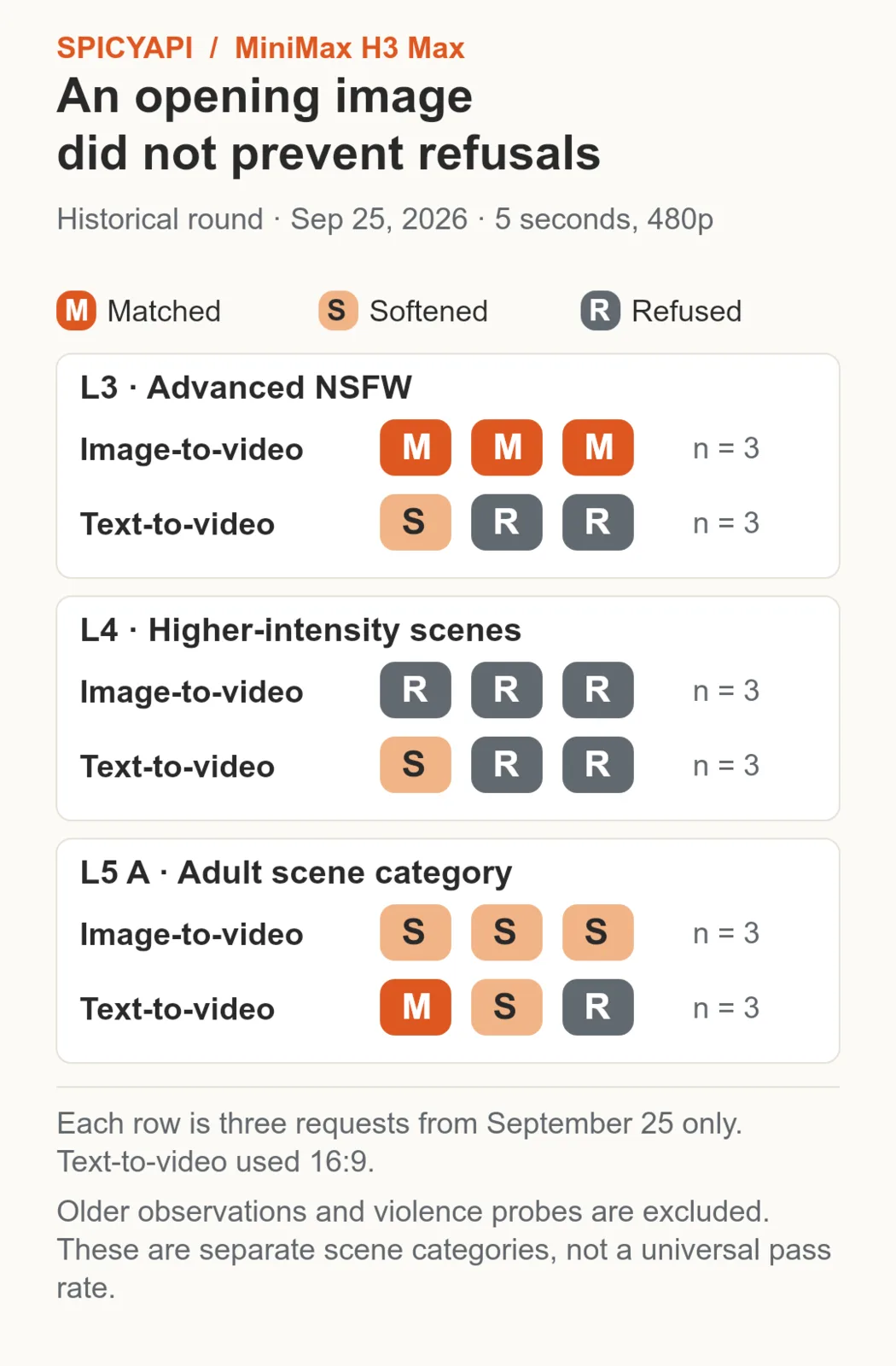
The matched subset shows why an image is not a blanket solution: Max matched all three L3 image-to-video requests, refused all three L4 requests, and softened all three L5 A requests. Older observations and violence probes are excluded.
Why “H3 is uncensored” does not settle the Max question
H3 and H3 Max are separate variants with separate tasks. A successful scene made on H3, a local H3 setup or an H3 LoRA workflow does not establish what H3 Max will return.
There is also a difference between the base model and the complete application around it. MiniMax's H3 model card describes a hosted context-processing component that interprets inputs and performs automated content checks. That component is not part of the released base-weight package. This explains why a statement about a local H3 run should not be transferred wholesale to an online product.
The current SpicyAPI task labels reflect that distinction: Softened for H3 Max image-to-video, Filtered for H3 Max text-to-video. They are not both unrestricted. SpicyAPI does not add its own content filter; the labels describe the observed content handling associated with the tasks.
What an opening image helps with—and what it does not
An opening image gives the model a character, outfit, pose and composition to continue. That is useful for an adult series because you can approve the still before buying motion. With text-to-video, those choices have to be created from the description and can change from one take to the next.
The test table shows a concrete content difference too: Max image-to-video matched all three L3 requests, while text-to-video matched none. That makes the image task the more relevant candidate when you already own an adult character still at a content level covered by the successful image tests.
It is not evidence that an image can make any request acceptable. Max refused every L4 image request in this round. An accepted upload and an output that preserves the requested scene are separate things.
Consider a fictional adult woman in her thirties, fully dressed in an opaque black evening outfit, seated by a window. You want a five-second preview for an NSFW character profile: a small head turn, a relaxed glance toward the viewer and soft room sound. The public version of this example is an adult-themed teaser rather than a demonstration of the stronger test categories.
Prepare a still with a recognizable face, clear hands and one consistent outfit. Crop it for your delivery format before uploading; the image-to-video task follows the opening image's shape and has no separate aspect-ratio control. Do not start with a close face crop if the desired action depends on hands resting on a chair.
Example teaser prompt:
The fictional adult woman in the supplied image turns her head slightly from the window toward the viewer, pauses and holds a relaxed smile. Her hands stay on the chair arms and her black evening outfit stays unchanged. One continuous medium shot with the camera in place. Soft rain against the window and quiet room ambience, no spoken dialogue.
The request is specific enough to judge: did the turn happen, did the face stay recognizable, did the outfit stay intact and did the sound suit the clip? It also makes the source's role clear. Describing a different outfit in the motion prompt would give the model two conflicting appearances to resolve.
Try it in the H3 Max image-to-video Playground:
- Add your still under Input image.
- Paste the teaser prompt into Prompt.
- Set Duration to 5 and Resolution to 480p for the first preview.
- Leave Prompt expansion off to keep your written brief unchanged. It is a control over prompt elaboration, not an adult-content permission or a refusal fix.
- Check the estimate shown before you submit, then press Run model and play the result in Output.
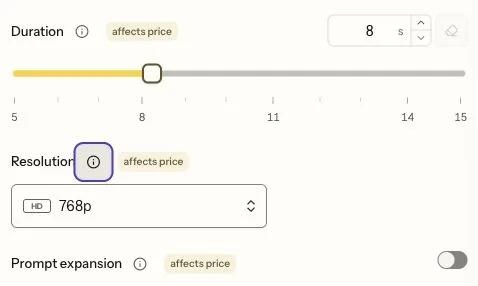
The default setup is eight seconds at 768p; shorten it before submitting a trial.
Read the failure before spending on another take
A refusal, a softened scene and an ordinary video defect require different next actions.
A content refusal: the requested file was not delivered. A model capable of attractive SFW footage can still refuse the particular adult category you need. If the requirement is essential and already falls in Max's documented weak area, choose an appropriate adult-oriented task rather than repeatedly disguising the same request.
A softened output: the file is there, but it depicts a different or less intense scene. This was the outcome for one of the three L3 text requests and one of the three L4 text requests. A softened clip is a completed task and is billed. If the substituted scene defeats the purpose of the clip, it is not a keeper, however smooth the camera looks.
An ordinary motion or appearance defect: the content is appropriate for the request, but the face shifts, a hand warps or the action stops early. Here a creative repair is relevant. Simplify a head turn to a small glance, make the hand placement clearer in the input, or remove an unnecessary camera move. Those changes address a visible generation problem; they are not established remedies for content refusal.
For the window example, if the woman smiles but never turns, replace vague mood words with the turn and pause. If she turns and the face changes halfway, use a smaller angle or a more readable starting pose. If the outfit changes while the camera moves, remove any redesign language and try a fixed shot. Each repair targets one defect you can actually see.
Do not add a closing image merely to solve a refusal. Max image-to-video has an optional Closing frame (last_image_url), which constrains the ending composition. It does not bind every intermediate frame or establish a different NSFW allowance. When used for creative continuity, the two stills should agree on character, outfit and lighting.
Max versus H3: what a five-second clip costs
The current public rates are the same for Max text-to-video and image-to-video. The table assumes prompt expansion is off. Turning it on adds a flat $0.1334 per request: the five-second 480p Max trial then quotes at $0.3834 rather than $0.25. Expansion develops the shot description; it does not broaden the tested adult-content range.
| Task family and resolution | Per generated second | One 5-second clip | Three 5-second candidates |
|---|---|---|---|
| H3 Max, 480p | $0.050 | $0.250 | $0.750 |
| H3 Max, 768p | $0.080 | $0.400 | $1.200 |
| H3, 768p | $0.037 | $0.185 | $0.555 |
At 768p, Max’s $0.40 five-second clip is about 2.16 times the H3 price of $0.185. Paying more does not mean you get a wider adult-content range.
For 20 character previews with three five-second candidates per character at 768p, the listed generation allowance is $24 for Max or $11.10 for H3, with prompt expansion off. That is the price of 60 generated candidates, not a promise of 20 accepted or usable results. Source-image creation, editing and other tools are outside the calculation. A refused request normally releases the balance hold; Max has no disclosed refusal-charge exception.
Max accepts 5–15 whole seconds and defaults to eight seconds at 768p. Leaving those defaults unchanged lists at $0.64 before any prompt-expansion charge, rather than the $0.25 five-second 480p trial above. Select the duration and resolution deliberately.
On SpicyAPI, Max currently offers 480p and 768p. It has no 2k tier and no reference-image video task. H3 has a 2k tier and a separate reference-image video task, but those are additional creative capabilities—not proof that every adult scene will work on them.
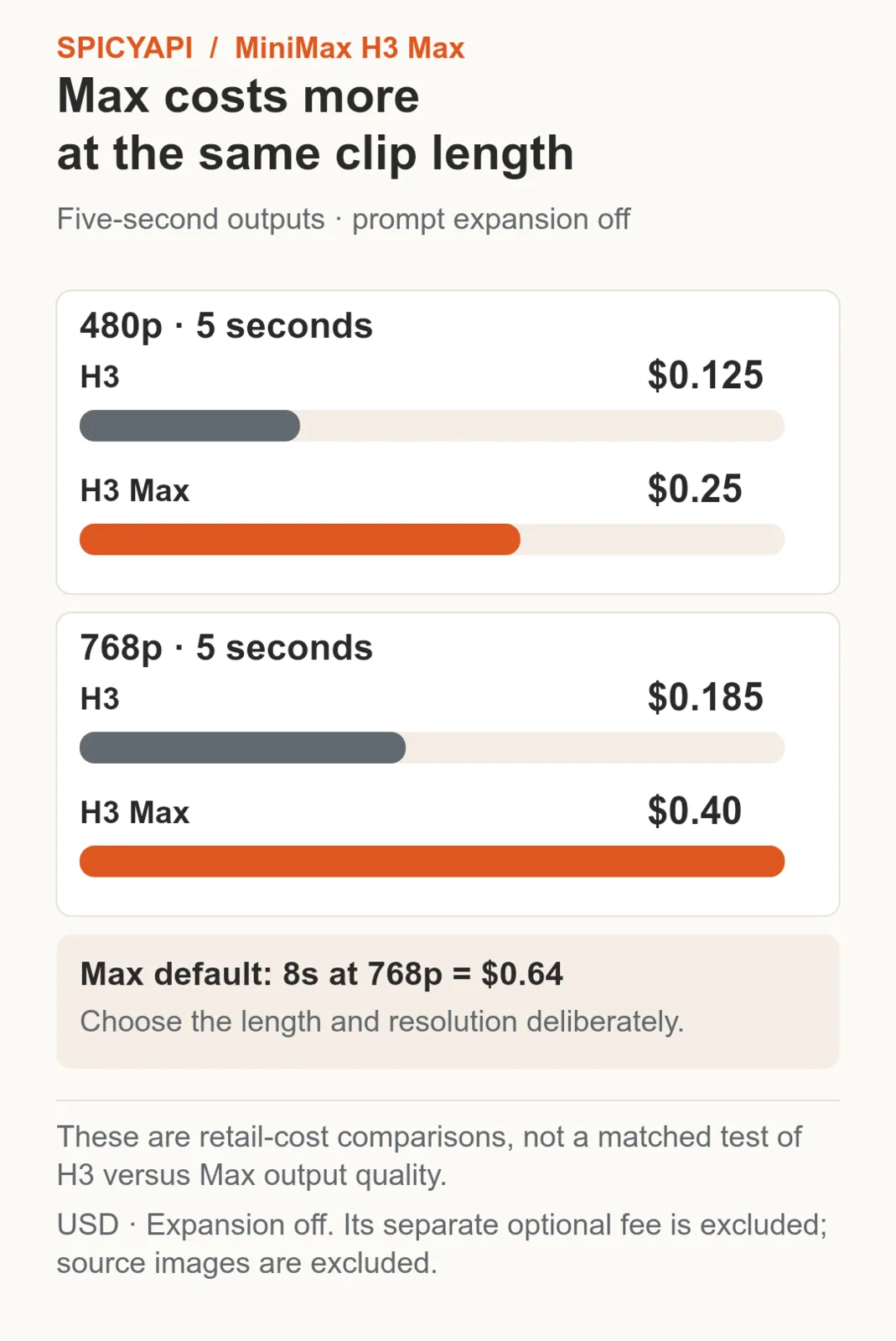
At five seconds, H3 Max costs $0.25 versus H3’s $0.125 at 480p, and $0.40 versus $0.185 at 768p. The H3 480p figure is from a tier no longer offered since 9 October 2026.
Which one should you use for NSFW?
For a covering-outfit, adult-themed preview, Max remains worth considering if its creative behavior suits the shot. Open H3 Max image-to-video when you already have the approved character still. If you are starting from an idea rather than an image, H3 Max text-to-video is the separate option, with a narrower observed adult-content range.
For advanced NSFW imagery from an existing still, Max image-to-video has positive L3 observations, while Max text-to-video does not in these tests.
For higher-intensity adult scenes, begin with MiniMax H3 image-to-video if you have a still, or MiniMax H3 text-to-video if you do not. H3's L4 matches came from text-to-video; its image task delivered L3 advanced NSFW and L5 (the tested high-intensity subcategory) requests. Its prices are lower, but choose the input route for your scene rather than treating those outcomes as interchangeable.
All depicted people must be adults. Use original fictional characters or appropriately authorized likenesses, and material you have the right to upload. An adult-content label does not grant rights to another person's image.
Questions readers ask before choosing Max
Is MiniMax H3 Max completely uncensored?
No. Its image-to-video task has a softened label and its text-to-video task a filtered label. The recorded Max tests include both changed scenes and refusals. A claim about unrestricted H3 output does not automatically apply to Max.
Can Max still make adult-themed videos?
Yes. In these tests, each task matched all three L1 and all three L2 requests. Use Max for that lighter range.
Does uploading an image prevent NSFW refusals?
No. It helped preserve the tested L3 content, but every L4 image-to-video request was refused in that round. The opening image fixes the starting appearance; it is not a universal acceptance switch.
How long can a Max video be?
The current SpicyAPI tasks accept 5–15 whole seconds. They default to eight seconds at 768p. The longer request buys more generated duration, without a stronger promise about content or consistency.
Choose Max for a shot it has reason to deliver, not because “Max” sounds more permissive. When higher-intensity NSFW content is the non-negotiable part of the brief, H3 is the better-supported starting choice from the evidence available here.