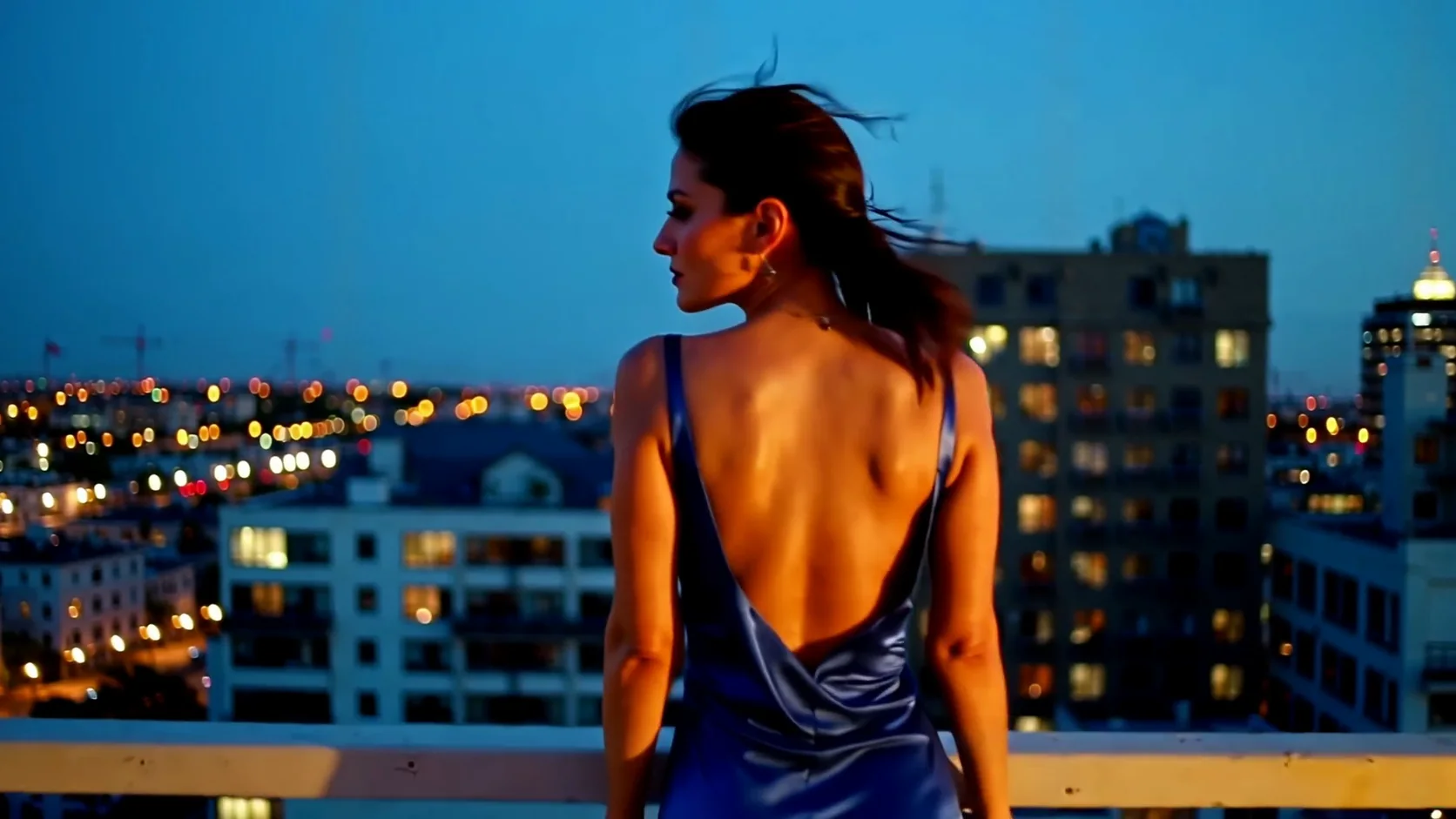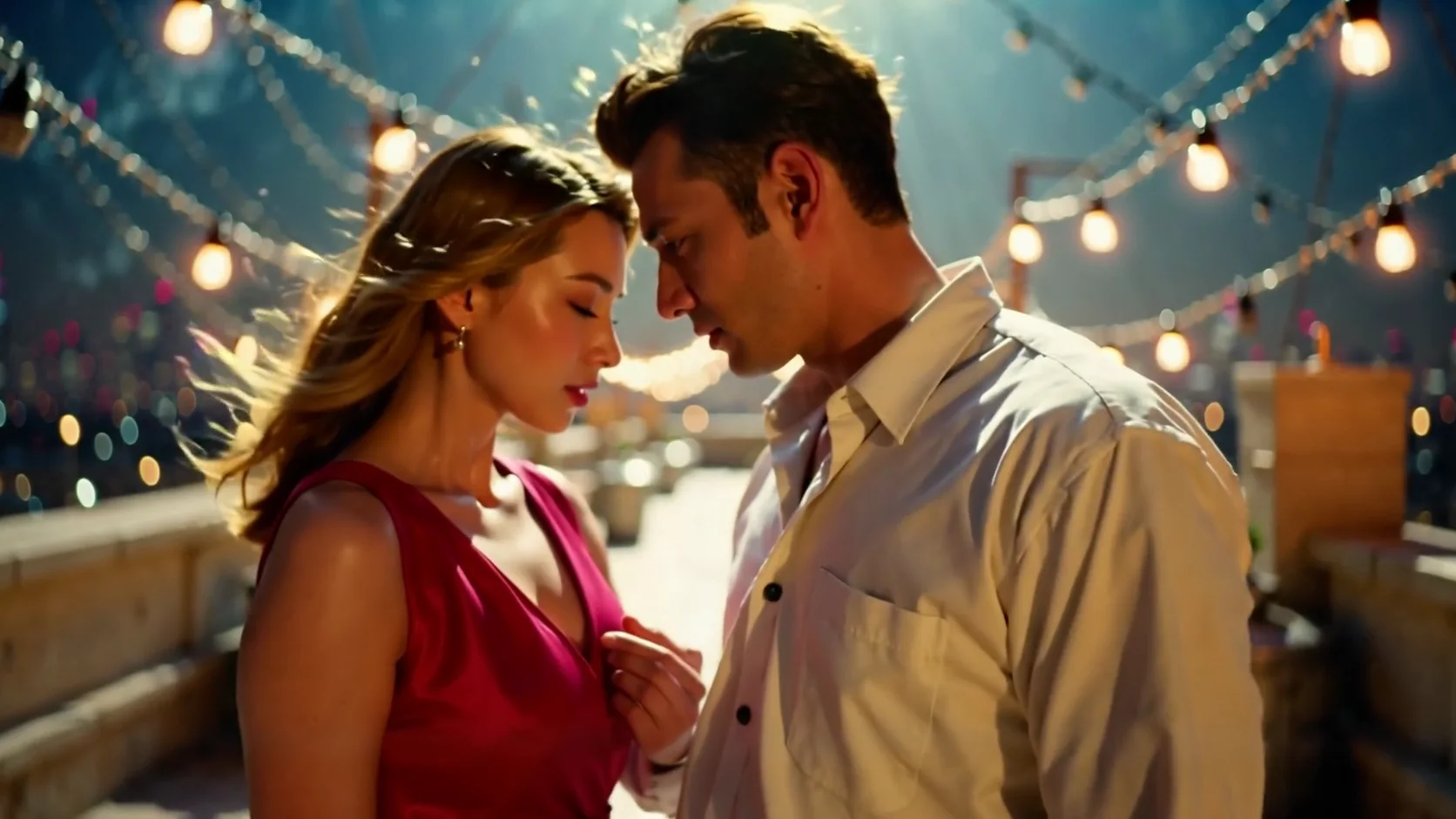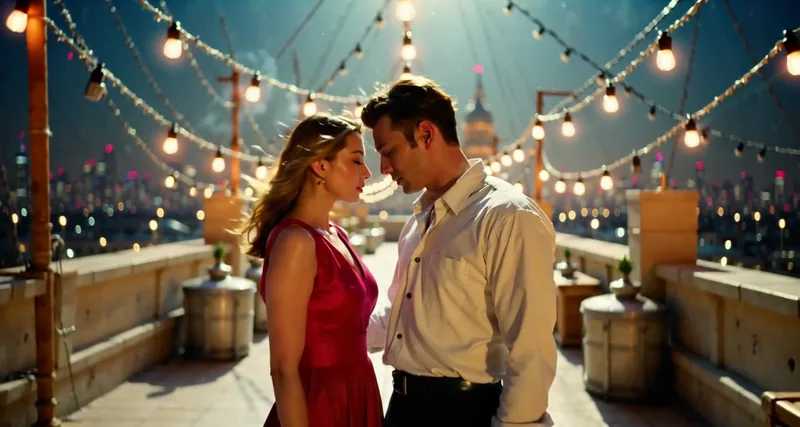
You want a short adult-themed clip that already sounds like something: rain on the window, a crowd behind the couple, a line said softly to the camera. Plenty of uncensored video models still hand you a silent file and leave the sound to a second tool.
LTX-2 19B makes the picture and a stereo soundtrack in one request, with no content filter, from $0.0144 per second of video. All 55 clips we generated on 5 and 6 October 2026 carried an AAC stereo track at 24 kHz that ran the full length of the picture, and the sound moved with the action: when a propeller started turning halfway through a clip, the track stayed near silence until then. What you do not get is consistency. Loudness swung by more than 30 LU between seeds of one prompt, and 5 of our 15 controlled clips came back with invented captions burned into the frame.
We cannot listen the way you can, so every audio claim here is measured: loudness over time, stereo width, length. We did not score how good a voice or a melody sounds. The embedded clips play with sound, so you can judge that part. The models are on the LTX-2 19B family page and the LTX-2 19B LoRA family page; every prompt printed here is a scene with clothed adults.
At a glance
| LTX-2 19B with its own soundtrack | |
|---|---|
| Endpoints | Text-to-video and image-to-video; the LoRA build adds up to three LoRA files |
| Sound | Stereo AAC at 24 kHz on every clip, no switch to turn it off |
| Length | 5 to 20 whole seconds; in 55 clips, sound and picture lengths matched to within 0.0004 s |
| Resolution | 480p (832 x 448), 720p (1280 x 704), 1080p (1920 x 1024); 9:16 swaps the sides; image-to-video follows the photo |
| Price, live catalogue | $0.0144, $0.0192 or $0.0288 per second; LoRA build $0.018, $0.024 or $0.036; sound included |
| Steering the sound | A closing sentence that starts with "Audio:" |
| Loudness we measured | −42.1 to −8.3 LUFS, median −13.2; no clip peaked above −1.6 dBTP |
| What goes wrong | Loudness swings between seeds, invented captions, timed cues that arrive late or never |
| Content | No content filter; text-to-video delivered 4 of 7 ladder probes, image-to-video 2 of 7, none refused |
How the soundtrack is made
Lightricks describes LTX-2 as one model that generates synchronised video and audio. In practice:
- One request, one file. No separate audio job and no syncing step. A five-second 720p clip costs $0.096 with its sound.
- The input is text or a photo, never audio. You cannot give it a voice file to match.
- The sound cannot be switched off. For a silent clip, turn the clip's audio down in the Studio video editor or strip the track after download.
The publisher also warns that prompt following depends heavily on how you write, and that audio without speech may come out at lower quality.
Write the Audio line
The model reads picture and sound from the same prompt. What worked for us follows the publisher's LTX-2 prompting guide (four to eight sentences in one paragraph) and ends with one sentence that starts with "Audio:" and names each sound by its source. A published example, a ferry docking at night:

LTX-2 19B, text-to-video, 16:9, 720p, 6 seconds, seed 510512. Its soundtrack stayed between −12.7 and −10.5 dBFS in every half second.
The car deck of a night ferry as it docks. Sodium-vapour lamps turn everything orange and rows of parked cars glint. An adult Black woman in her early thirties in a long camel coat worn open over a fitted black bodysuit leans on the bonnet of a vintage car, her hair whipped by wind from the opening bow. The huge steel ramp lowers with a groan and slams onto the quay, showing the harbour lights beyond; she pushes off the car and walks toward the light, glancing back at the camera. Low-angle wide shot, slow dolly forward, sodium orange against black water, anamorphic flares. Audio: the deep thrum of the engines, chains rattling, the ramp groaning down and landing with a heavy metallic boom that echoes through the hold, then the ship horn.Five habits, from the publisher's guide and our runs:
- Name the thing that makes the sound. "Chains rattling" points at something in the frame; "atmospheric audio" names no source at all.
- List sounds in the order they happen. The night-train example on the model page goes wheels, wind, a crossing bell that rises and fades, then a horn far ahead.
- Let the outfit and the looks carry the mood, and the sound carry the room. A slipping strap, a slow smile, rain on the glass and a saxophone on a record are enough for a suggestive scene.
- Say a short line instead of describing noises. Put the words in quotes and say how ("says softly"). A community thread on LTX-2 reported that vocal-noise cues came out as odd laughter; we did not test those, and a short line is more predictable.
- On image-to-video, give sound to what is in the photo. The photo fixes the person and the place; describe what happens next and what it sounds like. A prompt describing a different room can make the clip cut away from your photo.
| Cue type | Wording we used | What the measurements showed |
|---|---|---|
| A steady bed | "the deep thrum of the engines, chains rattling" | Steady level for the whole clip |
| One event in the shot | "the engine coughing and catching into a roar" | Near silence, then the roar once the propeller spins (2 of 2 seeds) |
| Music starting on cue | "near silence at first … then … a slow, smoky saxophone ballad starts" | One seed jumped at 5.0 s of 6; the other never changed |
| A spoken line in quotes | says softly, "Stay. The rain isn't stopping tonight." | Two loud bursts, near silence between |
| A crowd with music | "a string quartet playing a slow waltz, the murmur of a crowd" | Steady level; one of two seeds burned in captions |
| Faint, distant sounds | "a faint dance band drifting from a villa along the coast" | Same line, four seeds: −10.9 to −42.1 LUFS |
What 55 soundtracks showed
We measured 40 clips from the 5 October example runs (both endpoints, base model and LoRA build) and 15 controlled clips we ran on 6 October with base text-to-video. Format and length came from ffprobe, integrated loudness and true peak from the EBU R128 meter in ffmpeg, the curves below from the level of each 0.1-second slice, and stereo width from comparing the two channels.
The sound is always there, as long as the picture
All 55 clips had a stereo AAC track at 24 kHz, including two whose prompt never mentioned sound. Five-second requests returned 5.042 seconds of picture and of sound, six-second requests 6.042, a twenty-second request 20.042. No track ended before the picture did.
The sound follows the action
A pilot climbs into a propeller plane in the rain; the prompt asked for the starter whine, the engine catching and propeller wash.
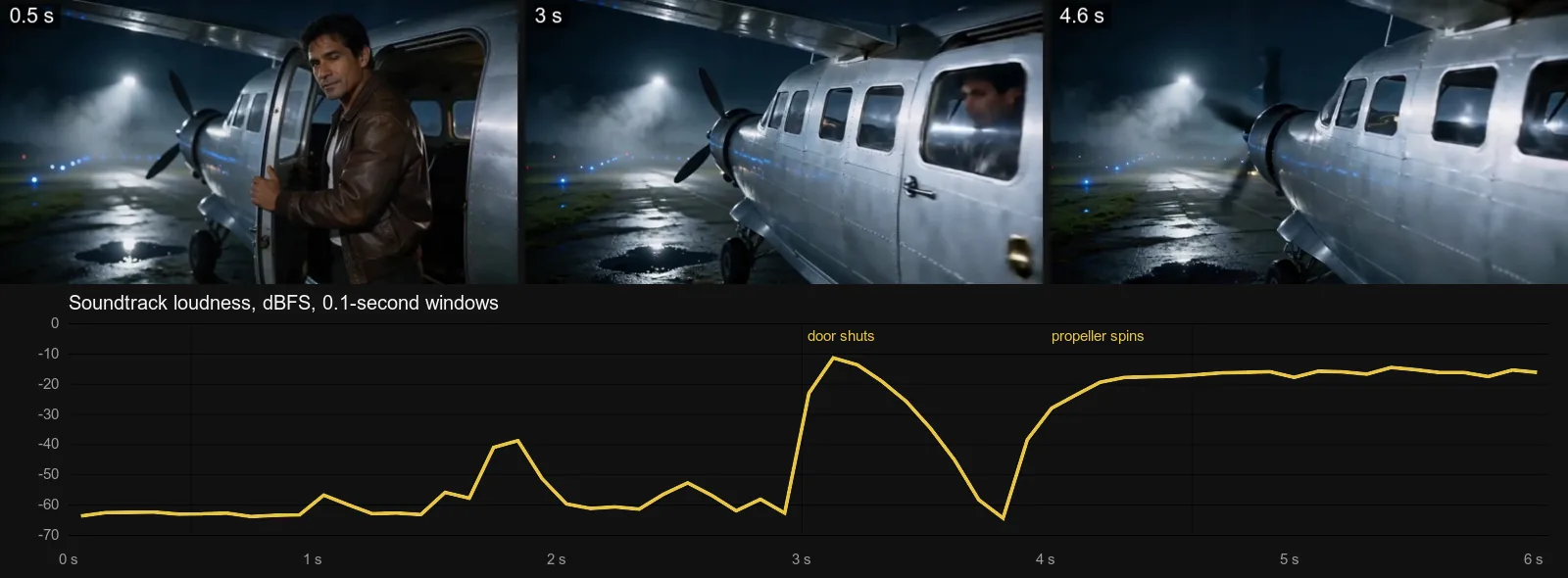
Image-to-video, 720p, 6 seconds, seed 510515. Near −60 dBFS for three seconds, a jump as the door shuts, then about −16 dBFS once the propeller spins. A second seed also stayed silent for three seconds, then held a loud, steady level.
That is the main reason to generate sound with the picture: the loud part lands where the picture changes.
A timed cue is a request, not a cue sheet
Asking for silence first and music later is less reliable. This loft prompt asked for near silence, then a needle landing and a saxophone ballad.
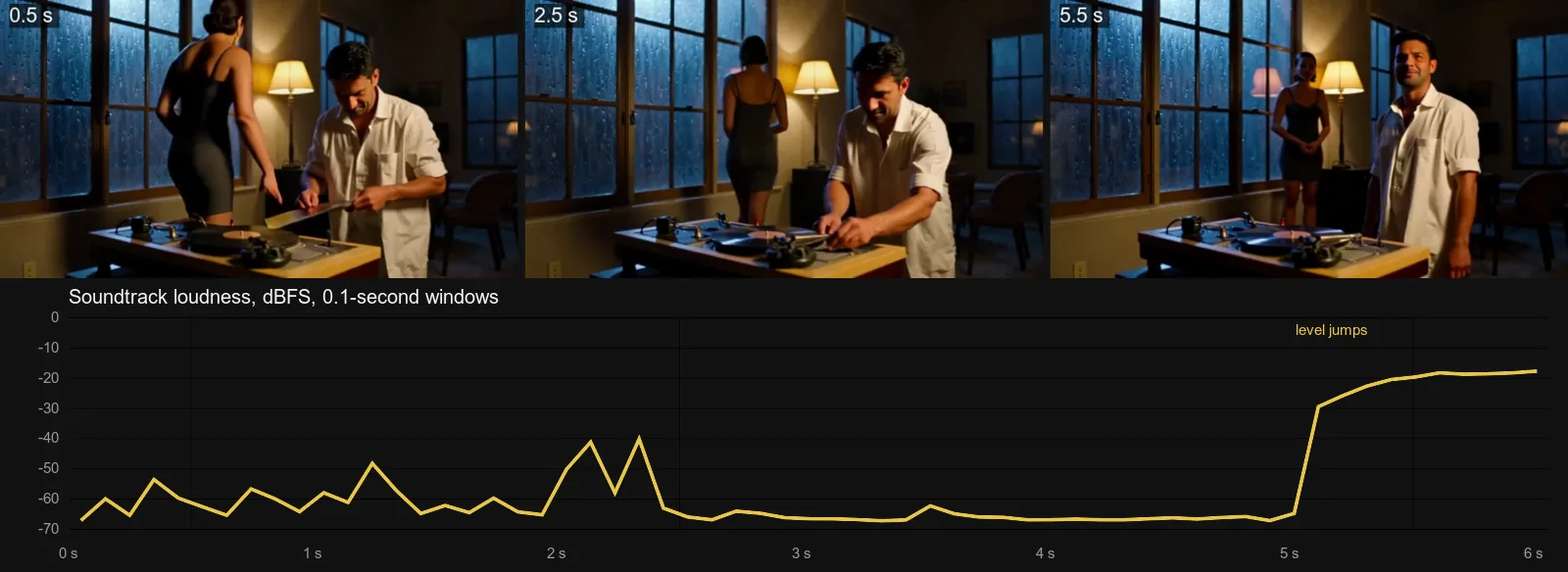
Text-to-video, 480p, 6 seconds, seed 610611. The level jumps at 5.0 seconds of 6.
The second seed sat at about −45 dBFS for all six seconds and never changed. If a sound must land on a frame, describe the action that makes it, as the plane prompt did. If it must be exact, add it afterwards.
Loudness changes a lot from seed to seed
This matters most when you join clips. A moonlit terrace scene ran four times with the same Audio line:
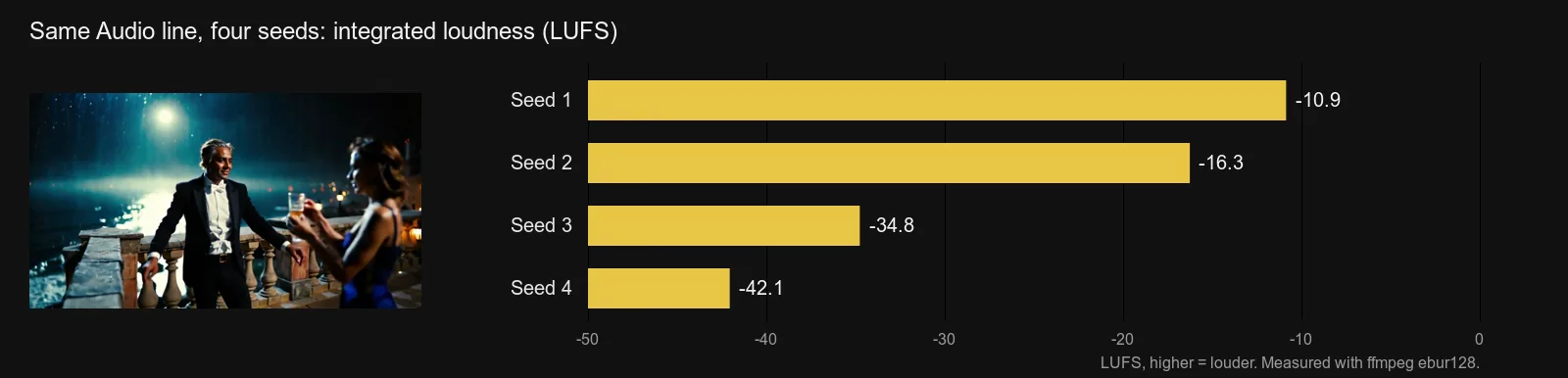
LTX-2 19B LoRA with the Dolly Out camera LoRA, text-to-video, 720p, 5 seconds, four seeds. The Audio line was identical; the last two prompts also described both outfits in more detail.
Across all 55 clips, integrated loudness ran from −42.1 to −8.3 LUFS with a median of −13.2; 35 sat within 3 LU of the median and 7 were quieter than −20. No clip peaked above −1.6 dBTP, so nothing came back clipped. The wording does not decide this on its own: the loudest and quietest terrace runs had the same Audio line, word for word.
So match loudness before you join clips, in the Studio editor or with a loudness normaliser. Six of the 40 example clips also ended at least 15 dB below their loudest moment, all from runs with a camera LoRA loaded, so check the ends before you cut.
"Stereo" is sometimes mono
Every file has two channels, but in 14 of the 55 the channels were practically identical (correlation 0.99 or more), and in 13 they were clearly different (below 0.6). All four clips built around one spoken line were effectively mono. If width matters, check on headphones.
Leaving out the Audio line still gives you sound
We ran a masquerade-ball scene twice with an Audio line (string quartet, crowd, glasses, her laugh) and twice without, on the same seeds.
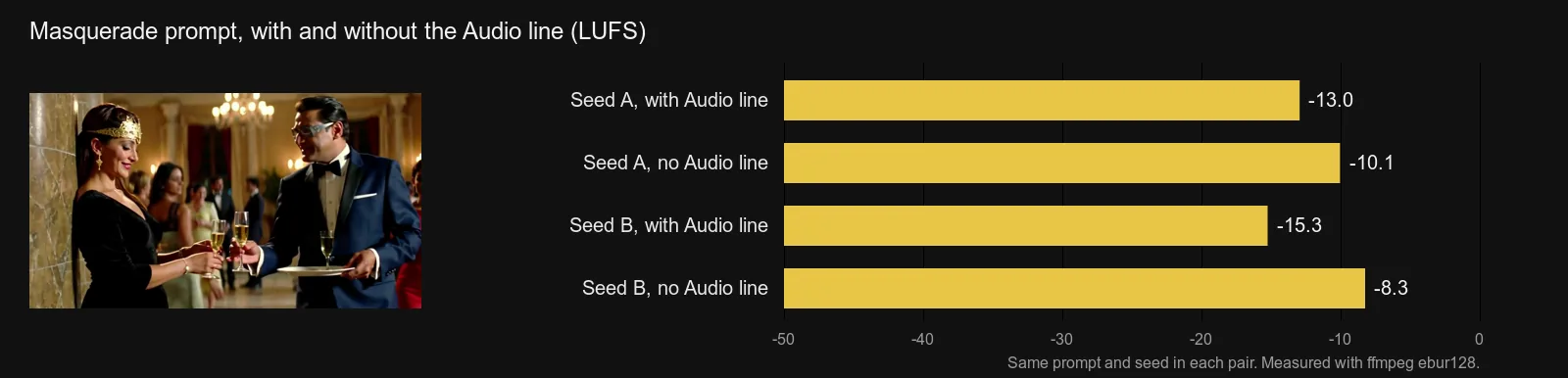
Text-to-video, 720p, 5 seconds, seeds 610601 and 610602. The two clips without an Audio line were the louder ones.
Without the line you still get a track; you just do not choose what is on it. Keep the Audio line even when sound is not the point.
Twenty seconds held
Long clips are where a separate sound pass gets tedious, so we ran one 20-second clip at 480p.
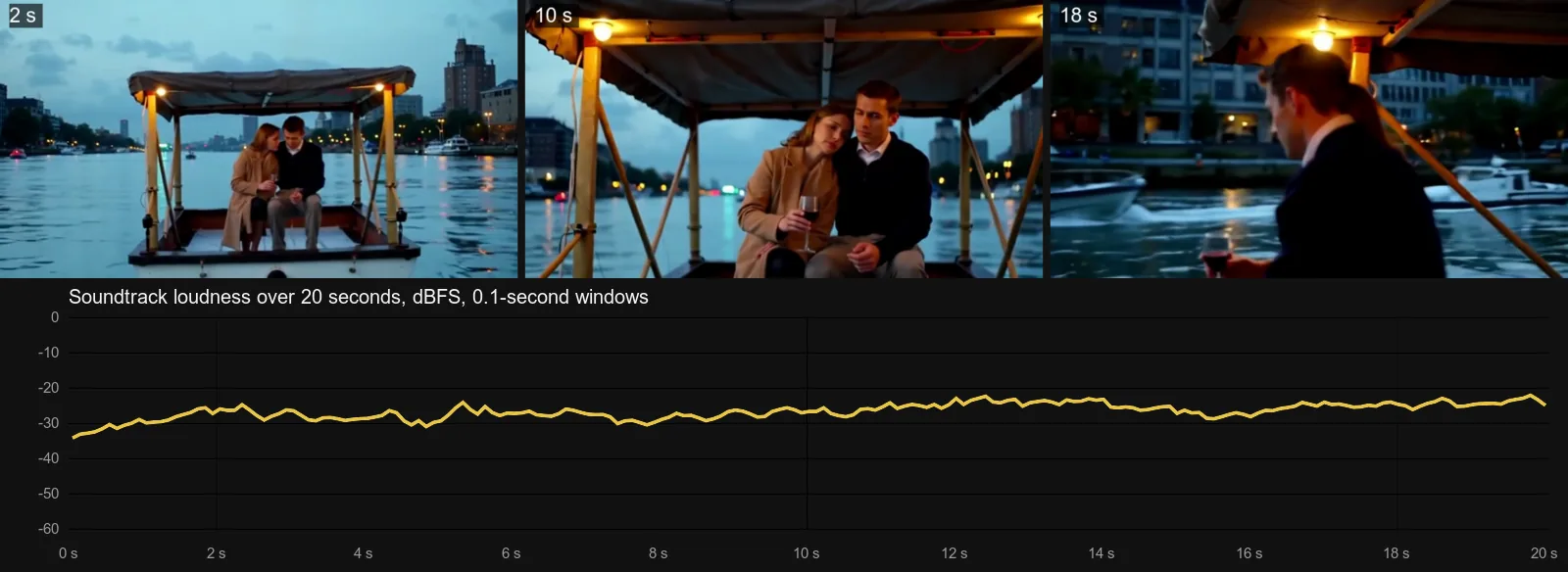
Text-to-video, 16:9, 480p, 20 seconds, seed 610631. Every half second of sound stayed between −32.6 and −22.9 dBFS.
The sound held for all twenty seconds. The picture drifted instead: the slow push-in kept going until she was mostly hidden behind him. The clip cost $0.288. The prompt as we ran it, minus a "no on-screen text" phrase we no longer recommend (see the next section):
A houseboat on a river at dusk in light rain. An adult couple in their forties, a woman in a long camel coat and a man in a navy wool sweater, sit close under the canvas awning at the stern sharing a blanket, watching the city lights come on along the bank. He refills her glass of red wine; she leans her head on his shoulder; later a tour boat glides past and its wake rocks them gently. Wide shot, slow push-in, blue dusk with warm string lights, film grain. Audio: rain pattering on the canvas, water lapping against the hull, a distant radio playing old jazz, the low rumble of the passing boat and its wake slapping the side.Run this prompt on LTX-2 19B text-to-video →
Spoken lines, and the captions nobody asked for
A short line makes a suggestive clip feel personal. We asked a woman in a cream silk robe to look up at the camera and say, softly, "Stay. The rain isn't stopping tonight."
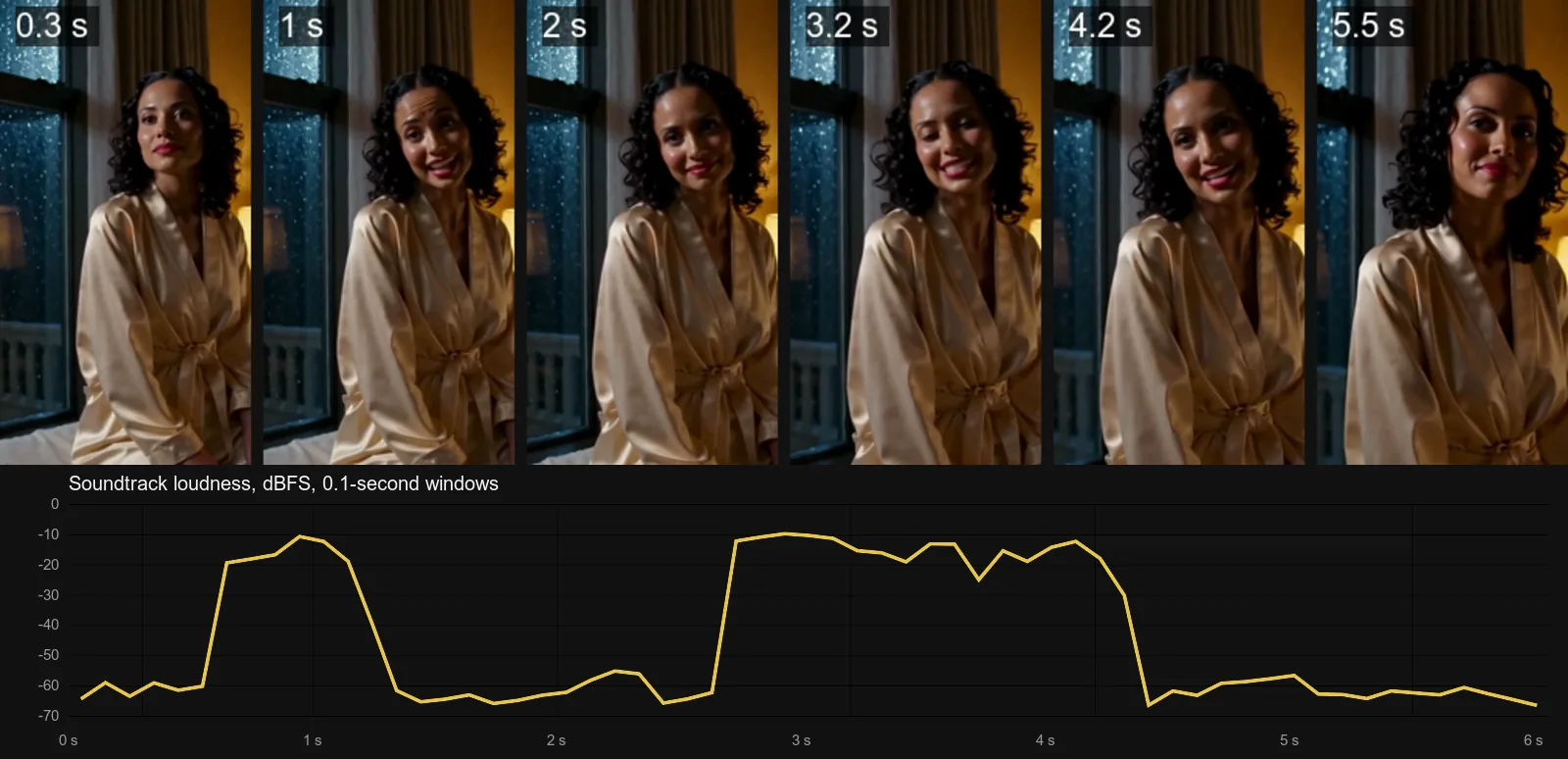
Text-to-video, 9:16, 480p, 6 seconds, seed 610622, no caption words in the prompt.
Two loud stretches fit a line spoken in two parts, but we did not check the words, so listen before you rely on it. What the curve does show is that the "steady rain on the glass" we asked for was not underneath: between and after the bursts the level fell to about −60 dBFS. When there is a voice, it may take over the track.
The bigger surprise was text in the picture. Five of our 15 controlled clips had invented words burned in:
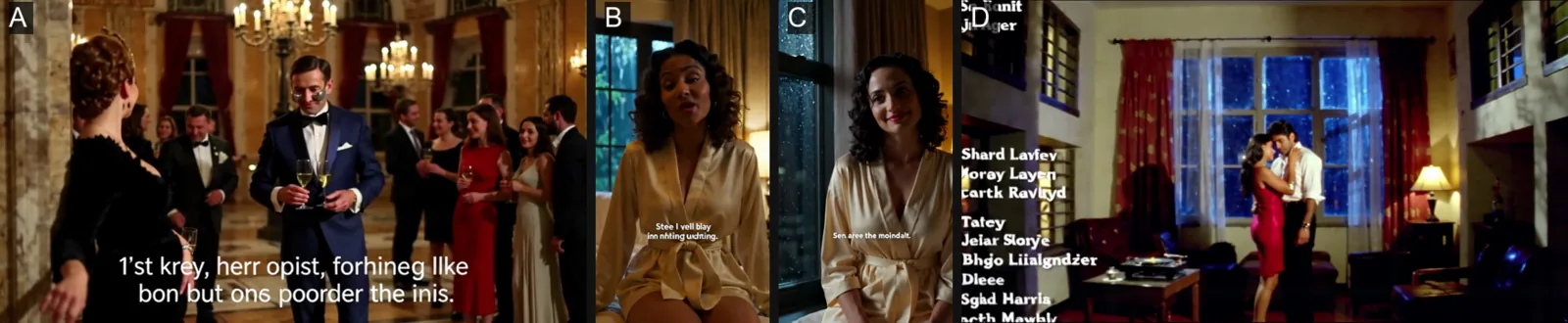
A: masquerade prompt with its Audio line, seed 610601, first 0.8 seconds only. B and C: the spoken-line prompt with "no subtitles, no captions, no on-screen text" added, both seeds. D: a 1080p prompt about a couple dancing to a record; its second seed showed sing-along lyrics instead.
Eleven of the 15 prompts ended with "no subtitles" or "no on-screen text", and all five captioned clips were among them; the four prompts without such a phrase came back clean. The same spoken-line prompt at the same two seeds was clean without the phrase and captioned with it. Six of the eleven were clean too, and in an earlier batch two landscape clips with "no subtitles" came back clean, so on this small sample the phrase did not protect anything and may have provoked the text. The text is always gibberish, which fits the publisher's note that LTX-2 does not render readable text.
- Leave caption words out of the prompt. They prevented nothing in our runs.
- Check the first and last second. In clip A the text lasted 0.8 seconds; trimming the opening fixed it.
- Change the seed. The second seed of the masquerade prompt was clean.
- Look twice at prompts built around a song. Both 1080p clips of a couple dancing to a record came back with credits or lyrics.
Built-in sound or a silent model plus a sound pass?
The other route is a silent clip with effects, a voice and music added afterwards, as in our guides on adding voice and music to an NSFW AI video and the Foley sound-effects workflow. One five-second clip, live catalogue prices and our index scores:
| Route | Sound | 5-second clip | Freedom score | Blind-test score |
|---|---|---|---|---|
| LTX-2 19B, 720p | Always on, stereo | $0.096 | 76.1 | 47.5 |
| MiniMax H3, 768p | Generated with the clip | $0.185 | 70.7 | 67.6 |
| Wan 3.0, 720p | On by default, can be switched off | $0.45 | 96 | 70.9 |
| Seedance 2.0 Fast, 720p | On by default; off does not lower the rate | $0.48 | 72.2 | 68.6 |
| HunyuanVideo 1.5, 720p, then Foley v1 | Silent clip, effects added after | $0.24 + $0.006 | 88.1 | 57.7 |
Freedom is our 0 to 100 score for how much of the adult-content ladder a model delivers; the blind test scores picture quality with model names hidden. Both come from our live index as of 5 October 2026; for the two-step route they are HunyuanVideo's.
- Pick LTX-2 19B for many cheap drafts with sound. It is the cheapest route in the table, and a five-second 720p clip took 14 to 25 seconds in our runs. The trade is the picture: its blind-test score is the lowest of the five.
- Pick Wan 3.0 when picture quality and range on adult content matter more than price. It costs several times more per second and still gives you sound.
- Add sound afterwards when a specific line must be spoken or you already like a silent clip. Foley effects cost $0.0012 per second.
The built-in route's structural limit: the sound is baked into the render, so a wrong word means paying for the picture again.
How far it goes
LTX-2 19B filters nothing on the prompt or the result. On our seven-probe ladder (L1 Suggestive, lingerie or a slipping strap; L2 Partial; L3 Strong; L4 Intense, an intimate scene between two adults; L5 Extreme, consensual restraint between adults or cinematic gore), text-to-video delivered L1, L2, L3 and the restraint probe as written, and toned down L4, the gore probe and the probe with a man in frame. Image-to-video delivered L1 and L3 and toned down the rest. Nothing was refused. Full results are in the LTX-2 19B review; camera moves and LoRA files are in our LTX-2 19B LoRA guide. The ladder had no sound-specific cues, and we do not print probe prompts.
Limits
- Loudness is unpredictable. Normalise every clip before joining.
- Captions can appear, with or without a "no subtitles" phrase. Check the first and last second of every keeper.
- Timed cues drift or vanish. Tie sounds to actions in the frame.
- No audio switch, no audio input.
- Voices can take over. In our spoken-line clip the rain we asked for was missing.
- Stereo width varies. Some clips are effectively mono.
- The picture trails pricier models. Blind-test score 47.5.
- We measured the sound; we did not judge it. Voices and music are for your ears.
FAQ
Does LTX-2 19B generate audio?
Yes. Every clip has a stereo AAC track at 24 kHz made in the same pass as the picture, including clips whose prompt never mentions sound.
How do I write a prompt for LTX-2 with sound?
Describe the shot in four to eight sentences, then end with one sentence that starts with "Audio:" and names each sound by its source, in the order it happens. Put spoken words in quotes and keep them short.
Which AI video generators make sound, and which are uncensored?
On SpicyAPI, LTX-2 19B always does, and Wan 3.0, Seedance 2.0 Fast and MiniMax H3 generate sound with the clip too. All four have a Freedom score on our index (70.7 to 96); they differ in price, picture quality and how far they go.
Can AI make a video from an audio file?
Not on this route: LTX-2 19B takes a prompt or a photo. To make a face say a line you already have, run lip sync on a finished clip, as in our voice and music guide.
How long can a clip with sound be?
5 to 20 whole seconds at 480p, 720p or 1080p. Our 20-second clip had sound for all of it, and a 20-second 480p clip costs $0.288.
Can I turn the sound off?
No. Turn the clip's audio down in the video editor or remove the track after download.
Why does my AI video have random subtitles?
The model sometimes burns invented text into the frame, and writing "no subtitles" did not stop it in our runs. Change the seed, trim the affected second, and leave caption words out of the prompt.