Kling 4.0 is Kuaishou's newest video model, sold here as three tasks: text-to-video (kling/4.0/text-to-video), image-to-video (kling/4.0/image-to-video) and reference-to-video (kling/4.0/reference-to-video). It has been callable on SpicyAPI since 16 October 2026. Kling's own developer API still lists 4.0 as coming soon and publishes no price for it, so this is the way to call it by API today.
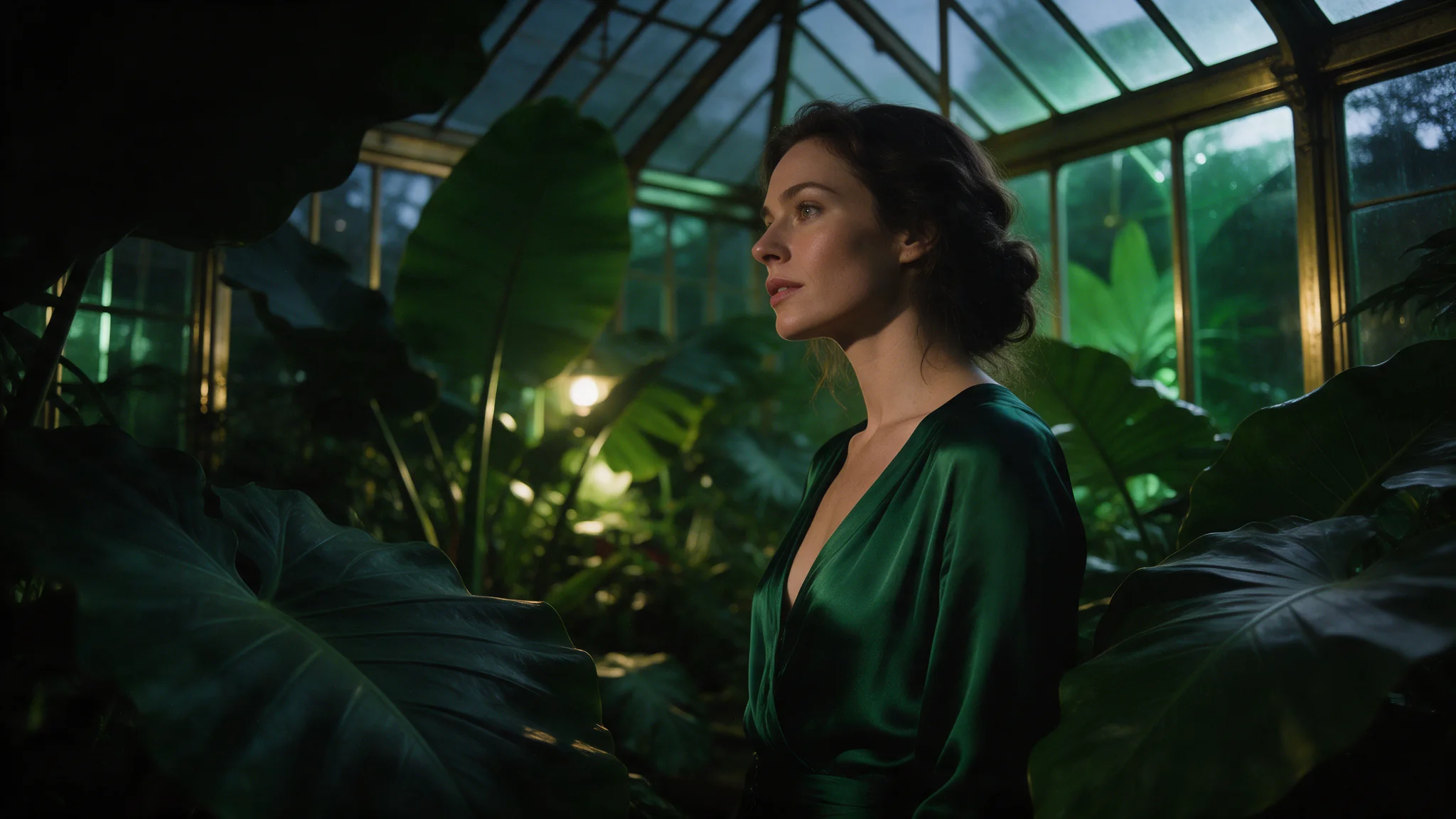
Inside a white observatory dome on a high-desert mesa at indigo dusk. An astronomer in her late thirties with short silver-streaked hair, wearing a charcoal wool sweater and fingerless gloves, turns a heavy brass wheel; with a deep rumble the dome slit slides open and a band of deep-blue sky full of first stars pours light across the polished chrome telescope. She looks up, breath visible in the cold air, and says quietly, "There you are." Slow crane up from her hands on the wheel to the opening sky. Sound: the grinding rumble of the dome motor, desert wind, the soft hum of equipment.
Vertical shot on a dusty two-lane desert highway at indigo dusk. A chrome-trimmed 1960s pickup truck rolls onto the gravel shoulder and stops, headlights catching drifting dust. A man in his thirties with a short beard, in a cream western shirt with rolled sleeves and worn jeans, climbs into the truck bed, lies back with his hands behind his head and grins as the Milky Way brightens overhead. The camera tilts up from him to the sky. Sound: the engine ticking as it cools, crickets, a distant coyote, a low whistle of wind.
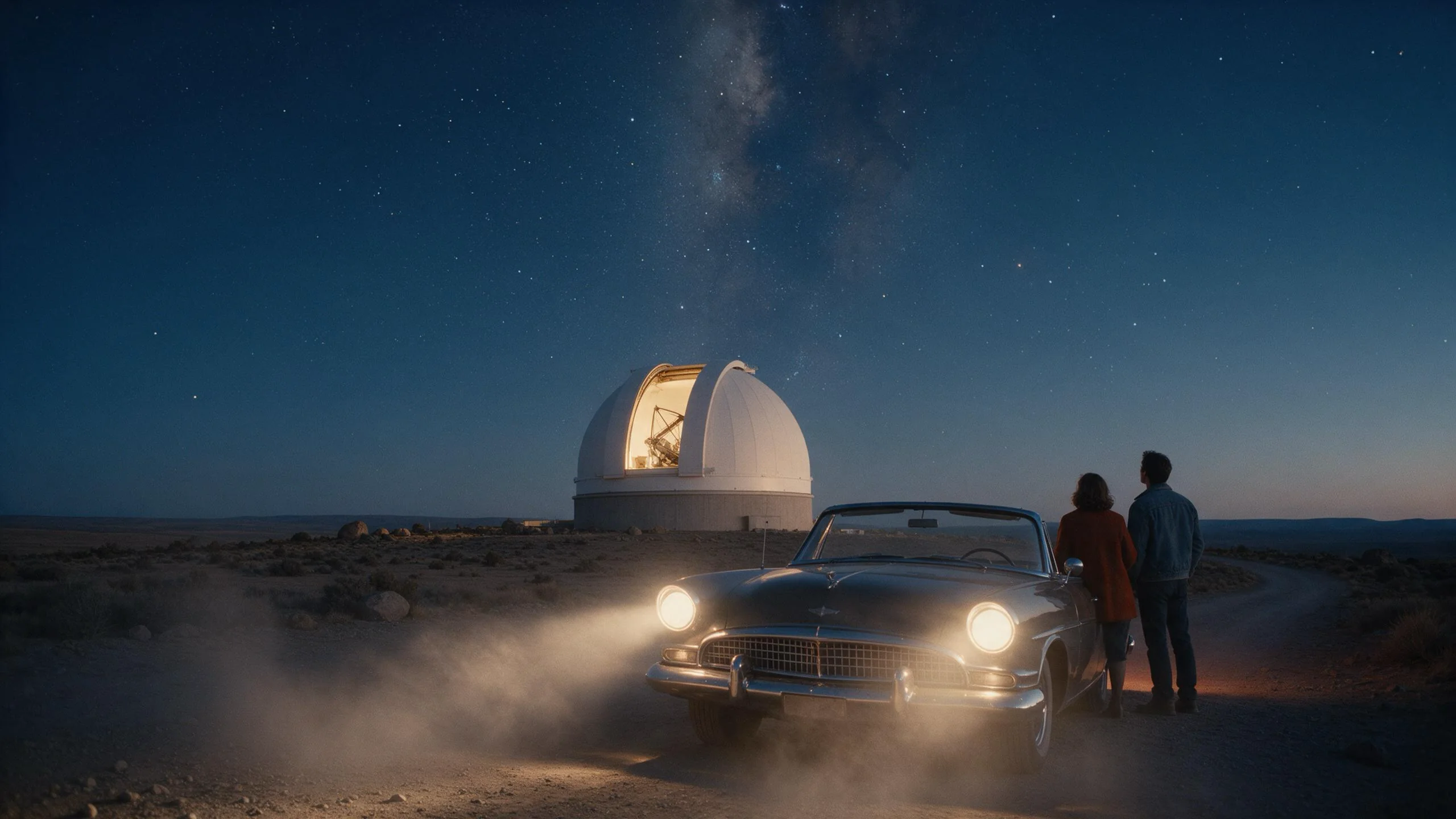
The sodium lamp above the pumps buzzes and flickers fully on. He folds the road map, glances up at the light with a tired half-smile, then pushes off the chrome grille and walks along the convertible toward the driver's door, dust drifting through the headlight glow. Slow dolly-in, then a gentle lateral track. Sound: the electric buzz of the lamp, boots on gravel, paper folding, a warm desert wind.
She takes one last look through the open slit of the dome, then turns around, leans back against the steel railing and crosses her arms with a small satisfied smile as more stars come out over the mesa. Static wide shot, her braid and coat stirred by the wind. Sound: steady desert wind, the faint whirr of the telescope motor.
@Image1 is the woman, @Image2 is the chrome trailer. At blue hour in the high desert, the woman from @Image1 steps out of the door of the trailer from @Image2 holding two steaming enamel mugs; the string lights along its awning blink on one by one and their glow slides across the polished aluminium. She stops, looks up at the first stars and smiles, then glances at the camera. Slow push-in. Sound: the creak of the trailer door, boots on cracked earth, a soft desert wind, a distant owl.
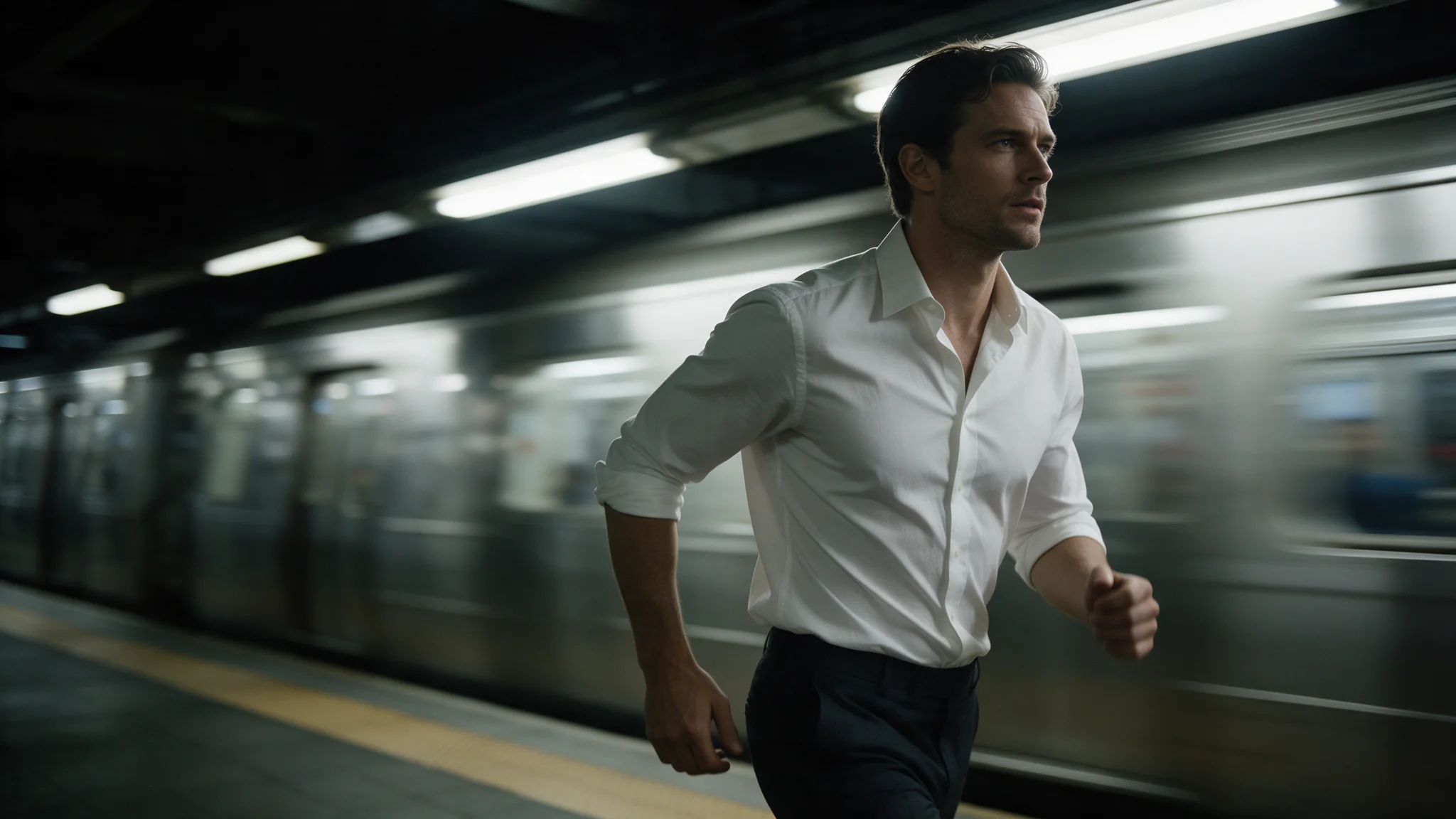
@Image1 is the man, @Image2 is the motorcycle. On a dusty desert highway shoulder at indigo dusk, the man from @Image1 walks up to the chrome café-racer from @Image2, runs a hand along its fuel tank, swings a leg over and kicks it into life; the round headlight flares on and lights the drifting dust, the radio-telescope dishes silhouetted behind him. Low tracking shot circling from the front wheel to his face. Sound: footsteps on gravel, the kick-start, a throaty engine settling into idle, wind.
We ran all three tasks on 17 October 2026 with safe-for-work prompts, and ran our content check on text-to-video on 16 October. The content result is plain: Kling reviews the request itself, and the Moderate and Very strong requests we sent to text-to-video were refused after about 2.5 seconds, before any video was made and at no charge. The page label is Filtered.
Pick Kling 4.0 when you need a long take. Clips run 3 to 30 whole seconds, double Kling 3.0's 15, at 720p or 1080p, in 16:9, 9:16, 1:1 or 21:9, and every clip arrives with a stereo soundtrack. Pick something else when the brief needs stronger content, or when the first answer has to arrive fast: our 3 to 5 second clips took one to four minutes.
How it scores. The Spicy Index and Freedom Score are on this page's score card, computed from our test records. We have not run the blind quality test on Kling 4.0 yet, so its index is preliminary; check the card rather than a number printed here.
Content limits: filtered. Moderate and Very strong text-to-video requests were refused before rendering. Image-to-video and reference-to-video have not been run against our content check.
Price: $0.216 a second at 720p and $0.324 a second at 1080p on all three tasks. Aspect ratio, keyframes, reference images and reference audio do not change it; reference-to-video adds a lower per-second charge for the seconds of any reference video. Refused and failed requests are not charged. The model page shows the current price.
Length and shape: 3 to 30 whole seconds. Aspect ratio 16:9, 9:16, 1:1 or 21:9; image-to-video can also follow the opening frame. A 1080p 21:9 clip came back at 2200 x 940.
Sound: always generated, with no switch and no extra charge. Name the ambience you want in a separate Sound line, or ask for quiet room tone.
Image-to-video: an opening frame, an optional closing frame and in-between keyframes. In our three-frame test the clip passed through all three poses in order.
Reference-to-video: up to 10 images, 5 videos and 3 voice clips, named in the prompt as @Image1, @Video1 and @Audio1 in upload order.
Speed: 3 to 5 second clips took roughly one to four minutes in our runs.
良かった点と足りなかった点
良かった点
Long single takes with sound. Up to 30 seconds in one request, with dialogue, effects and ambience from the prompt's Sound line.
The closing frame is honoured. With only an opening and a closing frame, the clip landed on the closing pose, and the sky darkened as that frame showed.
Three keyframes in order. An opening pose, a middle pose and a closing pose came back as one continuous 3-second move.
References stay recognisable. In the trailer and motorcycle examples the person and the object each match their reference photo.
A true 21:9 frame. Ultrawide is rendered as ultrawide, not cropped from a wider shot.
A reference clip's motion carries over. When the prompt described the same action as a reference video, the result followed that clip almost frame for frame.
Refusals cost nothing and come back fast.
足りなかった点
Filtered above Mild. Moderate and Very strong text-to-video requests were refused outright. There is no quiet softening in what we saw: the job fails rather than returning a toned-down clip.
Slow for iteration. Expect minutes for a 3 to 5 second draft.
It adds shots you did not ask for. The observatory example cut from a close angle to a wide one, and the trailer example ended on a face close-up. Write "one continuous shot, no cuts" if you need a single take.
Small lighting cues can be missed. In the gas-station example it switched on the car's headlights instead of the lamp the prompt named.
Sound is always on. You cannot turn it off; ask for quiet room tone instead.
More per second than Kling 3.0 for the same length, in exchange for 30-second clips, sound and 21:9.
What the clips show
The gallery holds the six published examples from the Kling 4.0 model page, two per task, at 720p and 5 seconds. All show clothed adults, and none is a content-test clip.
Text-to-video, two framings. An astronomer opens an observatory dome and says a quiet line under a band of dusk sky; the model chose two camera angles for one paragraph. A vertical highway shot follows a pickup arriving, a man lying back in the truck bed and a tilt up to a brightening Milky Way: three beats in five seconds.
Image-to-video, with and without a closing frame. A man at a gas station keeps his face, jacket and car from the opening frame while the lamp flickers on. In the second example the opening and closing frames share a camera position, and the clip walks the astronomer from the telescope to the railing.
Reference-to-video.@Image1 is a woman and @Image2 a chrome trailer; both appear as the references show, and the model added string lights and a closing face shot. The second example casts a man from a portrait onto a motorcycle from a product photo and keeps the jacket, beard, tank and headlight.
Other checks. A 3-second clip with an opening, a middle and a closing frame passed through all three. A reference clip's action was reproduced almost frame for frame when the prompt described it. A 1080p 21:9 clip measured 2200 x 940, and a 1080p clip following a 16:9 reference video came back 1920 x 1080.
Prompts that worked
Write in the order things happen: subject and wardrobe, action, one camera move, then a separate Sound line. Put spoken words in quotes. For image-to-video, describe only the motion; the frame already shows the look. For reference-to-video, open with a cast list ("@Image1 is the woman, @Image2 is the chrome trailer"). Draft at 720p and 3 to 5 seconds before paying for 1080p or a long take.
1. Text-to-video, an establishing shot with a spoken line.aspect_ratio 16:9, duration_seconds 5.
text
Inside a white observatory dome on a high-desert mesa at indigo dusk. An astronomer in her late thirties with short silver-streaked hair, wearing a charcoal wool sweater and fingerless gloves, turns a heavy brass wheel; the dome slit slides open and a band of deep-blue sky full of first stars pours light across the telescope. She looks up and says quietly, "There you are." Slow crane up from her hands on the wheel to the opening sky. Sound: the grinding rumble of the dome, cold wind, a faint motor whirr.
2. Reference-to-video, a person and an object. Two images in reference_image_urls, the person first, then the object.
text
@Image1 is the man, @Image2 is the motorcycle. On a dusty desert highway shoulder at indigo dusk, the man from @Image1 walks up to the chrome café-racer from @Image2, swings a leg over and kicks it into life; the round headlight flares on and lights the drifting dust. Low tracking shot circling from the front wheel to his face. Sound: footsteps on gravel, the kick-start, a throaty engine settling into idle, wind.
Weak: a long list of keywords and no order of events. Strong: one paragraph in the order it happens, with the sound described on its own line and "one continuous shot, no cuts" if you want a single take.
How far it goes
Kling reviews requests itself, so SpicyAPI adds no filter of its own on top; the page label is Filtered. On 16 October 2026 we sent two text-to-video requests, one at Moderate and one at Very strong, and both were refused after about 2.5 seconds with "Content flagged as potentially sensitive". No video was rendered and nothing was charged. Readings are delivered / toned down / refused.
Intensity
Text-to-video
Moderate
0/0/1
Very strong
0/0/1
That is a small sample, and we did not test Mild, Strong or Maximum on Kling 4.0, nor any content request on image-to-video or reference-to-video. Kling 3.0's earlier results are a fair guide: there Mild requests rendered, every Moderate and stronger request was refused, and Kling checked the prompt, any upload and the finished clip. We have no evidence that 4.0 differs, and no refusal has ever been billed.
Adults only, in every prompt, upload and output. Never depict a real, identifiable person without their consent, and make sure you hold the rights to any photo or clip you upload.
Shorter clips for less?Kling 3.0 costs less per second and adds Motion Control, but stops at 15 seconds and is filtered the same way. See the Kling 3.0 review.
No. It is a filtered model. Our Moderate and Very strong text-to-video requests were refused before any video was rendered, and refused requests are not charged. For wider limits, use Seedance 2.5, Seedance 2.5 Spicy or Wan 3.0.
$0.216 a second at 720p and $0.324 a second at 1080p, on text-to-video, image-to-video and reference-to-video. Reference-to-video also charges a lower per-second rate for the seconds of any reference video. The model page shows the current price.
3 to 30 whole seconds in one request, at 720p or 1080p. Every clip has a stereo soundtrack.
Yes, on SpicyAPI, since 16 October 2026. Kling's own developer API lists 4.0 as coming soon and publishes no price.
No. Audio is always generated at no extra charge. Describe the ambience you want, or ask for quiet room tone.