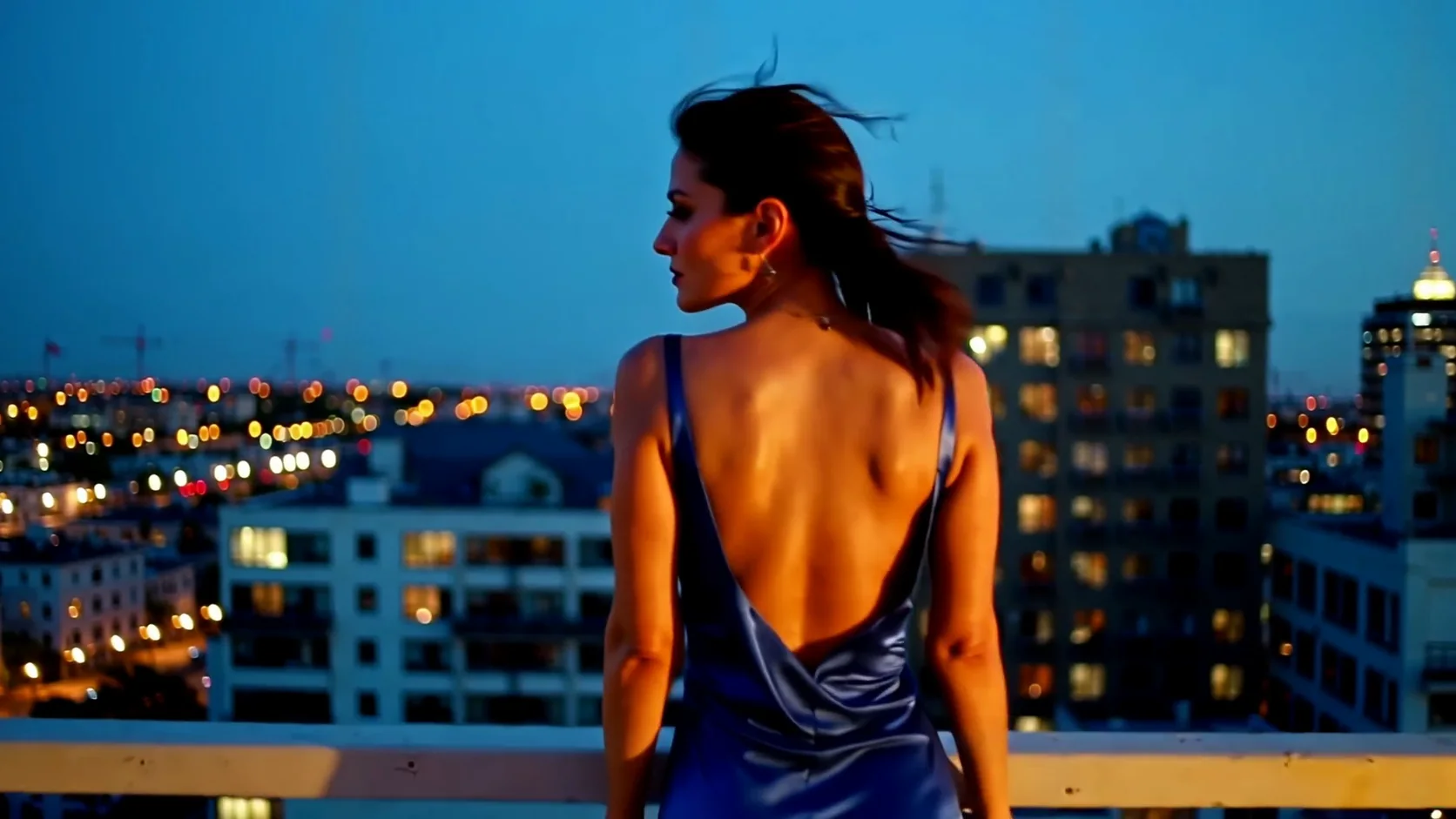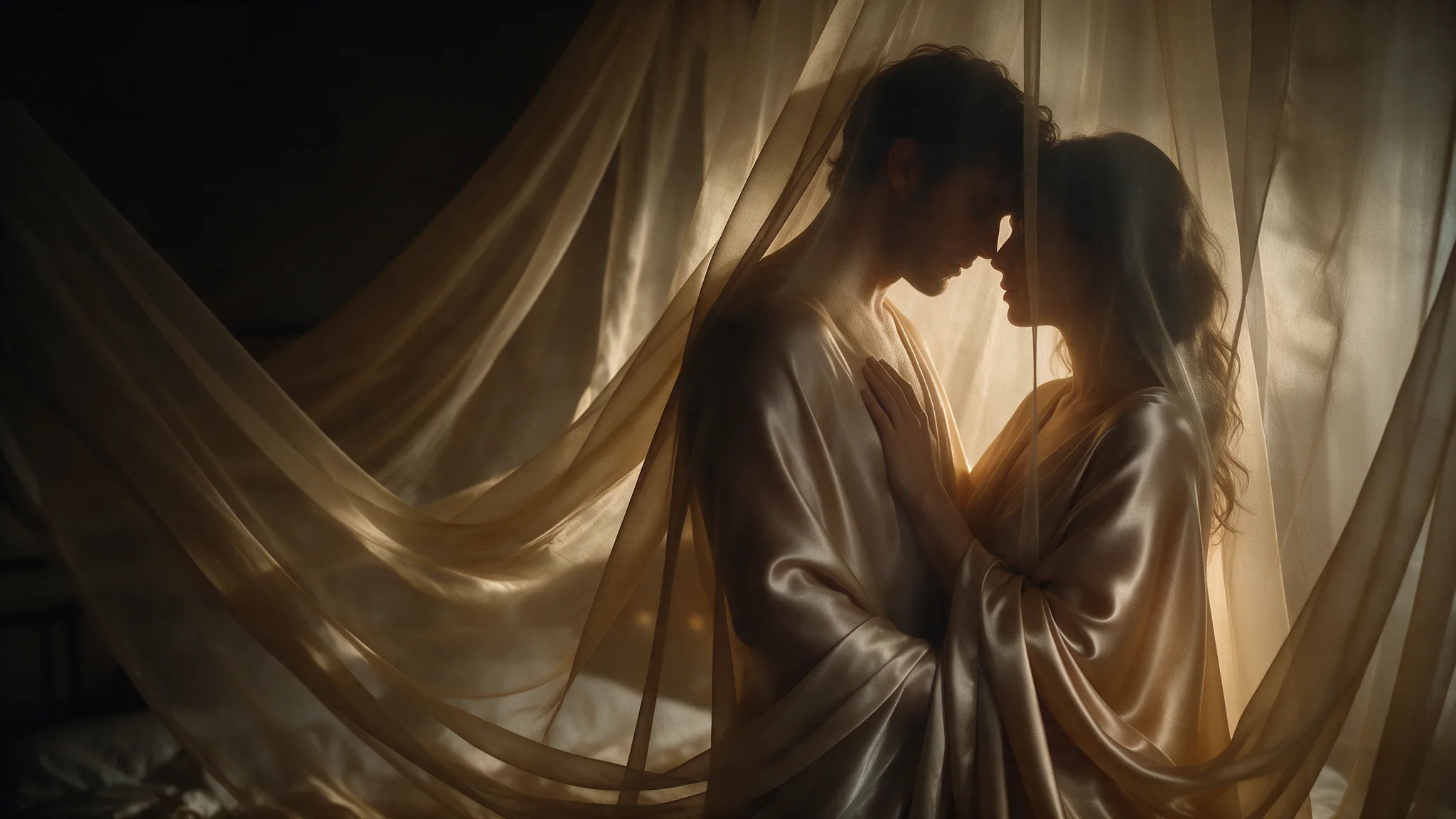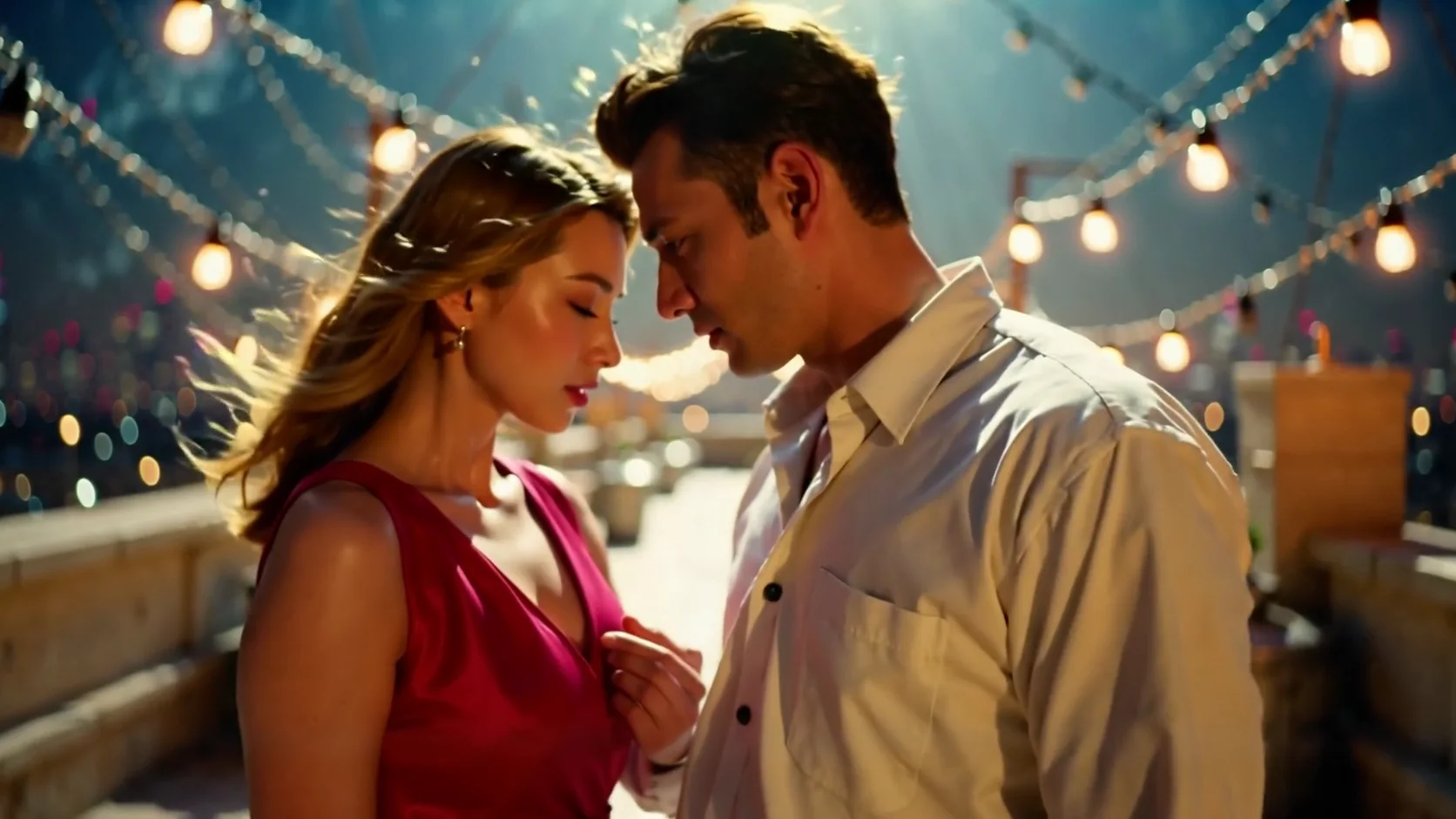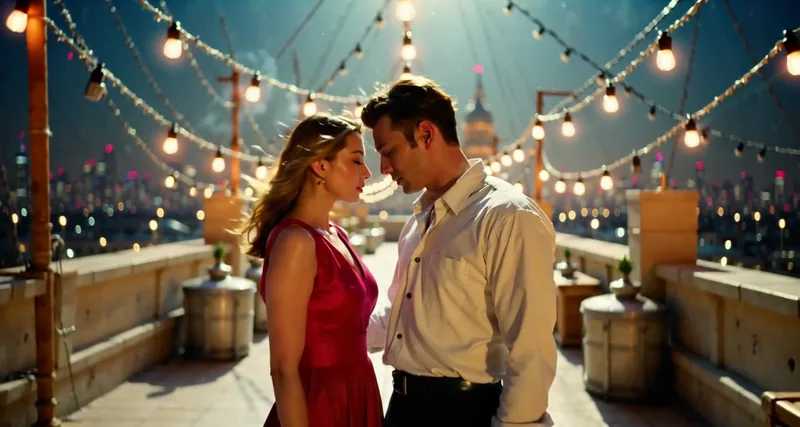
If you want an open-weight video model, LTX-2 and Wan 2.2 are a common shortlist: Lightricks' LTX-2 because it renders sound with the picture and runs long, Alibaba's Wan 2.2 because of its motion and its large LoRA library. Most "LTX-2 vs Wan 2.2" pages either compare spec sheets or quietly swap in LTX 2.3. We ran the same prompts through both at the same settings and looked at every clip.
Short answer: in our tests Wan 2.2 followed the prompts more closely; LTX-2 was faster, about a third of the price and the only one with sound. In five single-run matched tests, Wan 2.2 did what we asked better on three (a running dog, a product push-in, a dancer), the two were close on a city walk, and in an image-to-video test Wan 2.2 finished all four actions where LTX-2 finished two. In one batch of concurrent jobs, LTX-2 returned 480p clips in 11 to 28 seconds against Wan 2.2's 54 to 116, at $0.072 per 5-second clip against $0.24, with a stereo soundtrack and up to 20 seconds per clip. On unfiltered content the standard Wan 2.2 is the stricter of the two; LTX-2 and the Wan 2.2 Spicy build are not.
- Start with Wan 2.2 when the shot has to match the brief: a specific animal or product, a named camera move, an exact sequence of actions from a still.
- Start with LTX-2 for cheap drafts, clips with sound, anything longer than standard Wan 2.2's 5 seconds, and NSFW text-to-video.
- Start with Wan 2.2 Spicy for NSFW image-to-video at Wan quality: $0.095 per 5-second clip.
Which LTX-2 and which Wan 2.2?
Both names cover several models, and the comparison pages you find often mix them up.
LTX-2 is the 19-billion-parameter audio-video model Lightricks released as open weights in January 2026, listed on our API as LTX-2 19B. Its successors, LTX 2.3 and LTX 2.5, are separate models with separate weights, and LoRAs trained for one don't load on the others. If you meant the newer ones, see our LTX 2.3 prompt guide or LTX 2.5 vs MiniMax H3.
Wan 2.2 was released by Alibaba in July 2025 in several sizes. Comparisons usually mean the A14B models: text-to-video and image-to-video, each a mixture of two 14-billion-parameter experts (one sets layout and motion, one adds detail), rendering 480p or 720p. There is also a smaller TI2V-5B model that does 720p at 24 fps, plus speech-driven and character-animation variants. On our API, standard Wan 2.2 is the A14B pair; Wan 2.2 Spicy, Wan 2.2 LoRA and Wan 2.2 5B LoRA are builds of the same release with different content handling and LoRA support.
This article compares LTX-2 19B with standard Wan 2.2, and brings in the Spicy and LoRA builds where they change the answer.
The quick decision table
| What you need | Choose | Why |
|---|---|---|
| The shot must match a detailed prompt | Wan 2.2 | Closer to the brief in 4 of our 5 single runs |
| Sound in the same file | LTX-2 | Every clip came with a stereo track; Wan 2.2 is silent |
| More than 5 seconds in one take | LTX-2 | 5 to 20 seconds; standard Wan 2.2 makes about 5, the Spicy and LoRA builds 5 or 8 |
| Many cheap drafts | LTX-2 | $0.072 per 5 s at 480p vs $0.24 |
| 1080p | LTX-2 | Offers 1080p; Wan 2.2 renders up to 720p |
| A complete action sequence from a still | Wan 2.2 or Wan 2.2 Spicy | Both finished all four actions; LTX-2 finished two |
| Unfiltered content from a text prompt | LTX-2 | Standard Wan 2.2 refused every unfiltered text prompt |
| Unfiltered content from a still | Wan 2.2 Spicy | Delivered every level up to Very strong |
| A big library of community LoRAs | Wan 2.2 LoRA builds | The larger LoRA ecosystem; LTX-2 has its own, smaller one |
| Running locally on one consumer GPU | LTX-2 (fp8 or fp4) or Wan 2.2 5B | Wan's A14B officially wants 80 GB of VRAM, the 5B 24 GB |
A full spec table for the two hosted endpoints is on our LTX-2 19B vs Wan 2.2 comparison page.
How we tested
On 17 October 2026 we sent the same four text prompts to LTX-2 19B text-to-video and Wan 2.2 text-to-video: 480p, 16:9, 5 seconds, the same seed, Wan's prompt expansion off. We repeated the city walk at 720p. For image-to-video, we generated one still of a woman at a café table and animated it with LTX-2 19B, Wan 2.2 and Wan 2.2 Spicy. The visual prompt was identical for both models; LTX-2 also got one extra line starting with Audio:, because that is how you steer its sound.
That is one run per prompt, 13 clips in total, and it cost $2.25 including the two test stills. One run shows what happened on that seed, not a success rate. We looked at every clip frame by frame.
One caveat on fairness: Lightricks says LTX-2's prompt following depends heavily on prompting style, and its guidance favours longer, shot-by-shot prompts. Ours were short and the same for both models, which may have favoured Wan 2.2. A rewritten LTX-2 prompt could change the dog and bottle results.
Motion and prompt adherence: Wan 2.2 was closer to the brief
The running dog
Prompt
A golden retriever sprints along the edge of the surf on a sandy beach at sunrise, water spraying up from its paws. The camera pans from left to right to follow it, the sun low behind the waves.This was the clearest gap. Wan 2.2 drew an unmistakable golden retriever, kept it the same dog for all five seconds and panned with it, exactly as written. LTX-2 drew a dark, backlit dog that read more like a shepherd, the camera didn't follow it, and it ran away from us into the water until it was small in the frame. The picture was also grainier. LTX-2's soundtrack, on the other hand, was loud surf and wet sand, matching the scene.
The product push-in
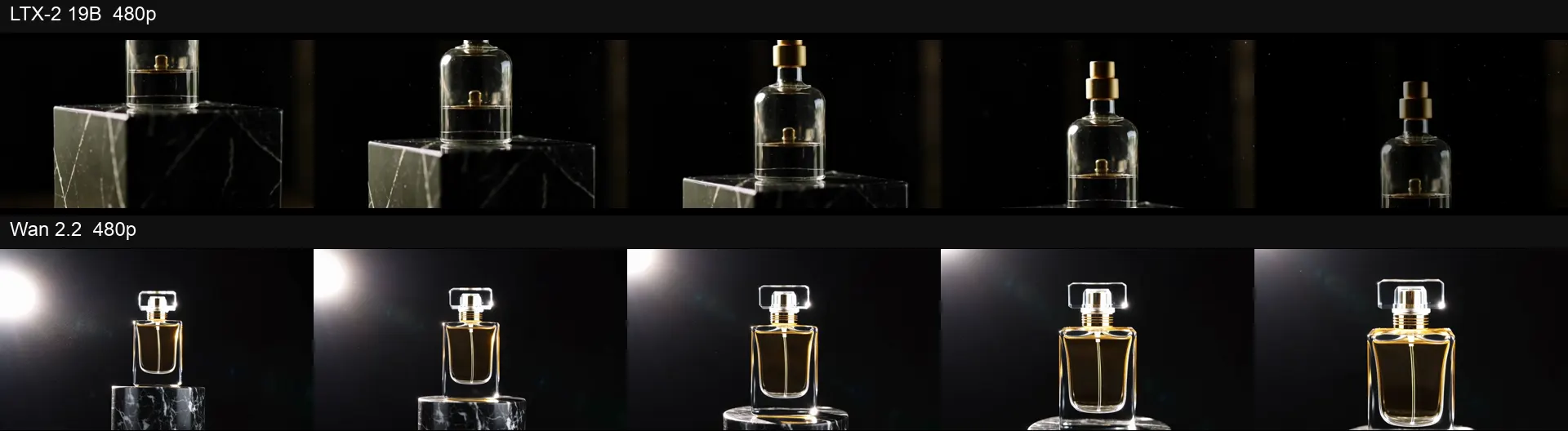
Frames at 0.3, 1.5, 2.7, 3.9 and 4.9 seconds. Same prompt, 480p, same seed.
Prompt
Slow camera push-in on a clear glass perfume bottle standing on a black marble pedestal. A single soft key light from the left; a thin gold reflection slides across the glass as the camera moves closer; dust particles drift through the light. Dark background.Wan 2.2 pushed in and kept the bottle identical from first frame to last. LTX-2 moved the wrong way: its first frames cropped the top of the bottle, and as the camera pulled back the cap came into view and changed shape, and the pedestal vanished. For product shots, where the object has to stay the object, that is disqualifying.
The dancer
The prompt asked for a male dancer in a loose white shirt to spin twice in a sunlit studio and stop facing the camera with his arms out. Wan 2.2 turned him in place and ended on the pose, although we could count only one clear spin and the sun produced a heavy lens flare. LTX-2 began with floor work nobody asked for, crouching and kicking, then stood up and ended on the right pose. Both ended correctly; Wan 2.2 was closer to the described action, though it showed one clear spin, not two.
The city walk, at 480p and 720p
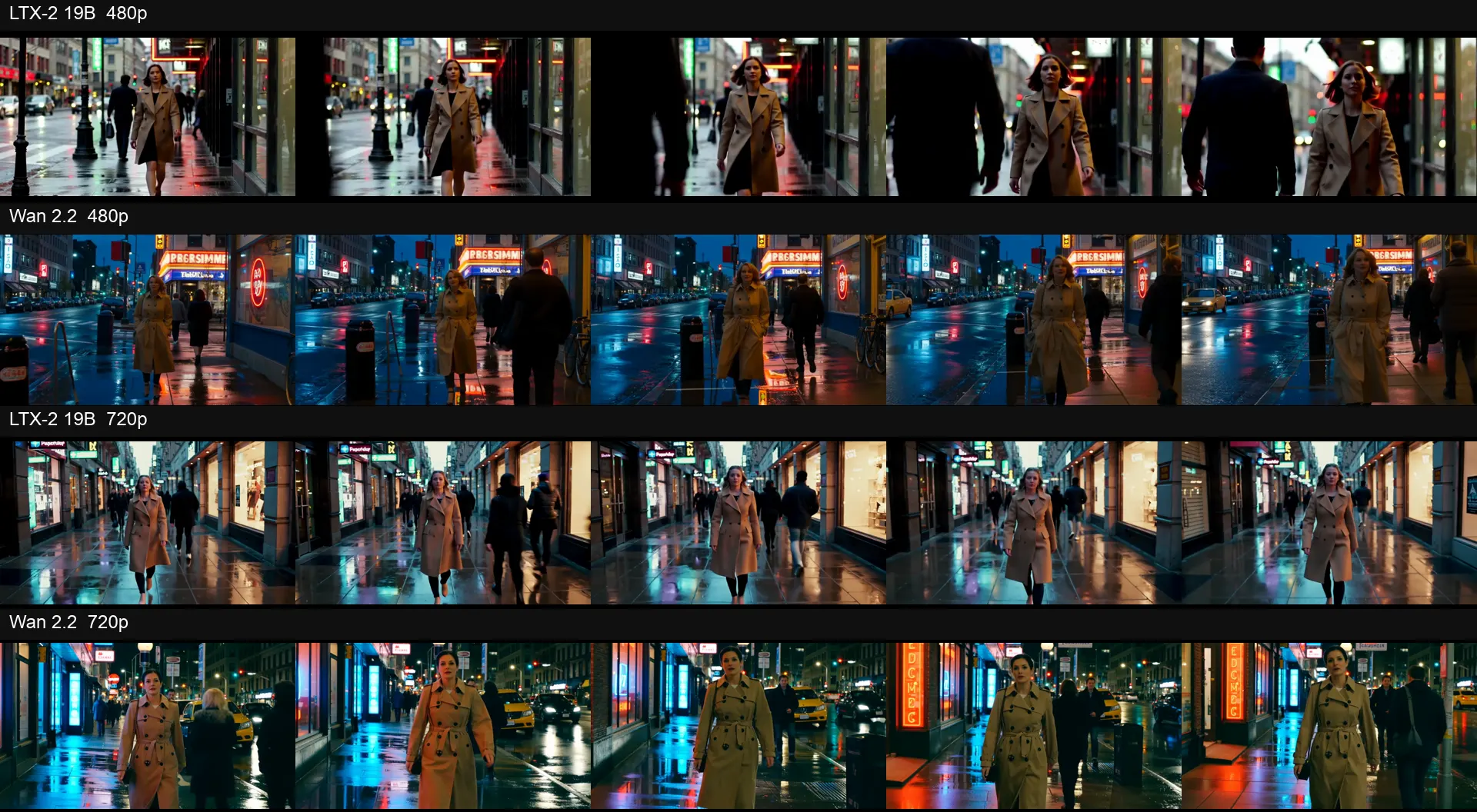
The same walking prompt at 480p and 720p. All four clips kept the same woman and coat throughout.
Prompt
A woman in her thirties wearing a camel trench coat walks toward the camera along a wet city sidewalk at dusk. Neon shop signs reflect in the puddles and people pass behind her. The camera tracks backward at her walking pace, keeping her framed from the knees up.This one was close. All four clips kept the same face and coat, and the wet street reflections were convincing in each. At 480p LTX-2 brought her closer, and its knees-up framing matched the prompt better than Wan 2.2's distant full-body shot, though a passer-by crossed in front of her at the end; Wan 2.2 also turned its large neon sign into nonsense letters. At 720p Wan 2.2 held the "knees up" framing best and looked the most finished; LTX-2's 720p walk was steady but stayed wider than asked. If you only need a person walking, either will do.
Image-to-video: the café still
Prompt
She lifts the coffee cup with her right hand, takes a slow sip, sets it back on the saucer, then turns her head toward the window and smiles. The camera holds still.Four actions in five seconds is a lot, and that is where the difference showed. Both Wan builds did all four: lift, sip, set down, turn and smile. LTX-2 did the lift and the sip, then stopped with the cup still in her hand. All three kept her face and sweater consistent with the still. If you need a sequence of actions from one image, give LTX-2 fewer actions or a longer clip; it allows up to 20 seconds, and the extra time is often enough for the rest.
Our findings line up with what people report in community threads (mostly about LTX 2.3): Wan 2.2 is praised for motion and prompt adherence, LTX for speed and sound. One test set doesn't prove it in general, but in ours the pattern held.
Sound, length, frame rate and resolution
| LTX-2 19B | Wan 2.2 | |
|---|---|---|
| Sound | Stereo AAC, 24 kHz, on every clip; steer it with an Audio: line | None |
| Clip length | 5 to 20 seconds, any whole number | About 5 seconds, fixed |
| Frame rate in the file | 24 fps | 30 fps in the file (the model itself renders 16 fps) |
| 480p output | 832 x 448 | 832 x 480 (image-to-video: 856 x 476, 5.77 s) |
| 720p output | 1280 x 704 | We received a 1920 x 1080 file, which suggests resizing after generation |
| 1080p | Yes, 1920 x 1024 | No |
| Aspect ratios from text | 16:9, 9:16 | 16:9, 9:16 |
Sound is LTX-2's biggest practical advantage. Every clip arrived with a track, and the levels matched the scenes: loud surf for the beach, near silence for the empty studio, a quiet café murmur for the still. We measured levels; we did not judge fidelity, and Lightricks notes that audio without speech can be lower quality. Wan 2.2 clips are silent, so you add sound in editing. Alibaba's separate Wan 2.2 speech-to-video model is a different tool for lip-synced talking video.
Length is the second. Standard Wan 2.2 renders a fixed clip of about 5 seconds. LTX-2 goes to 20 seconds in one take, and also has a video-extend endpoint that continues an existing clip. The Wan 2.2 Spicy and LoRA builds offer 5 or 8 seconds.
Frame rate: Wan 2.2's A14B models render 16 frames per second. The files we received ran at 30 fps (and 64 fps on Wan 2.2 Spicy), which suggests the frames were interpolated after generation. Interpolation smooths playback but doesn't add motion the model didn't draw. Our LTX-2 files were 24 fps.
Speed
| Hosted, our test | LTX-2 19B | Wan 2.2 |
|---|---|---|
| Text-to-video, 480p, 5 s | 11 to 28 s | 54 to 116 s |
| Text-to-video, 720p, 5 s | 57 s | 117 s |
| Image-to-video, 480p, 5 s | 59 s | 109 s (Spicy: 42 s) |
Times run from submission to finished file. We submitted all 13 jobs at once, so they include some queueing. LTX-2 was faster on every matched pair, three to five times faster at 480p.
Running locally, speed depends on your card. One published guide puts Wan 2.2's 14B model at about 4 minutes 20 seconds for a 5-second 720p clip on an RTX 4090, and Alibaba says its 5B model makes one "in under 9 minutes" on a single consumer GPU. The test comparisons that show LTX finishing several times faster are mostly about LTX 2.3, not LTX-2, so treat the multiplier as a direction, not a number.
Price per clip
These are our current prices per clip on the API, confirmed with live quotes.
| 5-second clip | 480p | 720p | 1080p |
|---|---|---|---|
| LTX-2 19B | $0.072 | $0.096 | $0.144 |
| LTX-2 19B LoRA | $0.09 | $0.12 | $0.18 |
| Wan 2.2 | $0.24 | $0.48 | — |
| Wan 2.2 Spicy (image-to-video) | $0.095 | $0.19 | — |
| Wan 2.2 LoRA | $0.24 | $0.42 | — |
| Wan 2.2 5B LoRA | $0.12 at 720p |
LTX-2 is billed per second, so a 20-second 720p take costs $0.384. Standard Wan 2.2 is billed per clip. The price gap matters most when you iterate: ten LTX-2 drafts at 480p cost $0.72, the price of three Wan 2.2 clips. If Wan 2.2 gets the shot in one try where LTX-2 needs four, the cost evens out.
A sensible split: draft framing, timing and sound with LTX-2, then render the keeper with Wan 2.2 if LTX-2 can't hold the subject or the camera move.
Running them yourself: VRAM, license and LoRAs
If you're choosing open weights for your own GPU rather than an API, three things differ.
VRAM. Alibaba lists at least 80 GB of VRAM to run Wan 2.2's A14B models on one GPU, and at least 24 GB (an RTX 4090) for the 5B model. The community runs A14B on consumer cards with fp8 or GGUF quantization and offloading in ComfyUI; those are community setups, not Alibaba's figures. Lightricks publishes no minimum VRAM for LTX-2. It ships fp8 and fp4 versions of the 19B checkpoint, a faster distilled version, and CPU offloading for smaller cards. Test the quantized checkpoint on your own card before planning around it.
License. Wan 2.2 is Apache 2.0. LTX-2 uses the LTX-2 Community License: free to use, but companies with $10 million or more in annual revenue need a paid commercial license from Lightricks.
LoRAs. Wan 2.2 has the bigger LoRA ecosystem. A14B LoRAs come as a high-noise and a low-noise file because of its two experts, and our Wan 2.2 LoRA endpoints take both. LTX-2 has its own trainer and official camera-move LoRAs; on our API the LTX-2 19B LoRA build loads up to three LoRA files of up to 2 GiB each, and we tested Dolly camera LoRAs in LTX-2 19B and LoRA camera moves. Neither model accepts the other's LoRAs, and LTX-2 LoRAs don't carry over to LTX 2.3 or 2.5.
NSFW: which one goes further?
The model weights of both have no built-in content filter, but the hosted versions behave differently. Our content tests run each request type three times, on our scale from Mild to Maximum; the test prompts are not published. Here is what came back.
| Endpoint | Mild | Moderate | Strong | Very strong |
|---|---|---|---|---|
| LTX-2 19B, text-to-video | 3/3 | 3/3 | 3/3 | Toned down 3/3 |
| LTX-2 19B, image-to-video | 3/3 | 2/3 | 3/3 | Toned down 3/3 |
| Wan 2.2, text-to-video | Refused | Refused | Refused | Refused |
| Wan 2.2, image-to-video | 3/3 | 3/3 | 3/3 | Toned down 3/3 |
| Wan 2.2 Spicy, image-to-video | 3/3 | 3/3 | 3/3 | 3/3 |
Tested 25 September (Wan) and 5 October 2026 (LTX-2). "Toned down" means the clip completed but stopped short of what was asked. Refused Wan 2.2 requests are not charged. The LTX-2 rows are without a LoRA.
So for unfiltered work: from text, LTX-2 is the option of the two: it rendered 3 of 3 at every level up to Strong. From a still, Wan 2.2 Spicy goes furthest and costs little more than LTX-2. For every Wan 2.2 build, see Wan 2.2 NSFW: 7 builds tested. If neither is enough, newer models such as Wan 3.0 went further in our Wan uncensored tests.
Which should you use?
- Product, food or animal shots where the subject must stay correct: start with Wan 2.2. In our runs it kept the retriever and the bottle intact; LTX-2 didn't.
- Specific camera moves from text: start with Wan 2.2. In our runs it panned and pushed in as asked; LTX-2 missed both camera moves.
- Talking or ambient scenes where sound matters: LTX-2. You get the soundtrack in the same file, with no extra tool.
- Longer takes: LTX-2, up to 20 seconds per take. Standard Wan 2.2 stops at about 5 seconds, the Spicy and LoRA builds at 8.
- Fast, cheap iteration or high volume: LTX-2, at about a third of Wan 2.2's price and several times the speed.
- Animating a still through several actions: Wan 2.2, or Wan 2.2 Spicy at $0.095 for a 5-second clip.
- Unfiltered content: LTX-2 for text-to-video, Wan 2.2 Spicy for image-to-video. Avoid standard Wan 2.2 text-to-video.
- Local, consumer GPU, commercial product: Wan 2.2 5B or LTX-2 quantized for the hardware; check the LTX-2 license if your company passes $10 million in revenue.
To try your own prompt on both, start with LTX-2 19B text-to-video, then run the same text on Wan 2.2 at 480p and compare before you pay for 720p.
FAQ
Is LTX-2 better than Wan 2.2?
Not overall. In our single-run same-prompt tests Wan 2.2 matched the prompt more closely, while LTX-2 was faster, cheaper, longer and the only one with sound. Choose by what your shot needs.
Does Wan 2.2 generate audio?
The standard text-to-video and image-to-video models don't; their clips are silent. Alibaba's separate Wan 2.2 speech-to-video model animates a picture from an audio track you supply. LTX-2 creates its own soundtrack with every clip.
Is LTX 2.3 the same as LTX-2?
No. LTX 2.3 and LTX 2.5 are later Lightricks models with different weights. Many "LTX-2 vs Wan 2.2" comparisons actually test LTX 2.3, so check which version a result refers to.