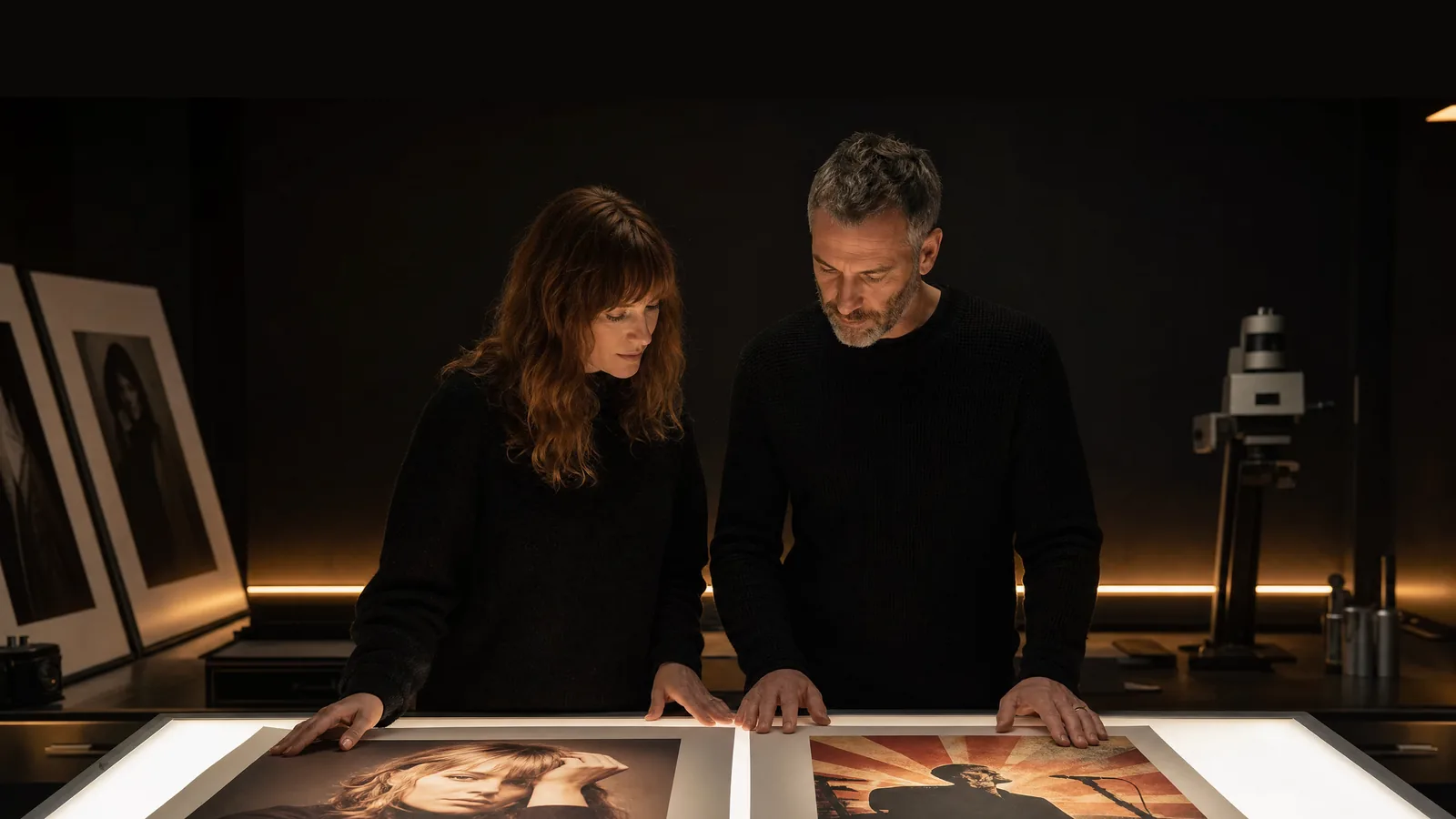
Both models come from Alibaba and both have open weights under Apache-2.0, so the choice usually comes down to one practical question: which one gives you a usable picture for the job you actually have, at what cost per image? Community comparisons disagree. Most were run on a single local setup with two to five prompts, and Lumenfall's blind community vote across 13 shared prompts went 77.8% to 22.2% for Z-Image Turbo while its own AI-judge notes mostly favoured Qwen.
We ran the same six prompts, with two fixed seeds each, through both models on the SpicyAPI endpoints on 17 October 2026: a studio portrait, a poster with three lines of text, a product label, a crowded street, a hands close-up and a three-person table layout. That is 24 images, $0.48 in total.
Short answer: use Z-Image Turbo for textured photoreal portraits, simple product shots and anything you generate in volume (it is a third of the price, at $0.01 an image). Use Qwen Image 2512 at $0.03 when the image is a designed piece (styled lettering, a dense scene, a specific mood), when you need larger output or wide formats such as 21:9 on our endpoints, or when you want to load Qwen-format LoRAs. For unfiltered work without a LoRA, Z-Image Turbo is the more direct choice; Qwen Image 2512 toned down the Very strong level in our test history.
The quick decision
| If you need… | Start with | Why |
|---|---|---|
| Many drafts or a large batch | Z-Image Turbo | $0.01 per image, a third of Qwen Image 2512 |
| A close portrait with visible skin texture | Z-Image Turbo | Stronger freckles, pores and knit texture in our one portrait prompt (two seeds) |
| Posters, menus, covers with styled lettering | Qwen Image 2512 | Both spelled every word right; Qwen also followed the "art deco" and "weathered paper" cues |
| A dense crowd or a scene with a stated mood | Qwen Image 2512 | More people and closer to "candlelit" or "after rain" lighting |
| Output larger than about one megapixel on SpicyAPI | Qwen Image 2512 | 1328×1328 at 1:1 versus 1024×1024 on our endpoints |
| 21:9, 9:21, 3:2 or 2:3 framing on SpicyAPI | Qwen Image 2512 | Z-Image Turbo on SpicyAPI offers five ratios (1:1, 4:3, 3:4, 16:9, 9:16) |
| Prompts longer than 1,000 characters on SpicyAPI | Qwen Image 2512 | Our Qwen endpoint accepts up to 5,000 characters; the Z-Image Turbo endpoint caps at 1,000 |
| Community LoRAs | Z-Image Turbo LoRA | About four times as many published LoRAs on Hugging Face; Qwen LoRAs are heavier to train |
| Unfiltered images without a LoRA | Z-Image Turbo | Rendered every content level in our test history; Qwen toned down the Very strong level |
How we tested
Both models received identical prompt text, aspect ratio and seed (42 and 7). We kept every output; nothing was rerun or picked. The figures below show the seed 42 pair for each prompt; the seed 7 pair told the same story in every case.
- Qwen Image 2512 ran on the Qwen Image 2512 LoRA text-to-image endpoint with no LoRA attached, which runs the plain base model. PNG output.
- Z-Image Turbo ran on the Z-Image text-to-image endpoint (the Turbo weights) with prompt expansion off. It returns PNG only.
Native sizes differ at the same ratio: Qwen returned 1104×1472 at 3:4, 1328×1328 at 1:1 and 1536×864 at 16:9; Z-Image Turbo returned 864×1152, 1024×1024 and 1280×720. In each comparison figure both images are scaled to the same height, so you are comparing content, not resolution.
Twelve images per model is a small sample. Treat the results as a clear pattern on these six subjects, not a benchmark.
Portraits: Z-Image Turbo shows more skin texture
Prompt: Studio portrait of a woman in her early thirties with freckles and shoulder-length auburn hair, wearing a charcoal wool turtleneck. Soft key light from the left, gentle fill, seamless warm grey backdrop. 85mm lens, shallow depth of field, natural skin texture, calm direct gaze into the camera.
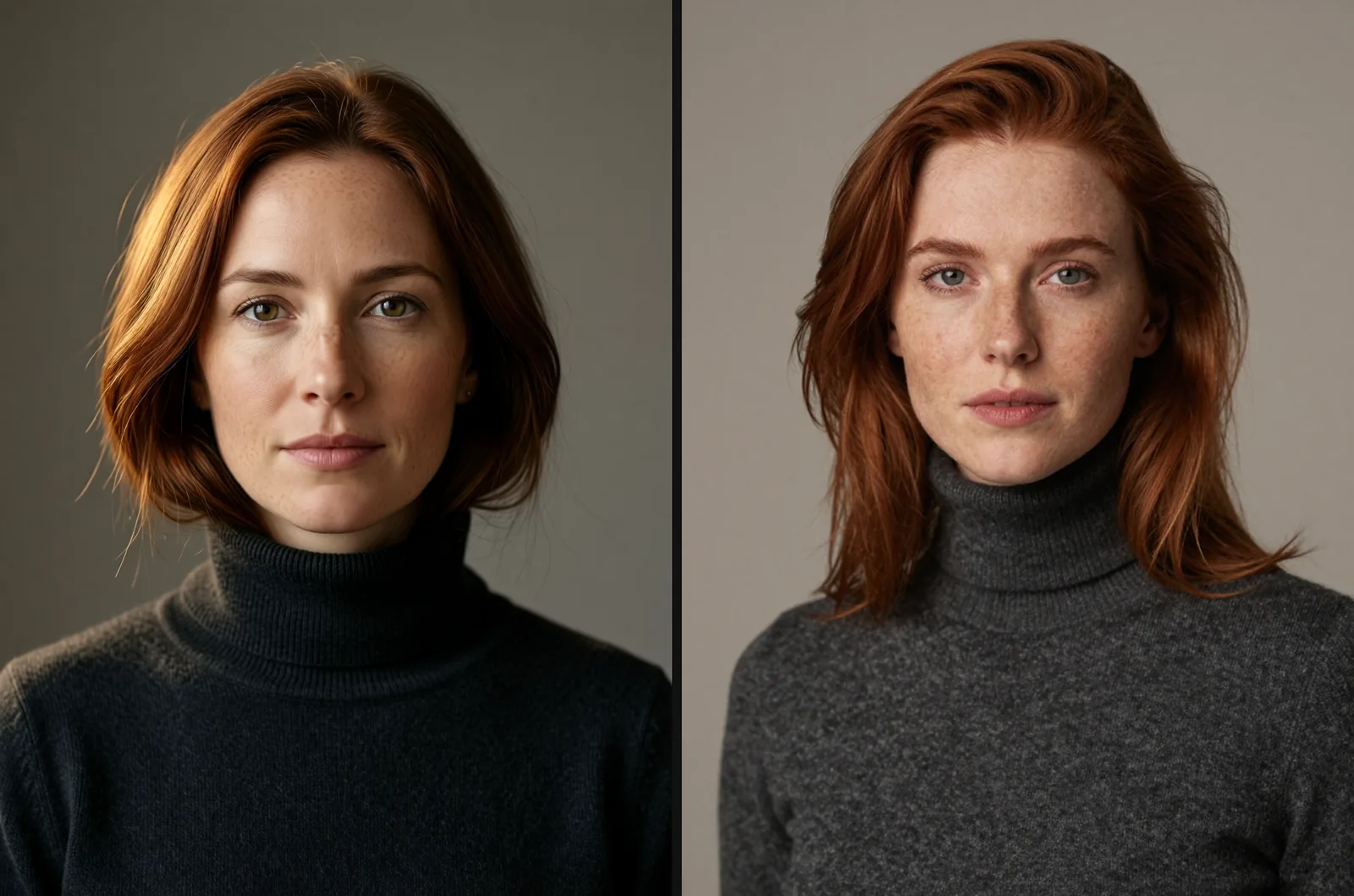
Left: Qwen Image 2512. Right: Z-Image Turbo. Same prompt, 3:4, seed 42.
Both portraits are usable. Z-Image Turbo (right) gives the freckles, pores and wool fibres more definition and puts the grey backdrop closer to "warm grey". Qwen Image 2512 (left) is smoother and warmer, closer to a retouched editorial headshot, and its hair is nearer the "shoulder-length" we asked for; Z-Image Turbo made it longer in both seeds.
This matches the community split. Some local testers prefer Qwen's softer light for "less AI-looking" faces; others find Z-Image Turbo's skin detail hard to beat. If your viewers zoom in on faces, start with Z-Image Turbo; if you want a polished look without retouching, try Qwen.
Notice also that each model produced almost the same woman with seed 42 and seed 7. Changing the seed alone gives little variety on either model; change the description (age, hair, lighting) when you need different people.
Text and labels: both spell correctly, Qwen follows the design brief
Prompt (poster): A vintage jazz concert poster pasted on a brick wall. Large art deco headline at the top reads "MIDNIGHT ECHOES". Below a saxophone illustration, smaller text reads "Live at The Blue Room" and on the last line "Friday 9 PM". Cream, navy and gold palette, slightly weathered paper.
Prompt (product): Commercial product photo of a matte black ceramic coffee mug with the word "NORTHWIND" printed in white capital letters on its side. The mug stands on a light oak table next to a small pile of roasted coffee beans and a folded linen napkin. Soft morning window light from the right, clean background, sharp focus.
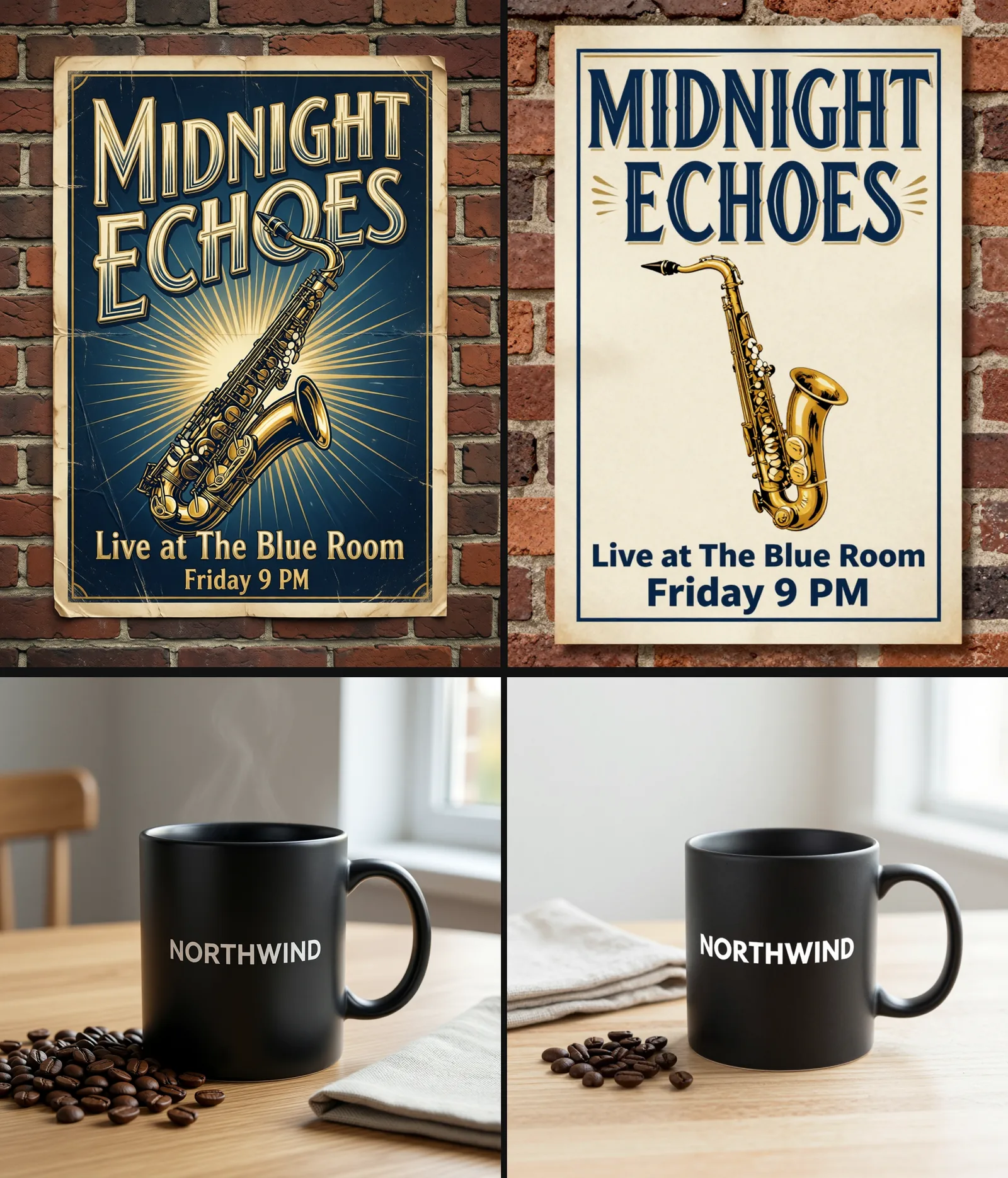
Left column: Qwen Image 2512. Right column: Z-Image Turbo. Seed 42; top 3:4, bottom 1:1.
Across four text strings and two seeds, neither model misspelled a single word. That is the main finding for anyone choosing on text alone: for short headlines and labels, both are reliable.
The difference is design. Qwen Image 2512 drew art deco lettering with a sunburst behind the saxophone and aged, creased paper, though its saxophone runs over the headline, which a designer may not want. Z-Image Turbo kept the cream, navy and gold palette more literally and left clear space around the text, but its poster is plainer and less weathered; the words are right, the "vintage" look is mostly missing. On the mug, the result flips slightly: Z-Image Turbo printed a crisper, brighter white label, while Qwen's lettering came out greyer and smaller. Both kept the beans, napkin and window light.
Choose Qwen Image 2512 when the typography is the design. For a product shot where the label just needs to be legible, both work; Z-Image Turbo's edge there is mainly that it costs a third as much.
Crowds and layout: both place people correctly, Qwen sets the mood
Prompt (street): Wide shot of a crowded street festival in a European old town at dusk after rain. Dozens of people walk between food stalls, some holding umbrellas, string lights overhead, steam rising from a grill, reflections on wet cobblestones, a cyclist in a yellow raincoat in the foreground. Cinematic, natural colours.
Prompt (layout): Three friends at a candlelit dinner table, photographed from the front. On the left, a woman in a red dress raises a glass of white wine. In the middle, a bald man with a grey beard in a blue shirt is laughing. On the right, a woman with short silver hair and round glasses is looking at her phone. A single blue vase with yellow tulips stands in the centre of the table.
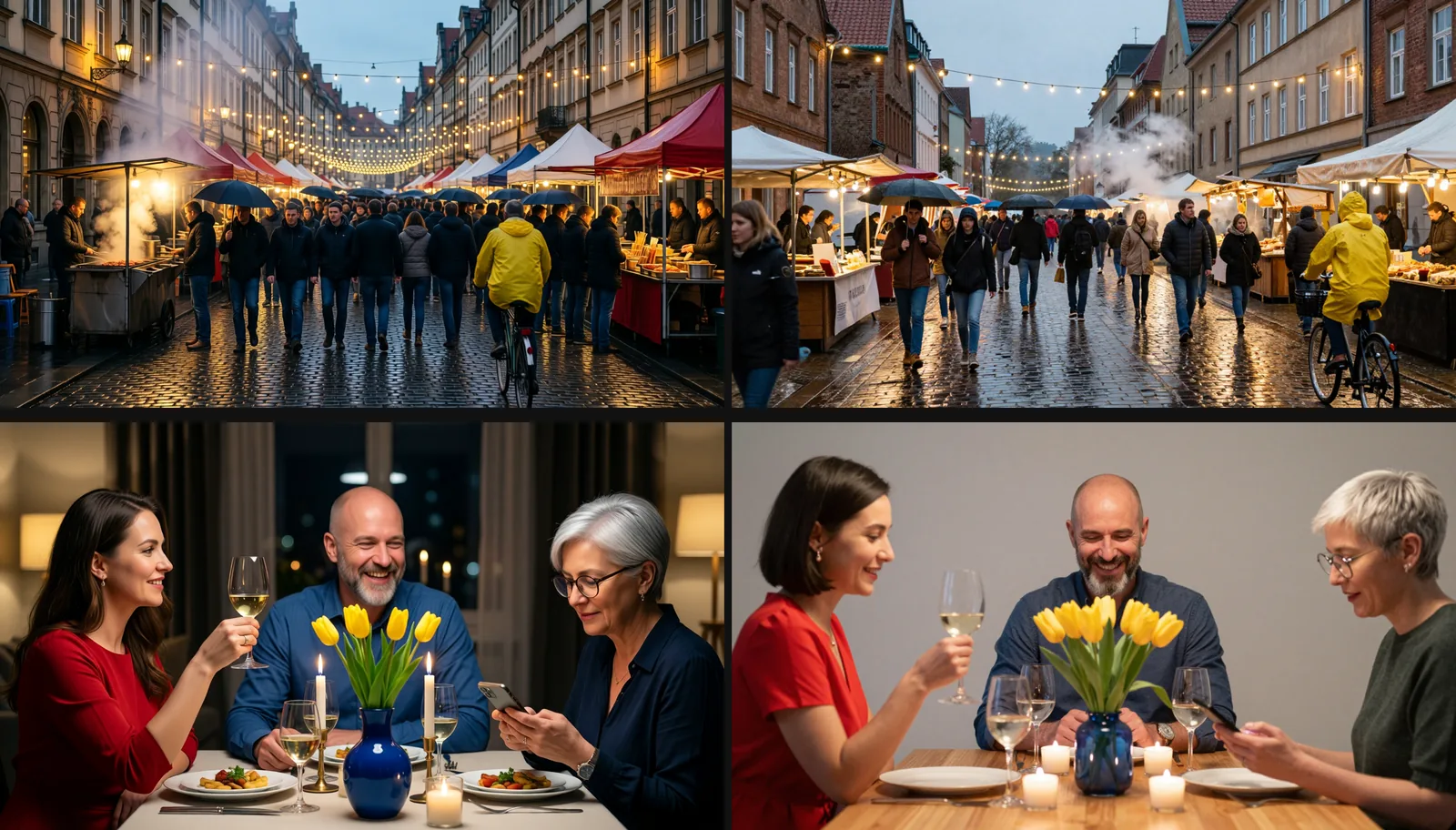
Left column: Qwen Image 2512. Right column: Z-Image Turbo. 16:9, seed 42.
The three-person layout is the cleanest prompt-adherence test in the set, and both models passed it in both seeds: red dress on the left raising a glass, bald bearded man laughing in the middle, silver-haired woman with round glasses on her phone on the right, one blue vase of yellow tulips in the centre. Some community posts say Z-Image Turbo ignores parts of prompts; on this explicit positional prompt it did not.
The gap is atmosphere. Qwen Image 2512 made a real candlelit evening with a dark window and warm lamps. Z-Image Turbo placed candles on the table but lit the room like a grey afternoon. On the street, Qwen packed in a genuinely crowded festival with the rainy dusk light, though the middle distance repeats similar faces in dark jackets. Z-Image Turbo's street is more spacious than "crowded", with the cyclist pushed to the right edge of the frame in both seeds.
Hands: both clean, both missed the ring detail
Prompt: Close-up photo of a man's hands tying the laces of a worn brown leather boot on a wooden workshop bench. Both hands fully visible, five fingers on each hand, a silver ring on the left ring finger, visible knuckles and veins. Warm side light, shallow depth of field.
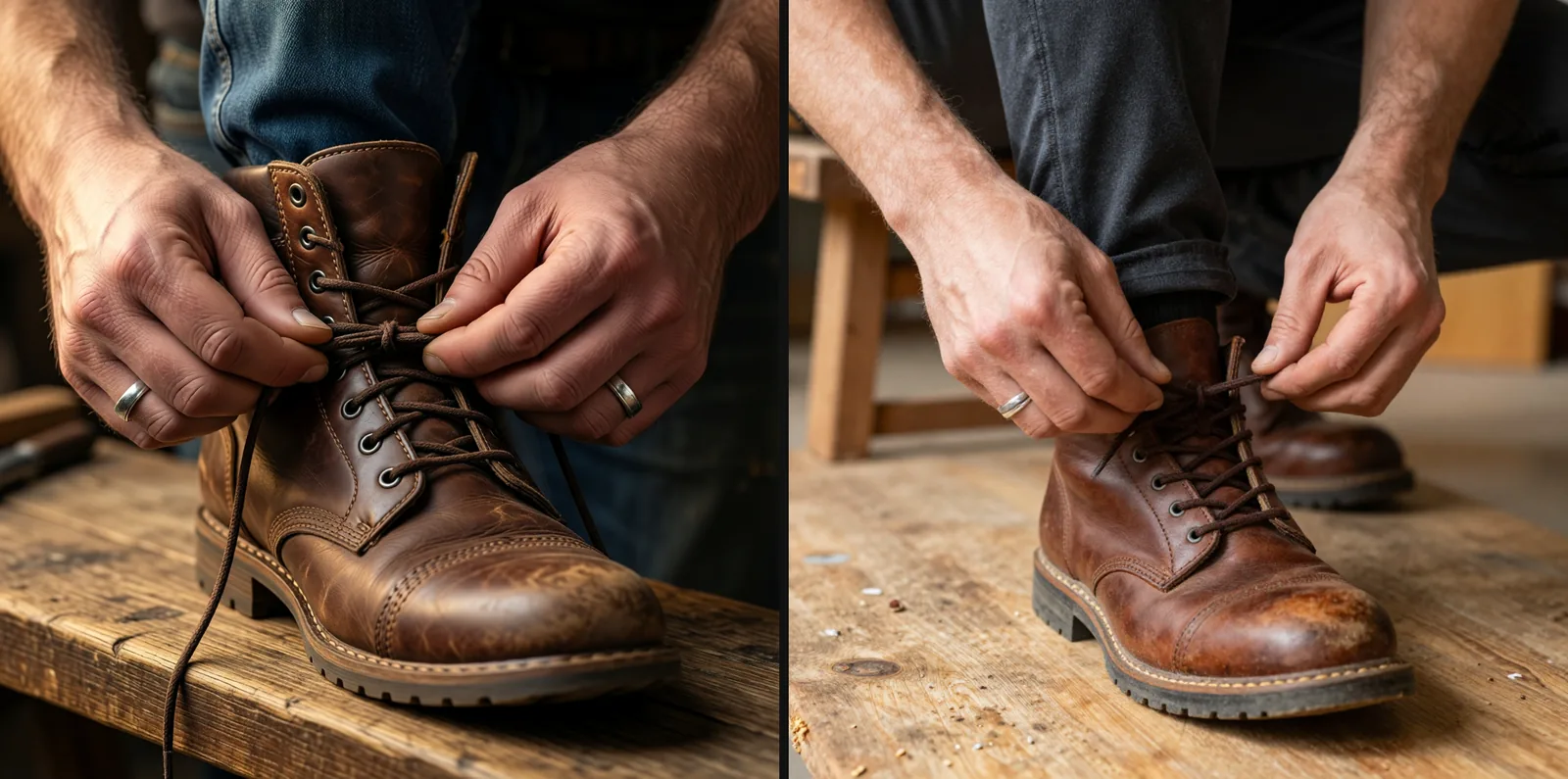
Left: Qwen Image 2512. Right: Z-Image Turbo. 1:1, seed 42.
All four hand images had five natural fingers per hand and believable lace handling; neither model produced the extra or fused fingers older models are known for. Both missed the small instruction, though. Qwen Image 2512 put a ring on both hands in both seeds. Z-Image Turbo drew one ring, but on the hand that reads as his right. Qwen framed a tighter close-up with more leather texture; Z-Image Turbo pulled back to show the bench and his knees.
If a small detail must be exact, such as which hand wears a ring, expect to check every output or fix it with an edit pass, whichever model you pick.
Speed and price per image
| Qwen Image 2512 | Z-Image Turbo | |
|---|---|---|
| Price per image | $0.03 | $0.01 ($0.016 with prompt expansion on) |
| Charged in our test | $0.03 × 12 | $0.01 × 12 |
| Median time, request to finished image | 8.5 s | 19 s |
| Range across 12 images | 7.8–32 s | 13–31 s |
| Native size at 1:1 / 16:9 | 1328×1328 / 1536×864 | 1024×1024 / 1280×720 |
| Output formats | JPEG, PNG, WebP | PNG |
Prices are the current SpicyAPI list prices, and both tasks charged exactly that. A batch of 1,000 images costs $10 on Z-Image Turbo and $30 on Qwen Image 2512.
The speed result surprised us. Z-Image Turbo is the faster model on paper: 6B parameters and eight sampling steps, against 20B parameters and a recommended 50 steps for Qwen Image 2512, and on a local GPU testers report it finishing in a fraction of Qwen's time. Through the hosted API on 17 October, however, Qwen Image 2512 came back sooner in eleven of twelve runs. Hosted time includes queueing and delivery, which depend on load and change over time, so read this as "both finish in seconds, neither is a bottleneck", not as a permanent ranking. If you run the weights yourself, Z-Image Turbo's speed and its ability to fit on a 16 GB card are real advantages.
LoRA support and open weights
Both models are released under Apache-2.0 with open weights: Qwen-Image-2512 on 31 December 2025, Z-Image-Turbo from Alibaba's Tongyi-MAI team in late November 2025. The licence allows commercial use of the outputs and the weights; check each model card for the attribution notice.
LoRAs do not transfer between them. They are different architectures, so a Z-Image Turbo LoRA will not load on Qwen Image 2512, and the reverse.
- Z-Image Turbo has the larger community library, because a 6B model is cheap to fine-tune. On 17 October 2026, Hugging Face listed 879 models tagged as LoRA adapters for Z-Image-Turbo against 200 for Qwen-Image-2512. Load up to three LoRAs on the Z-Image Turbo LoRA endpoint at $0.012 an image. Our same-seed LoRA test shows how to check that a LoRA actually changes the picture.
- Qwen Image 2512 takes up to three Qwen-format LoRAs on the same endpoint we tested, at no extra cost. Fewer exist, because training on a 20B model needs much more hardware. Editing in the same family runs on a different base (Qwen Image Edit 2511), so match the LoRA to the task; which Qwen LoRAs fit which base explains the split.
Unfiltered images: how the two differ
Neither endpoint adds a platform filter; differences come from the models themselves, and they show up only near the top of the content scale.
Our internal test history covers six categories across five content levels, from Mild to Maximum, three runs each, and every output is reviewed by eye (the test prompts are not published):
- Z-Image Turbo (September 2026) rendered all six categories in all three runs, with no refusals and no softening.
- Qwen Image 2512 without a LoRA (September 2026) rendered five categories in full, including the Strong level, but toned down the Very strong level in all three runs: the result stayed implied. In a single earlier run with a publicly available uncensored LoRA attached, the same level came back as asked.
So for unfiltered character work from a plain prompt, Z-Image Turbo gets you there more directly and at a third of the price. If you need exact pixel sizes up to 1,536 or prompts beyond 1,000 characters, the same family's Z-Image Spicy endpoint costs $0.01235 an image. Qwen Image 2512 is still a fine choice for anything below the Very strong level, or when you bring a LoRA built for it. For wording that works on Z-Image Turbo, see our Z-Image Turbo NSFW prompt guide; for its sibling models, Is Z-Image uncensored?. Use adult subjects only and never real people without consent.
Which one should you use?
- Character, portrait and unfiltered photography in volume: Z-Image Turbo. More skin texture in our portrait test (Qwen's dinner-scene people were realistic too), the more complete content-test record of the two, $0.01 an image. Add the Turbo LoRA endpoint when you need a specific look.
- Posters, covers, social graphics with lettering: Qwen Image 2512. Both spell correctly, but Qwen follows typographic and paper-texture cues.
- Busy scenes, lighting moods, cinematic frames, 21:9 banners: Qwen Image 2512, for the mood, the density and the wider ratios.
- Product shots with a short label: either; Z-Image Turbo if cost matters, since both printed the label correctly.
- Long, detailed prompts over 1,000 characters: Qwen Image 2512.
A practical pattern is to draft with Z-Image Turbo, keep the prompts that work, and rerun the few that need designed text or a stronger atmosphere on Qwen Image 2512. Both use the same request shape on SpicyAPI, so switching is a change of model name. Open Z-Image Turbo or Qwen Image 2512 to try your own prompt.
FAQ
Is Z-Image Turbo a Qwen model?
No. Both come from Alibaba, but Qwen-Image is built by the Qwen team and Z-Image by the Tongyi-MAI team. They use different architectures and different LoRAs.
Which is better at text in images?
For short headlines and labels, both spelled every word correctly in our test. Qwen Image 2512 is the better pick when the lettering itself needs a style, and its publisher lists text layout and text-plus-image composition among the 2512 improvements.
Can I use a Qwen Image 2512 LoRA on Z-Image Turbo?
No. A LoRA only works on the model family it was trained for.
Why does changing the seed give me nearly the same image?
Both models produced almost the same person and composition with seeds 42 and 7 for every prompt. To get variety, change the description itself (age, hair, setting, light) rather than the seed.